


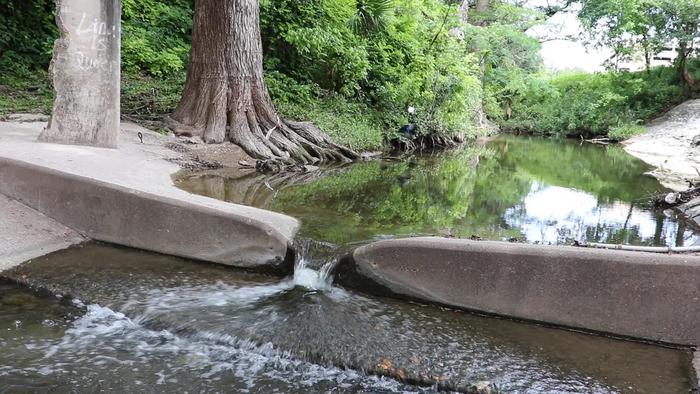
Even in dry times, Waller Creek on The University of Texas at Austin campus is never without water. That’s because a significant portion of the water that flows through it — anywhere from 25% to 50% — can be traced to wastewater from leaky city pipes.

Credit: The University of Texas at Austin Jackson School of Geosciences
Even in dry times, Waller Creek on The University of Texas at Austin campus is never without water. That’s because a significant portion of the water that flows through it — anywhere from 25% to 50% — can be traced to wastewater from leaky city pipes.
But there’s a silver lining to the less-than-perfect plumbing, according to new research. The water flowing through the creek sustains trees growing along it, allowing them to thrive during drought conditions that take a toll on trees growing along streams in more rural areas.
The research highlights how urbanization can have unintended positive effects among more well-known negative effects, such as pollution and higher levels of illness-causing bacteria.
“Those negative effects are not canceled out,” said Jay Banner, a professor in the Jackson School of Geosciences and the director of the Environmental Science Institute. “One has to weigh the unintended positive consequences with the expected and long-shown negative consequences.”
The findings were published in the Nature Partner Journal Urban Sustainability.
Researchers compared the growth record of bald cypress trees along Waller Creek and Onion Creek, a rural stream about 12 miles from the UT campus, to the drought record of the region.
A tree’s growth is recorded in tree rings in its wood, with thicker rings reflecting wetter times and strong growth and thinner rings reflecting dryer times and little growth. Banner and his students extracted this record from living trees by taking cores — narrow rods of wood pulled from tree trunks — and sending them to the Laboratory of Tree-Ring Research at the University of Arizona for analysis.
The oldest trees from Waller Creek date to 1933 and the oldest trees from Onion Creek date to 1844. The cores revealed that from the beginning, the trees along Waller Creek were sheltered from drought, with tree growth showing only a weak connection to drought severity.
“[The trees’] needs are being met. They’re not being stressed by the climate,” said co-author Bryan Black, an associate professor at The University of Arizona who led the core analysis. “It fits right in line with the hypothesis that they’re receiving supplemental water though this urban infrastructure leakage.”
Even during the state’s most severe drought on record, which spanned 1950-1957, the Waller Creek trees showed only a small decline in growth. In contrast, the trees of Onion Creek faced a steep decline.
In addition to sustaining the trees through drought, the constant flow of wastewater also appeared to make the Waller Creek trees take on an individualized growth pattern, with different trees having different growth rates throughout the year. The researchers think that with their water needs met, other factors that affect tree growth — such as genetics, competition from other trees, nutrients, or the presence of pests — took on a bigger influence. Although this would be an unusual result in a rural setting, researchers said they were not surprised to see the Waller Creek trees doing their own thing.
“That’s kind of what we expect in an urban environment,” Banner said. “We would expect the natural system to be, well, for lack of a better term, messed up.”
Ongoing research is investigating how the chemistry of the tree rings may reflect the timing and amount of this municipal water input, as well as distinguishing between the municipal water sources of wastewater, tap water, and irrigation.
Leaky infrastructure is commonplace across cities worldwide. That means that across the world, there are probably pockets of trees being sustained by wastewater like those along Waller Creek, the researchers said. Understanding the extent of infrastructure leakage and its ecological influence can help policymakers understand the broader effects of urbanization — the good and the bad — and plan accordingly.
“In my mind, this can help inform city development and city planners,” Banner said. “We can take into account and calculate costs and invest in a better municipal water network — but maybe one where we could still have positive consequences.”
As climate extremes become more frequent, the leaky pipes feeding Waller Creek could also prove to be an important lifeline, Banner said, sustaining not only the trees but the array of streamside plants and animals that also call the creek home.
The research was funded by the National Science Foundation, the Cynthia and George Mitchell Foundation, the Jackson School of Geosciences and the UT Planet Texas 2050 initiative.
Journal
npj Urban Sustainability
Method of Research
Observational study
Subject of Research
Not applicable
Article Title
Positive unintended consequences of urbanization for climate-resilience of stream ecosystems
Article Publication Date
20-Mar-2024
Cite Scienmag News
Courtney Benton. (May 15, 2024). Trees on UT’s campus endure droughts with help from leaky pipes. Scienmag. https://scienmag.com/trees-on-uts-campus-endure-droughts-with-help-from-leaky-pipes/
Courtney Benton. "Trees on UT’s campus endure droughts with help from leaky pipes." Scienmag, 15 May 2024, https://scienmag.com/trees-on-uts-campus-endure-droughts-with-help-from-leaky-pipes/. Accessed 3 September 2026.
Courtney Benton. "Trees on UT’s campus endure droughts with help from leaky pipes." Scienmag. May 15, 2024. https://scienmag.com/trees-on-uts-campus-endure-droughts-with-help-from-leaky-pipes/

