


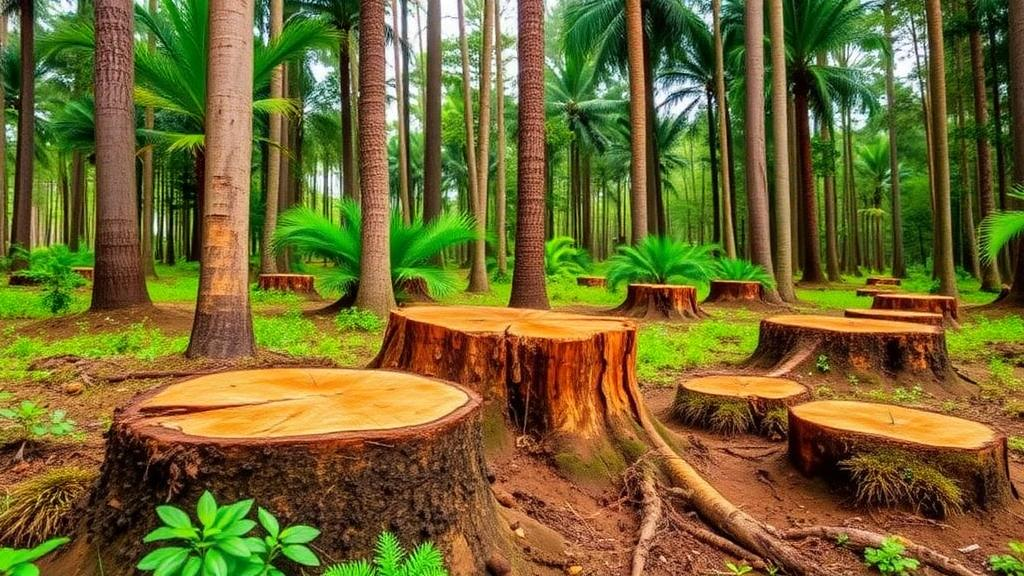
Every year, millions of hectares of tropical plantations are harvested, replanted, and harvested again, and every one of those cycles raises the same deceptively simple question: how much carbon did the forest actually store? The standard answer in forestry has long depended on a single measurement, diameter at breast height, taken with a tape at 1.3 meters above the ground. But in dense Acacia stands where thorny branches block access, on buttressed stems where a tape cannot sit flat, and above all in harvested compartments where the trees no longer exist to be measured, that trusted number is simply unavailable. A new study from Bangladesh now offers a strikingly practical alternative, showing that the humble stump left behind after felling can reconstruct both tree size and carbon storage with remarkable precision.
The research, published in Discover Forests by Niamjit Das of Shahjalal University of Science and Technology and Md. Qumruzzaman Chowdhury, examined three of the most widely planted timber taxa in South and Southeast Asia: Acacia auriculiformis, Acacia mangium, and the interspecific hybrid between them. Working across ten plantation sites in Sylhet Division, a humid monsoon landscape receiving roughly 5,000 millimeters of rain each year, the team measured 1,050 trees spanning ages of 8 to 15 years and stand densities of 1,100 to 1,400 trees per hectare. Crucially, they did not stop at tape measurements. They felled 75 trees, 25 of each taxon, cut the stems into sections, and dried them in ovens at 105 degrees Celsius until their weight stopped changing, producing the kind of ground-truth biomass data that allometric modeling depends on.
The central finding is that stump diameter, measured just 30 centimeters above the ground, predicts breast-height diameter almost perfectly. A simple log-log regression achieved adjusted R-squared values exceeding 0.98 across all three taxa, with root mean square errors as low as 0.048. In practical terms, this means a forester walking through a recently harvested compartment can measure the remaining stumps and reconstruct the diameter distribution of the trees that once stood there with negligible error. The relationship makes intuitive biological sense: the base of the stem and the breast-height section are connected by the tree’s taper, and within a given species and growth environment that taper follows a consistent geometric pattern.
Biomass prediction proved nearly as strong. Stump-based models performed comparably to the conventional DBH-based equations, with the parsimonious log-log stump model reaching adjusted R-squared values between 0.945 and 0.968 for stem biomass. The authors were careful to emphasize validation statistics rather than goodness-of-fit alone, a discipline that forest scientists have repeatedly called for after decades of unreliable generic equations being applied across unrelated ecosystems. Observed and predicted values clustered tightly around the one-to-one line, paired t-tests found no significant bias, and residuals were balanced across the size spectrum. For the hybrid Acacia, mixed-effects models that accounted for random variation among species and sites reduced prediction bias even further.
The study also put machine learning to the test, and the results offer a cautionary tale for the current enthusiasm surrounding artificial intelligence in environmental science. Random Forest, an ensemble method that averages hundreds of decision trees, consistently identified stump diameter as the strongest predictor of stem biomass and produced stable, generalizable predictions under five-fold cross-validation. Gradient Boosting, by contrast, assigned the highest relative importance to DBH and showed a telltale 12 percent gap between training and validation accuracy, the classic signature of overfitting. The authors are refreshingly candid about what this means: stump diameter’s dominance in the Random Forest reflects its strong correlation with overall tree size, not some newly discovered biological law, and variable importance rankings can shift with model settings and data structure.
Converting biomass into carbon introduced a species-specific dimension that generic accounting often misses. Rather than applying the default IPCC carbon fraction, the researchers used conversion factors drawn from published Acacia studies: 0.475 for A. auriculiformis, 0.480 for A. mangium, and 0.485 for the hybrid, reflecting real differences in wood chemistry among the taxa. The resulting carbon stock estimates ranked the hybrid Acacia highest, followed by A. mangium and then A. auriculiformis, a pattern consistent with the hybrid’s reputation for superior growth and wood quality. The authors stress that these figures cover stem carbon only, excluding branches, foliage, and roots, and therefore should not be read as total ecosystem carbon stocks.
The methodological rigor underlying these numbers deserves attention. Measurements were restricted to the dry season to minimize moisture-related variability, instruments were calibrated daily, and any readings differing by more than 0.5 centimeters in diameter or 0.2 meters in height triggered re-measurement. Oven-drying continued for 48 to 72 hours with weights checked at 12-hour intervals, and data entry was cross-checked by two independent researchers. The validation design was two-tiered: 975 trees held back from model development served as an independent test set, and five-fold cross-validation stratified by species and site confirmed that the models were not merely memorizing the quirks of particular plantations. This is precisely the kind of quality assurance that earlier reviews of forest biomass estimation have found lacking in much of the published literature.
Why does this matter beyond Bangladesh? Tropical forests hold nearly a third of terrestrial carbon, and programs such as REDD+ depend on credible, verifiable measurements of how much carbon is stored and, crucially, how much is removed when trees are harvested. Under current practice, post-harvest carbon accounting is notoriously difficult because the trees that would provide the measurements are gone. Stump-based equations change that calculus entirely: the stumps remain in the ground, they are easy to locate and measure, and they now carry enough information to reconstruct the stand’s biomass and carbon content. The authors note that this capability could inform measurement, reporting, and verification frameworks under REDD+ and support IPCC Tier 2 and Tier 3 approaches, though they are careful to say that broader policy applications require independent validation.
The limitations are stated with unusual honesty. The study covered healthy trees in even-aged Acacia plantations on fertile alluvial loams in a single region; damaged or suppressed trees were excluded, which may limit applicability in operational forestry where such trees are common. Buttressed stems and mixed-species stands remain challenging, and the models were calibrated on trees aged 8 to 15 years, so extrapolation to older rotations or different environments is untested. The improvements offered by mixed-effects and machine learning approaches, while statistically significant, were described as modest in operational terms, and the authors insist that DBH remains the conventional standard with stump diameter serving as a complementary surrogate rather than a replacement.
Even with those caveats, the study delivers something tropical forestry has needed for a long time: a cheap, fast, and demonstrably accurate way to audit carbon in the places where conventional measurement fails. As plantation forestry expands across the tropics to meet timber demand and climate goals under SDG 13 and SDG 15, the ability to turn a field of cut stumps into a credible carbon ledger could reshape how harvest impacts are monitored and reported. The next step, the authors argue, is testing these equations across wider environmental gradients, diverse plantation ages, and mixed-species stands, and incorporating belowground biomass into the accounting. Until then, the message to foresters and carbon accountants is clear: do not overlook the stump, because it remembers everything the tree knew.
Subject of Research: Stump diameter as a predictor of biomass and carbon stocks in tropical Acacia plantations in Bangladesh
Article Title: Stump diameter is a robust predictor of biomass and carbon stocks in tropical Acacia plantations
Article References: Das, N., & Chowdhury, M. Q. (2026). Stump diameter is a robust predictor of biomass and carbon stocks in tropical Acacia plantations. Discover Forests, 2(1), Article 73. https://doi.org/10.1007/s44415-026-00137-1
Image Credits: AI Generated
DOI: 10.1007/s44415-026-00137-1
Keywords: stump diameter, biomass estimation, carbon stocks, Acacia plantations, allometric models, REDD+, Bangladesh, machine learning, mixed-effects models, forest mensuration, destructive sampling, carbon accounting
Cite Scienmag News
Violet Maxwell. (October 1, 2026). Tree Stumps Hold the Key to Counting Carbon in Tropical Plantations. Scienmag. https://scienmag.com/tree-stumps-hold-the-key-to-counting-carbon-in-tropical-plantations/
Violet Maxwell. "Tree Stumps Hold the Key to Counting Carbon in Tropical Plantations." Scienmag, 1 October 2026, https://scienmag.com/tree-stumps-hold-the-key-to-counting-carbon-in-tropical-plantations/. Accessed 4 October 2026.
Violet Maxwell. "Tree Stumps Hold the Key to Counting Carbon in Tropical Plantations." Scienmag. October 1, 2026. https://scienmag.com/tree-stumps-hold-the-key-to-counting-carbon-in-tropical-plantations/


