


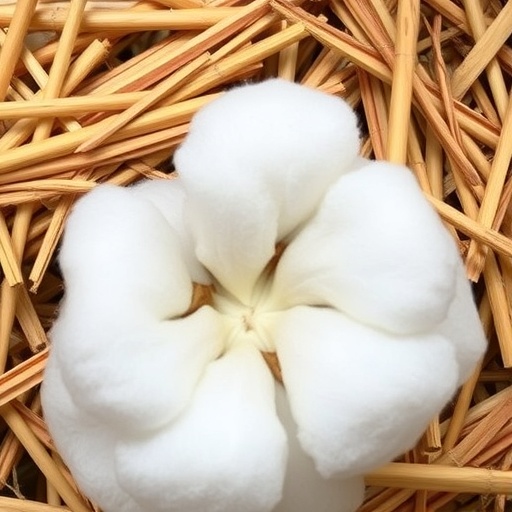
In the arid expanses of Xinjiang, China’s premier cotton-producing region, millions of tons of agricultural residues accumulate annually, presenting a persistent environmental challenge. Recent scientific advancements, however, reveal a transformative approach that could convert this agricultural waste into a climate-ameliorating resource. A groundbreaking study published in Agricultural Ecology and Environment unveils the potential of co-pyrolyzing cotton straw alongside discarded plastic mulch film to generate biochar, a carbon-rich material capable of dramatically reducing greenhouse gas emissions while fostering sustainable agricultural practices.
Xinjiang’s agricultural economy is heavily reliant on the cultivation of cotton, generating vast quantities of post-harvest waste, primarily in the form of cotton straw and plastic mulch film remnants. Traditionally, these residues have been poorly managed, often incinerated or discarded haphazardly, leading to significant air pollution and “white pollution”—the pervasive soil contamination caused by residual plastic films. The ecological and health implications of such practices are severe, contributing not only to atmospheric pollutant loads but also to soil degradation and diminished agricultural productivity.
Central to the study’s innovation is the process of co-pyrolysis, wherein organic and plastic wastes are thermochemically decomposed in an oxygen-deprived environment to produce biochar. Unlike conventional pyrolysis of a single substrate, co-pyrolysis synergistically enhances biochar yield and quality by optimizing the thermal degradation pathways of both biomass and plastics. This method not only maximizes carbon retention within the char matrix but also unlocks latent energy potential, thereby generating renewable energy streams during the conversion process.
Quantitatively, the researchers estimate that Xinjiang generates approximately 26 million tons of collectible crop straw annually, with cotton straw comprising a substantial fraction. The biochar production potential from cotton straw conversion alone reaches an impressive 3.5 million tons per year, representing a significant sequester of carbon in solid form. This biochar can potentially offset roughly 10 million tons of carbon dioxide equivalent emissions annually. Such carbon capture capabilities position biochar as a vital ally in regional and national climate mitigation strategies.
However, the isolated pyrolysis of plastic mulch film is less efficacious, yielding minimal biochar and restricted climate benefits due to the complex polymeric structures and lower carbon content of plastic wastes. The researchers discovered that co-pyrolyzing plastic film with cotton straw at a mass ratio of 1:4 markedly improves biochar yield by over 200,000 tons and slashes net greenhouse gas emissions by approximately 3.4 million tons of carbon dioxide equivalent. This synergy fundamentally alters the environmental calculus, enhancing both carbon sequestration and energy recovery.
Moreover, the study highlights ancillary environmental advantages intrinsic to this co-pyrolysis approach. The biochar produced enriches soil quality by improving nutrient retention, augmenting soil porosity, and fostering microbial activity. These enhancements translate into improved crop yields and reduced fertilizer dependency, further curbing indirect nitrous oxide emissions—a potent greenhouse gas—from agricultural soils. The system thus creates a virtuous cycle of emission reductions extending beyond direct carbon capture.
From a process engineering perspective, the integration of cotton straw and plastic film waste in co-pyrolysis capitalizes on the complementary degradation kinetics of biomass and polymers. The thermal decomposition of plastics releases volatile organic compounds and oils, which, in the presence of biomass pyrolytic intermediates, contribute to secondary char formation and augmented biochar stability. Additionally, the heat liberated during these reactions can be harnessed to power pyrolysis reactors, enhancing overall system efficiency and sustainability.
Policy implications of this research are profound. The demonstrated efficacy of co-pyrolysis underscores the necessity for supportive regulatory frameworks and financial incentives to scale these technologies in cotton-dominant agroecosystems. Such measures would facilitate the transition of agricultural waste from environmental liabilities into valuable carbon sinks and renewable energy sources, aligning agricultural practices with China’s ambitious carbon neutrality commitments.
Beyond its regional applicability, this study furnishes a scalable model for semi-arid agricultural landscapes globally, where plastic mulch application is prevalent, and crop residue management remains a challenge. The replication of co-pyrolysis technology could revolutionize waste management paradigms, mitigate air and soil pollution, and contribute meaningfully to global greenhouse gas reduction targets.
In conclusion, the integration of cotton straw and agricultural plastic waste through co-pyrolysis exemplifies a compelling nexus of environmental science, agricultural engineering, and climate policy. It emanates a beacon of hope where waste management confluences with climate action, inaugurating a sustainable future where farming and emission reductions coalesce synergistically. The adoption of such innovative solutions marks a pivotal step toward reconciling agricultural productivity with ecological stewardship.
News Publication Date: 28-Jan-2026
Web References: https://doi.org/10.48130/aee-0025-0016
References: Zhao X, Ji M, Bai H, Zeng L, Tang KHD, et al. 2026. Potential of biochar production and carbon emission mitigation through co-pyrolysis of cotton straw and mulch film waste in Xinjiang, China. Agricultural Ecology and Environment 2: e003.
Cite Scienmag News
Alan Morgan. (February 3, 2026). Transforming Farm Waste into Climate Solutions: Co-Pyrolysis of Cotton Straw and Plastic Film Promises to Slash Millions of Tons of Emissions. Scienmag. https://scienmag.com/transforming-farm-waste-into-climate-solutions-co-pyrolysis-of-cotton-straw-and-plastic-film-promises-to-slash-millions-of-tons-of-emissions/
Alan Morgan. "Transforming Farm Waste into Climate Solutions: Co-Pyrolysis of Cotton Straw and Plastic Film Promises to Slash Millions of Tons of Emissions." Scienmag, 3 February 2026, https://scienmag.com/transforming-farm-waste-into-climate-solutions-co-pyrolysis-of-cotton-straw-and-plastic-film-promises-to-slash-millions-of-tons-of-emissions/. Accessed 3 September 2026.
Alan Morgan. "Transforming Farm Waste into Climate Solutions: Co-Pyrolysis of Cotton Straw and Plastic Film Promises to Slash Millions of Tons of Emissions." Scienmag. February 3, 2026. https://scienmag.com/transforming-farm-waste-into-climate-solutions-co-pyrolysis-of-cotton-straw-and-plastic-film-promises-to-slash-millions-of-tons-of-emissions/


