


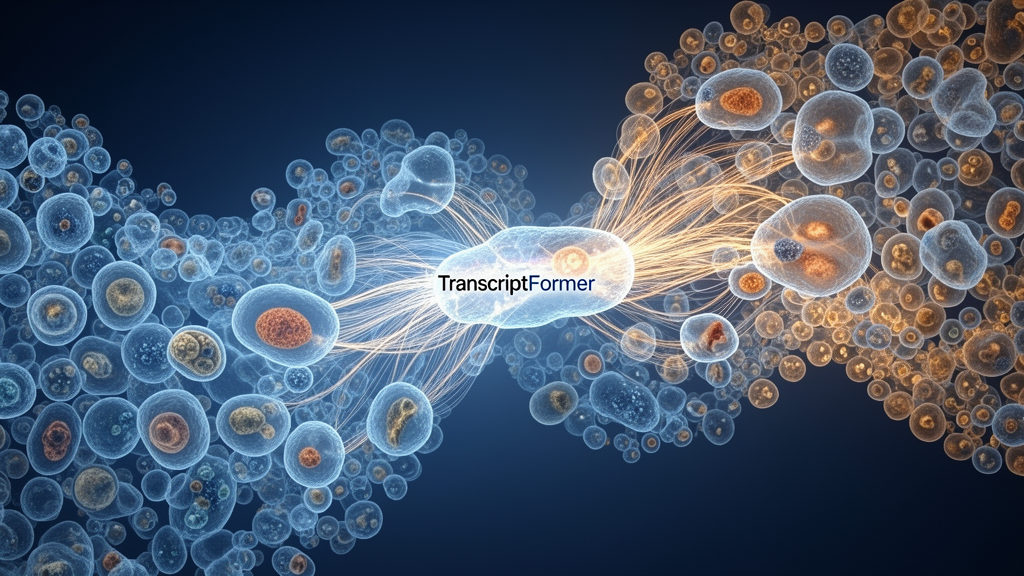
A second-generation artificial intelligence model developed by Stanford Medicine researchers can place cells from 12 species into a shared mathematical space, enabling researchers to compare their gene-expression profiles, identify cell types in species not included in its training data, distinguish healthy from diseased cells and examine evolutionary relationships. The model, called TranscriptFormer, was trained on profiles from 112 million cells and builds on an earlier computational approach known as universal cell embedding. The peer-reviewed work was published in Nature and Science, with contributions from researchers at the Chan Zuckerberg Initiative and BioHub.
Rather than working with each cellular profile in isolation, the system represents cells in a form that makes similarities and differences across tissues, species and disease states measurable. Stephen Quake, a Stanford professor of bioengineering and co-lead author of the two articles, said the project aims to open a new way to think about cell biology. The central challenge is scale: modern cell atlases characterize cells and tissues using measurements across tens of thousands of genes, and some atlases contain profiles from hundreds of millions of cells.
Gene expression indicates which genes a cell is using, allowing researchers to distinguish cell types and identify differences among healthy cells, diseased cells and organisms from different species. Human analysts, however, cannot readily consider all of those variables at once. Quake said the models are algorithms for understanding data too complex to wrap around in the human mind, while describing their intended role as a tool for skilled biologists investigating difficult questions.
The first model, universal cell embedding, established a foundation for the second-generation TranscriptFormer by learning representations from large collections of gene-expression data. In the resulting framework, an embedding is a mathematical representation that captures a cell’s expression profile while allowing comparisons with other cells. Quake described the combined output as a “universal space,” emphasizing that it is not a physical location but a coordinate system in which cells can be positioned according to their relationships.
TranscriptFormer was trained on cell atlases covering humans, yeast, mice, rabbits, chickens, zebrafish, fruit flies, African clawed frogs, malaria-causing parasites, sea urchins, sponges and the roundworm Caenorhabditis elegans. The training strategy was analogous to the masked-word method used in large language models such as ChatGPT. In a language model, portions of text are withheld and the system adjusts its parameters to predict the missing words.
TranscriptFormer used an analogous reconstruction task, but its inputs and prediction targets were gene-expression values rather than words. The resulting model was therefore trained to learn structure in cellular expression data at a scale encompassing many cell types and 12 species. One application was evolutionary comparison across species.
Scientists studying sponges had long wondered which sponge cell type was most closely related to neurons in other animals, a question connected to the evolution of nervous systems. TranscriptFormer found that choanocytes, a type of sponge cell, had gene-expression profiles quite similar to neurons in roundworms and frogs. In the universal space, this similarity provides a way to connect cellular profiles from organisms with very different body plans.
The analysis also challenged the interpretation of a sponge cell called the neuroid cell. Although its name had been assigned because it possessed some neuron-like features, the model found that its expression profile more closely resembled a frog gland cell. The researchers said this result suggests that neuroid cells may be involved in digestion rather than serving as direct neuronal counterparts, while choanocytes may provide a more relevant comparison for studying the emergence of neurons.
The model was also tested on a species that was not among its 12 training organisms. Given gene-expression data from a species outside the training set, TranscriptFormer was able to identify its cell types. The team additionally demonstrated that TranscriptFormer could distinguish healthy cells from diseased cells.
Together, these experiments showed two distinct capabilities: transferring cell-type identification to a previously unseen species and separating cells according to disease state. The release does not provide performance values, name particular diseases or evaluate the system prospectively in patients, so these findings are computational demonstrations rather than evidence of diagnostic readiness or clinical benefit. The model’s broad training set also provides a means of asking whether cellular similarities extend beyond the species used to train it.
By learning from yeast, insects, vertebrates, parasites and simple multicellular organisms, TranscriptFormer can represent relationships that would be difficult to inspect directly in raw expression tables. Researchers can compare the position of a newly profiled cell with reference profiles, place a cell type in an evolutionary context or examine how disease-associated cells depart from a healthy pattern. Researchers are also exploring whether a model of this kind could help design functional cells that do not currently exist.
The release presents this as a future possibility rather than a tested treatment. Such a system might eventually support efforts to design cell-based treatments, but the current work did not generate a therapeutic cell, test a treatment in animals or humans, or demonstrate a clinical outcome. Its value lies in making relationships among large expression datasets more accessible and comparable.
The work is a computational modeling study grounded in a large, cross-species collection of cell-atlas data. Its technical contribution is the combination of a masked-expression training strategy with a shared embedding that can support comparisons across evolutionary distance, unfamiliar species and health states. The biological examples provide concrete tests: choanocytes were compared with roundworm and frog neurons, neuroid cells were compared with frog gland cells, cell types were identified in an unseen species, and healthy and diseased cells were distinguished.
These analyses produce model-based relationships from gene-expression profiles, while the interpretation of cell roles remains a biological inference that can guide further investigation. By placing diverse cells into one mathematical map, TranscriptFormer offers a scalable route for examining cell identity, evolutionary similarity and disease-associated differences across a collection of 112 million profiles.
Subject of Research: Cross-species AI modeling of cellular gene-expression profiles
Article Title: Stanford Medicine-developed AI model opens new horizons for cell biology
Article References: Stanford Medicine-developed AI model opens new horizons for cell biology. Original publication (Bibliographic details unavailable.)
Image Credits: AI Generated
DOI: Not provided
Keywords: TranscriptFormer, cell biology, artificial intelligence, gene expression, cell atlases, cross-species modeling, evolutionary biology, computational biology, disease-state classification, Stanford, Medicine-developed, model
Cite Scienmag News
Drew Townsend. (October 21, 2026). TranscriptFormer Maps 112 Million Cells Across 12 Species. Scienmag. https://scienmag.com/transcriptformer-maps-112-million-cells-across-12-species/
Drew Townsend. "TranscriptFormer Maps 112 Million Cells Across 12 Species." Scienmag, 21 October 2026, https://scienmag.com/transcriptformer-maps-112-million-cells-across-12-species/. Accessed 21 October 2026.
Drew Townsend. "TranscriptFormer Maps 112 Million Cells Across 12 Species." Scienmag. October 21, 2026. https://scienmag.com/transcriptformer-maps-112-million-cells-across-12-species/


