


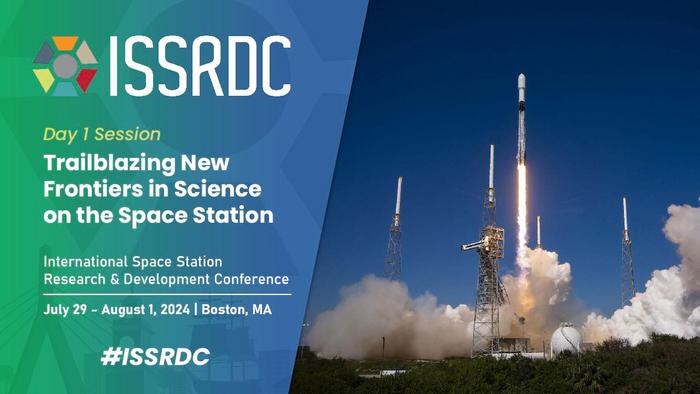
Pioneers in transformative research with clinical applications will discuss how space is advancing discoveries within the biomedical community at the 13th annual International Space Station Research and Development Conference (ISSRDC). The session “Trailblazing New Frontiers in Science on the Space Station” will provide insights into recent breakthroughs in cancer, regenerative medicine, and in-space manufacturing that may profoundly impact health outcomes on Earth.

Credit: NASA
Pioneers in transformative research with clinical applications will discuss how space is advancing discoveries within the biomedical community at the 13th annual International Space Station Research and Development Conference (ISSRDC). The session “Trailblazing New Frontiers in Science on the Space Station” will provide insights into recent breakthroughs in cancer, regenerative medicine, and in-space manufacturing that may profoundly impact health outcomes on Earth.
ISSRDC is the only conference dedicated to showcasing our nation’s orbiting laboratory and the growing market economy in low Earth orbit. This year’s ISSRDC will take place at the Boston Marriott Copley Place from July 29 through August 1.
The session, taking place on Tuesday, July 30, will be co-moderated by Jennifer Buchli, NASA chief scientist for the International Space Station (ISS) Program, and Michael Roberts, chief scientific officer for the ISS National Laboratory®. Both NASA and the ISS National Lab have prioritized utilization of the space station for cancer and other disease-related research, as well as in-space production applications and manufacturing opportunities, and this session features panelists within those respective fields.
Below highlights panelists slated for this session:
- Tony Atala, G. Link professor and director of the Wake Forest Institute for Regenerative Medicine, will lead a team of researchers launching multiple space station investigations focused on the vascularization of bioprinted tissue, sponsored by the ISS National Lab after originating through NASA’s Vascular Tissue Challenge.
- Catriona Jamieson, director of the Sanford Stem Cell Institute at the University of California, San Diego, has led multiple ISS National Lab-sponsored investigations focused on cancer. Additionally, her team worked with commercial astronauts through Axiom Space to uncover new insights into protecting astronaut health while improving cancer treatment on Earth.
- Adrian Radocea is chief science officer at Varda Space Industries, which successfully completed its first mission to crystallize therapeutics on its free-flying spacecraft in low Earth orbit, opening new and exciting possibilities for in-space biopharmaceutical development.
- Kenneth Savin is chief scientific officer for Redwire Space, which has developed various space station facilities available to the research community. Recently, Redwire used its BioFabrication Facility to successfully print the first human meniscus and cardiac tissue in space. The company also validated its Pharmaceutical In-space Laboratory by collaborating with Eli Lilly and Company, recently returning 36 crystallography investigations designed for potential pharmaceutical use.
“We are privileged to have these leaders in biomedical research and in-space manufacturing join us at ISSRDC to share their recent discoveries and perspectives on the next decade of results,” said Roberts. “We look forward to an engaging conversation about how low Earth orbit provides a unique environment to accelerate the diagnosis, prevention, and treatment of disease and opens novel pathways for drug development to benefit humans on Earth and those living and working off our planet.”
A series of announcements in the coming weeks will highlight additional keynote speakers and panel sessions at ISSRDC 2024. This year’s conference also features lightning talks, plenary presentations, technical sessions, workshops, an investor session, and networking opportunities. A marketplace expo allows companies to showcase the advancement of opportunities in low Earth orbit and will provide a venue to meet with researchers and stakeholders.
ISSRDC is hosted by the Center for the Advancement of Science in Space™ (CASIS™), manager of the ISS National Lab, NASA, and the American Astronautical Society. To learn more about ISSRDC, including how to register, exhibit, and become a sponsor, please visit our conference website.
Download a high-resolution photo: Trailblazing New Frontiers in Science on the Space Station
Cite Scienmag News
Nathaniel Bowman. (June 5, 2024). Trailblazers to lead ISSRDC panel on cancer research, regenerative medicine, and in-space manufacturing. Scienmag. https://scienmag.com/trailblazers-to-lead-issrdc-panel-on-cancer-research-regenerative-medicine-and-in-space-manufacturing/
Nathaniel Bowman. "Trailblazers to lead ISSRDC panel on cancer research, regenerative medicine, and in-space manufacturing." Scienmag, 5 June 2024, https://scienmag.com/trailblazers-to-lead-issrdc-panel-on-cancer-research-regenerative-medicine-and-in-space-manufacturing/. Accessed 5 September 2026.
Nathaniel Bowman. "Trailblazers to lead ISSRDC panel on cancer research, regenerative medicine, and in-space manufacturing." Scienmag. June 5, 2024. https://scienmag.com/trailblazers-to-lead-issrdc-panel-on-cancer-research-regenerative-medicine-and-in-space-manufacturing/

