


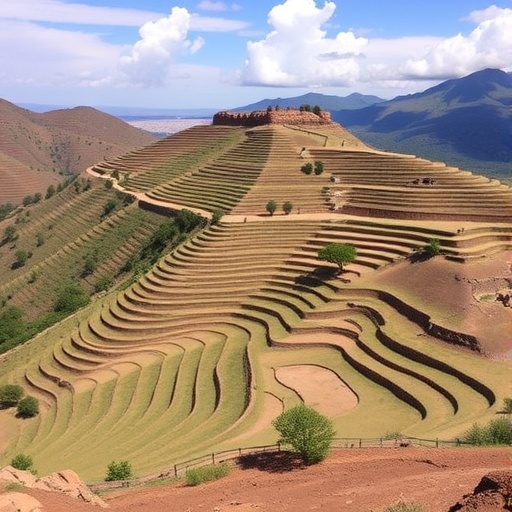
On the steep, stony slopes of southern Ethiopia, farmers have transformed terrain that appears almost hostile to agriculture into a productive patchwork of narrow fields, tree gardens and carefully managed water channels. A new archaeological and ethnobotanical study of the Konso Zone finds that this landscape is not simply an example of traditional farming, but the surviving expression of a sophisticated environmental technology developed over centuries. Konso communities construct and maintain terraces by hand, using locally available stone and a hoe known as a payra, to slow runoff, trap eroding soil and retain scarce rainfall. The approach has allowed agriculture to persist between roughly 1,400 and 2,000 metres above sea level, where slopes are fragile, rainfall is unpredictable and conventional ploughing is often impossible. Radiocarbon dating of charcoal from one abandoned terrace produced an age of 1,235 ± 30 radiocarbon years before present, pointing to a deep history for the system and offering a striking example of how people can adapt to environmental stress without mechanised agriculture.
The research, conducted between 2021 and 2023 by archaeologist Alemseged Beldados Aleho and archaeologist Fikadu Adugna, combined archaeological survey with ethnobotanical and ethnoarchaeological investigation. The team identified and described six agricultural terraces, including both active fields and sites that had been abandoned. Rather than treating terraces as isolated engineering structures, the researchers examined them as parts of a broader agricultural economy: one involving crop diversity, agroforestry, soil conservation, water management and local knowledge passed between generations. The study is significant because the Konso landscape preserves evidence of long-term human interaction with a difficult ecology, while also documenting practices that remain relevant to modern debates over dryland farming and climate adaptation. Its central message is not that an ancient technique can simply be copied elsewhere, but that resilience often emerges from close observation of local terrain and from agricultural systems designed around ecological limits rather than against them.
A terrace works by changing the movement of water and sediment across a slope. On an unprotected hillside, intense rain can rapidly flow downhill, gaining enough energy to detach soil particles and carry them away. This process, known as sheet and rill erosion when it occurs in thin flows and small channels, removes the upper soil horizon where organic matter and plant nutrients are concentrated. Stone terrace walls interrupt that downhill flow. They reduce slope length and water velocity, allowing sediment to settle behind the wall instead of being exported from the field. The structures also increase the time available for water to infiltrate the ground. In principle, this raises soil moisture, reduces peak runoff and limits the formation of gullies. In Konso, where cultivated plots are narrow, fragmented and often built directly into rocky slopes, these effects can determine whether rain becomes a crop-supporting resource or a destructive pulse of erosion.
The terraces are consequently both agricultural fields and water-harvesting infrastructure. Their effectiveness depends on constant maintenance: stones must be repositioned, damaged walls rebuilt and accumulated soil managed as the field slowly changes. The work is labour-intensive, but the landscape’s topography leaves few alternatives. Ox-drawn ploughs require enough space to turn and operate, while tractors and other machinery need broader, more continuous fields and gentler gradients. The Konso system instead relies on hand cultivation and the payra, enabling farmers to work small pockets of soil between rocks and terrace walls. This method permits precision in planting and weeding, although it demands substantial human effort. The study portrays that labour not as evidence of technological backwardness, but as a rational response to terrain in which mechanisation could damage terraces, compact soil or simply be physically unworkable.
Agriculture in the terraced landscape is also diversified across species and layers of vegetation. The researchers recorded crops including teff, sorghum, maize, finger millet, pigeon pea, soybean, linseed, gesho, chat and coffee. These plants do not all serve the same function or occupy identical ecological niches. Cereals provide staple grains, legumes can contribute dietary protein and, through biological nitrogen fixation, may add plant-available nitrogen to soil, while coffee and chat can support household income. Trees such as Moringa stenopetala, often called the cabbage tree, and Terminalia brownii are integrated into the farming system. Agroforestry of this kind can moderate near-ground conditions, provide food, fodder, fuel, medicine or construction material, and help stabilise soil with roots. Tree canopies may also reduce the direct impact of raindrops, an important early step in erosion, although competition for water and light must be managed carefully in dry environments.
The study’s ethnobotanical observations show that the selection of trees is not arbitrary. Plants are valued for multiple, overlapping reasons: their ability to survive local climate conditions, their contribution to soil and water conservation, their use as food or animal feed, and their roles in medicine, construction, ritual and household economies. This multifunctionality spreads risk. A field planted with a single crop can fail completely if rainfall arrives at the wrong time or a pest attacks, whereas a mixed system may continue to provide some food, fodder or income even during a poor season. Intercropping can also make more efficient use of space and time, because species with different heights, root systems or maturation schedules draw on resources differently. The research does not claim that Konso farmers are insulated from drought or climate change; rather, it shows how diversity and structural conservation can reduce vulnerability in a landscape where environmental shocks are recurrent.
Archaeological evidence supports the idea that human use of Konso’s plant resources has considerable antiquity. Excavations at the Koy-koy rock shelter and the open-air sites of Sohaito recovered cultural materials including worked stone tools, pottery fragments, a bead and botanical remains. Among the plant remains were fruit stones attributed to Moringa stenopetala, a species that remains important in Konso agroforestry. Such finds help connect contemporary ecological knowledge with earlier human-environment interactions, although a plant remain alone cannot prove that a particular cultivation technique was already in use at the time it was deposited. The strongest chronological evidence for terrace agriculture in the new study comes from charcoal excavated from an abandoned agricultural terrace. Radiocarbon dating measures the decay of carbon-14 in once-living material; because carbon-14 decreases at a known rate after an organism dies, the remaining amount can provide an estimate of age. The result of 1,235 ± 30 years before present places the charcoal in the early medieval period, subject to the calibration and archaeological context of the sample.
That distinction matters because terraces are complex archaeological features. A stone wall may be rebuilt repeatedly, while soil behind it can accumulate, erode or be redeposited. Charcoal found in a terrace may date the burning or burial of organic material rather than the first construction of the wall. The reported radiocarbon result therefore provides evidence for a long-established agricultural landscape, but it does not by itself establish that every visible terrace is equally old or that the entire system emerged at one moment. The authors interpret the date as a clue to the longevity of traditional terracing, alongside observations of active and abandoned fields and knowledge documented from local inhabitants. More dates from multiple terraces, together with soil studies, stratigraphic excavation and botanical analysis, would help establish how the system expanded, changed or responded to past shifts in rainfall and land use.
The Konso case also carries a warning about the vulnerability of terraced landscapes. A functioning terrace is not a permanent monument; it is a maintained system whose protective capacity can decline when walls are neglected or fields are abandoned. Once breached, concentrated runoff can rapidly remove the soil that earlier generations accumulated, turning a conservation structure into a source of degradation. Climate change may intensify this risk by altering seasonal rainfall, increasing the frequency of heavy downpours or lengthening dry intervals. At the same time, demographic pressure, changing markets and the loss of labour or specialised knowledge could weaken the social foundations of terrace upkeep. Preserving the landscape therefore involves more than conserving stone walls as heritage. It requires recognising the expertise of the people who manage them and supporting agricultural livelihoods that make continued maintenance possible.
The researchers present Konso as an example of resilience and adaptation built through sustained experimentation with altitude, slope, soil and rainfall. Its lesson for climate-stressed agriculture is less about reviving a romanticised past than about understanding the engineering principles and social practices embedded in a living landscape. Slowing water before it becomes erosive, retaining sediment, combining trees with crops and spreading risk across species are all strategies with clear ecological logic. Yet their success depends on local conditions and on the labour and institutions that keep them functioning. As governments and development agencies search for ways to protect food production in increasingly variable climates, the Konso terraces demonstrate that high technology is not the only form of sophisticated technology. In some of the world’s most difficult farming environments, a wall of carefully placed stones, a hand tool and generations of accumulated knowledge can form an agricultural system capable of enduring for more than a millennium.
Cite Scienmag News
Alan Morgan. (August 27, 2026). Traditional Terracing Sustained Agriculture in Ethiopia’s Konso Zone for Millennia. Scienmag. https://scienmag.com/traditional-terracing-sustained-agriculture-in-ethiopias-konso-zone-for-millennia/
Alan Morgan. "Traditional Terracing Sustained Agriculture in Ethiopia’s Konso Zone for Millennia." Scienmag, 27 August 2026, https://scienmag.com/traditional-terracing-sustained-agriculture-in-ethiopias-konso-zone-for-millennia/. Accessed 3 September 2026.
Alan Morgan. "Traditional Terracing Sustained Agriculture in Ethiopia’s Konso Zone for Millennia." Scienmag. August 27, 2026. https://scienmag.com/traditional-terracing-sustained-agriculture-in-ethiopias-konso-zone-for-millennia/


