


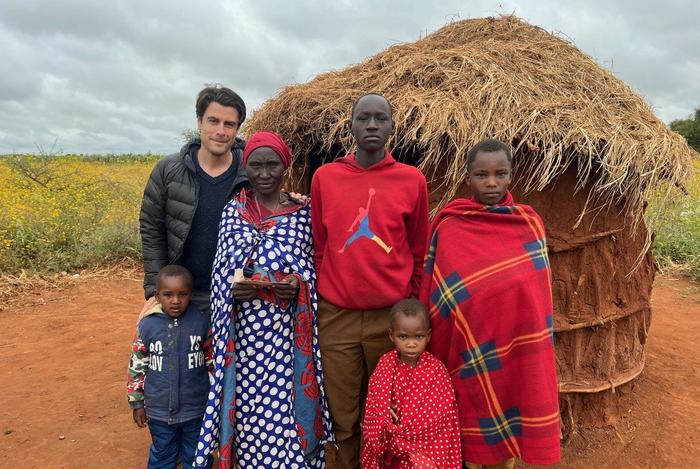
Few communities reveal both the challenges and opportunities presented by cultural globalism more than Maasai communities in northern Tanzania. Traditionally pastoralists, the Maasai ethnic group’s social structure is historically patriarchal, with a man’s prestige measured by the size of his family and by the livestock he owns.

Credit: Photo by Timothy Baird for Virginia Tech.
Few communities reveal both the challenges and opportunities presented by cultural globalism more than Maasai communities in northern Tanzania. Traditionally pastoralists, the Maasai ethnic group’s social structure is historically patriarchal, with a man’s prestige measured by the size of his family and by the livestock he owns.
The shrinking world has brought change: Urban centers and the promise of jobs are luring young Maasai from communities, and new technologies such as mobile phones are shifting social patterns and structures that go back generations. Even the East African landscape where the Maasai have traditionally grazed their cattle is altered. Dences protect agriculture efforts on lands where cattle previously grazed, and a nomadic life that relies on common land is rapidly ceding to western notions of individual ownership.
Virginia Tech Associate Professor Tim Baird is exploring the dimensions of change and empowerment that women in Maasai households are experiencing. A new paper in the Journal of Rural Studies reveals that newer livelihood activities are providing Maasai women more access to decision-making in households.
“Livelihood diversification is the foundation from which much of the change in these Maasai communities has grown,” said Baird, who teaches in the College of Natural Resources and Environment’s Department of Geography. “But Maasai still maintain a strong sense of identity centered on livestock.”
To explore pathways to empowerment for women, Baird and his colleagues focused on the decision-making processes within households to understand how the shifting world has impacted the lived experiences of Maasai women.
Through interviews and surveys of women and men in Maasai households, researchers identified 10 broad decision types households face, on subjects including agriculture, children’s education and health, local travel, and domestic tasks. The researchers also examined how issues such as land tenure, sons’ reputation, and participation in small community groups can impact women’s access to household decisions.
This research contributes to the United Nation’s Sustainable Development Goal of Gender Equality, which seeks to empower decision-making for women and girls.
Key findings
- Changing pastoral livelihoods leading to new decision-making opportunities for Maasai women. Women are gaining new opportunities for empowerment in areas such as income generation, access to education, and health care.
- Group membership and formal education are critical positive factors. Women’s access to education and participation in formal community groups are strongly correlated with greater access to decision-making.
- Access to land and decision making is a complex challenge. While having formal title to agricultural land shows positive links to empowerment, mere access to land without title can reduce decision-making capacities for women.
- Maasai women still have limited access to traditional decisions. Considerations over livestock management and the marriage of children still remains limited for women, suggesting that traditional patriarchal structures still constrain decision-making in some dimensions of Maasai life.
Overall, the paper’s finding underscore the value that education, secure land tenure, and community support have for women’s empowerment while also revealing the multiple dimensions that influence, support, and also limit decision-making access for Maasai women in a rapidly changing East Africa.
Researchers conduct a group interview about mobile phone use and empowerment with Maasai women in northern Tanzania in 2018: (from left) research assistant Felista Terta, lead researcher Kelly Summers, and research assistant Naomi Peter. Photo by Timothy Baird for Virginia Tech.
Such finding reveal that change is not a one-directional process, but rather an iterative process where change has the capacity to both expand opportunities for women and also preserving a way of life that has sustained the Maasai for centuries.
“If you observe how the Maasai have embraced the new, whether it is agriculture or the market system, they have often done so in service of preserving their old traditions,” said Baird. “They can embrace the new as a way of preserving the past. But change also breeds change and women are leveraging this.”
Looking ahead, Baird is looking to study how inter-generational inheritance, traditionally centered on livestock, is evolving to incorporate agricultural land. He notes that studying groups like the Maasai can provide insights on how difference cultures and communities adapt and adjust in a changing world.
“These are vulnerable people: they are poor and they live in a challenging environment,” said Baird. “But pastoralists like the Maasai are resilient and able to adapt. As the world becomes more dynamic and more vulnerable, each of us should be looking for wards to be adaptive and resilient, and Maasai have much to teach us.”
Related stories
Virginia Tech professor introduces new approach to human-environment interconnection
Research explores the impacts of mobile phones for Maasai women
Journal
Journal of Rural Studies
Article Title
New pathways for women’s empowerment in pastoralist Maasai households, Tanzania
Article Publication Date
1-Jul-2024
Cite Scienmag News
Alan Morgan. (August 6, 2024). Tradition meets transformation for Maasai women. Scienmag. https://scienmag.com/tradition-meets-transformation-for-maasai-women/
Alan Morgan. "Tradition meets transformation for Maasai women." Scienmag, 6 August 2024, https://scienmag.com/tradition-meets-transformation-for-maasai-women/. Accessed 4 September 2026.
Alan Morgan. "Tradition meets transformation for Maasai women." Scienmag. August 6, 2024. https://scienmag.com/tradition-meets-transformation-for-maasai-women/

