


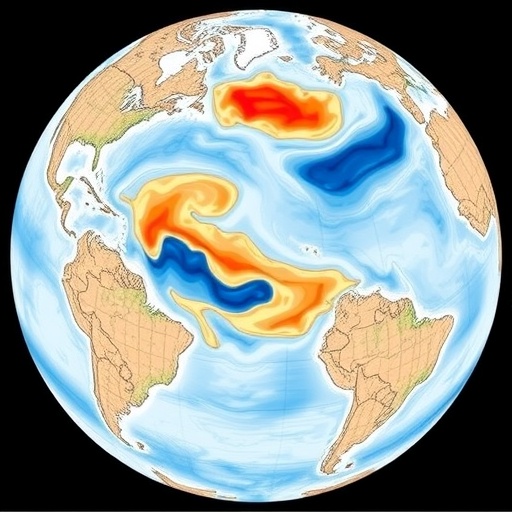
Using geochemical analyses of marine sediments, researchers have been able to quantitatively reconstruct the Atlantic Meridional Overturning Circulation over the past 12,000 years. An international research team, led by scientists from Heidelberg University and the University of Bern (Switzerland), is the first to calculate the large-scale circulation patterns of the Holocene. Their reconstruction shows that, while the AMOC experienced natural fluctuations over millennia, it remained stable for long periods of time.
The Atlantic Meridional Overturning Circulation (AMOC) is part of a global deep-ocean water system that redistributes heat and freshwater from the southern to the northern hemisphere, significantly impacting the weather, oceans, and climate. This makes it one of the key components of the Earth’s climate system. It includes the Gulf Stream system, a key driver of Europe’s climate. As part of the oceanic “conveyor belt”, it transports large amounts of heat from tropical regions to higher latitudes, playing a crucial role in balancing temperatures between the northern and southern hemispheres. According to Lukas Gerber, a doctoral researcher at the Institute of Earth Sciences at Heidelberg University, changes in the strength of this circulation can have far-reaching impacts on weather patterns, marine ecosystems, and long-term global climate trends. While the variability of the AMOC during the last Ice Age is well documented, its behavior during the Holocene – the comparatively mild period of Earth’s history that began some 12,000 years ago and continues to this day – is attracting increasing interest from researchers.
The reconstruction of the Atlantic circulation was based on geochemical measurements of the radioactive elements thorium and protactinium taken from sediments on the floor of the North Atlantic. The ratio of these rare radioisotopes records the circulation strength over the past 12,000 years and provides insights into the environmental conditions that have prevailed since the end of the last Ice Age. Using the data they had gathered, the scientists ran a numerical Earth system model to simulate the AMOC under various climate scenarios. This enabled them to calculate deepwater circulation patterns in the North Atlantic for the current geological epoch, the Holocene.
The team’s reconstruction shows that, after a period of recovery towards the end of the last Ice Age, the AMOC experienced another marked weakening between 9,200 and 8,000 years before present. “This phase coincides with meltwater pulses in the North Atlantic, during which large volumes of meltwater were released in a short period of time, most likely due to the collapse of the North American ice sheet,” explains Lukas Gerber. Around 6,500 years ago, the AMOC began to stabilize and eventually reached its present-day strength, according to the researchers. This is approximately 18 Sverdrups, with one Sverdrup corresponding to a volumetric flow rate of one billion liters per second.
“Our findings demonstrate that the AMOC remained stable throughout much of the Holocene,” emphasizes project leader Dr Jörg Lippold, who studies ocean dynamics with his team at the Institute of Earth Sciences at Heidelberg University. However, projections for the future clearly indicate that human-driven climate change could weaken the Atlantic circulation to levels never before seen in the present warm period of the Holocene. Dr Lippold points to current climate models that forecast a slowdown of five to eight Sverdrups, depending on the actual extent of global warming by the year 2100. In his view, such a change could have severe and unprecedented consequences for the stability of temperatures and for global precipitation patterns.
In addition to the scientists from Heidelberg and Bern, the project involved researchers from MARUM – Center for Marine Environmental Sciences at the University of Bremen, Friedrich-Alexander-Universität Erlangen-Nürnberg, and the University of São Paulo (Brazil). The work was funded by the German Research Foundation, the European Union, and Brazilian research funding. The results were published in the journal Nature Communications.
Journal
Nature Communications
Article Title
Low variability of the Atlantic Meridional Overturning Circulation throughout the Holocene
Article Publication Date
22-Jul-2025
Ute Mueller-Detert
Heidelberg University
ute.mueller-detert@rektorat.uni-heidelberg.de
Office: 004-962-2154 x19017
Journal
Nature Communications
Article Title
Low variability of the Atlantic Meridional Overturning Circulation throughout the Holocene
Article Publication Date
22-Jul-2025
Cite Scienmag News
Violet Maxwell. (August 14, 2025). Tracing 12,000 Years of Changes in Atlantic Ocean Circulation. Scienmag. https://scienmag.com/tracing-12000-years-of-changes-in-atlantic-ocean-circulation/
Violet Maxwell. "Tracing 12,000 Years of Changes in Atlantic Ocean Circulation." Scienmag, 14 August 2025, https://scienmag.com/tracing-12000-years-of-changes-in-atlantic-ocean-circulation/. Accessed 3 September 2026.
Violet Maxwell. "Tracing 12,000 Years of Changes in Atlantic Ocean Circulation." Scienmag. August 14, 2025. https://scienmag.com/tracing-12000-years-of-changes-in-atlantic-ocean-circulation/


