


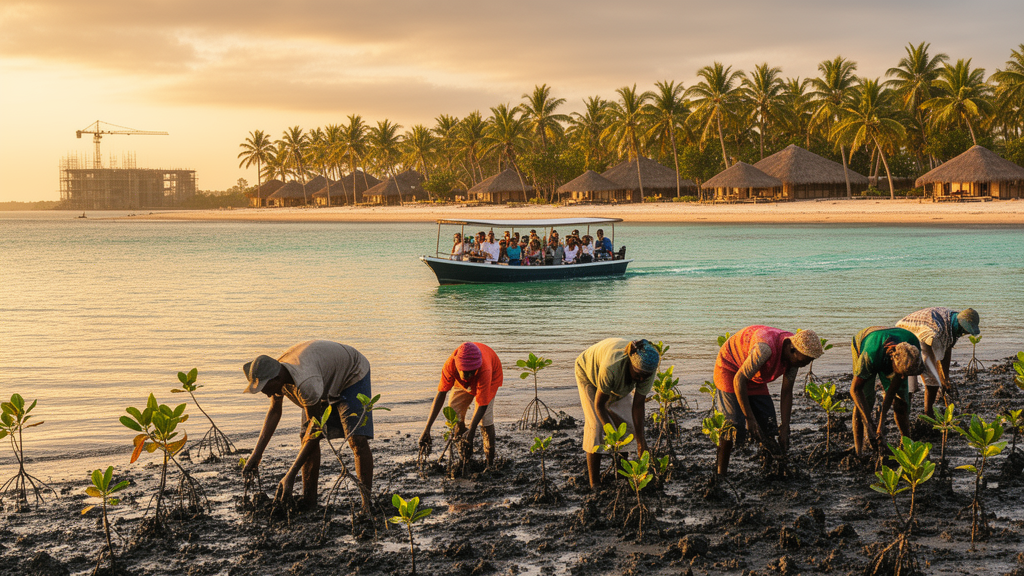
Ecotourism has long been sold as a win-win: travelers get pristine landscapes, and their money pays to keep those landscapes pristine. But hard evidence connecting visitor numbers to measurable ecosystem recovery has been surprisingly scarce, especially in the developing coastal regions where the model is most heavily promoted. A new eleven-year study from Tanzania now offers some of the most detailed data yet, tracking more than 353,000 visitor records across three coastal sites and pairing them with satellite-based land cover analysis. The verdict is a strikingly double-edged one. Higher visitation is strongly associated with increased restoration investment, yet at one forest reserve, a surge of tourists coincided with accelerating vegetation loss and urban sprawl.
The research, published in Frontiers in Sustainable Resource Management, was conducted by Oliver Simeon Lihuluku, Deo D. Shirima, and Agnes A. Sirima of Sokoine University of Agriculture in Morogoro. The team focused on three strategically contrasting destinations in Tanzania’s Pwani and Dar es Salaam regions: Pugu Kazimzumbwi Nature Forest Reserve, a protected coastal forest about 25 kilometers southwest of Dar es Salaam; Mbudya Island Marine Reserve, a coral reef and seagrass site within the Dar es Salaam Marine Reserve System; and the Kaole Ruins near Bagamoyo, a thirteenth-to-sixteenth-century archaeological site fringed by mangroves dominated by Avicennia marina and Rhizophora mucronata. Together, the sites span forest, marine, and cultural heritage conservation contexts, allowing the researchers to test whether the ecotourism-restoration link holds across fundamentally different ecosystem types.
The study’s architecture combined three data streams. First, the authors compiled official visitor statistics from the Tanzania Forest Services Agency and marine park records covering 2012 through 2022, cleaning and encoding eleven years of annual visitation data for statistical analysis. Second, they acquired multitemporal Landsat satellite imagery from the USGS archive, selecting scenes from Path 166/Row 065 with less than ten percent cloud cover. Raw digital numbers were converted to top-of-atmosphere reflectance using metadata-derived gain and bias coefficients, and thermal bands were translated into brightness temperature. Land use and land cover classes—vegetation, built-up area, bare land, water bodies, farmland, and rangeland—were then mapped with a Random Forest machine-learning classifier implemented through the Dzetsaka plugin in QGIS, with accuracy assessed via confusion matrices, user’s and producer’s accuracy, overall accuracy, and the Kappa coefficient. Third, the team conducted semi-structured interviews with fifteen key informants drawn from district councils, village elders, agency representatives, and tour operators, recruited through purposive sampling until data saturation was reached.
The visitation data alone tell a story of explosive growth. Over the eleven-year window, the three sites collectively recorded 353,492 visits. Kaole Ruins led with 170,971 visitors despite drawing nobody until 2016, when promotion and infrastructure finally arrived; its numbers then climbed steeply to 36,640 in 2022, the highest single-site annual total in the dataset. Mbudya Island maintained a steady marine tourism presence, totaling 130,000 visits anchored by snorkeling, diving, and beach activities. Pugu Kazimzumbwi was the late bloomer: essentially unvisited until 2017, it recorded an exponential rise after 2019, reaching 22,491 visitors in 2022—a 45 percent growth in visitation over the study period at the site level. Across all activities, worshiping at Kaole Ruins attracted the most participants, followed by hiking in the Pugu forest. Men outnumbered women overall, 179,515 to 173,977.
When the researchers correlated annual visitation with restoration indicators, the associations were remarkably strong. Pearson correlation coefficients between visitation rate and restoration index reached 0.992 at Pugu Kazimzumbwi, 0.971 at Kaole Ruins, and 0.858 at Mbudya Island, all statistically significant at the p < 0.01 level. The authors are careful to stress that these are exploratory correlations based on only eleven annual observations per site, and cannot establish causality. Still, the pattern is consistent with a plausible mechanism: entrance fees and tourism revenues are reinvested into restoration, so more visitors mean more money for conservation. Interview testimony reinforced this reading. As one key informant from Pugu Kazimzumbwi put it, “When we started the reforestation program, more visitors came to see the young trees and participate in planting activities,” while a Mbudya tour guide observed that “tourists are more willing to visit when they can see healthy coral reefs during snorkeling”—a feedback loop the researchers describe as a virtuous cycle.
The restoration portfolio documented at the sites is tangible. At Pugu Kazimzumbwi and Kaole, tree planting initiatives funded substantially by ecotourism revenues are organized by the Tanzania Forest Services Agency, the Tanzania Wildlife Management Authority, local government authorities, and WWF, with the Jane Goodall project supporting tree nurseries. Communities supply labor for nursery establishment and planting, and native species are prioritized for restoring degraded forest. At Mbudya Island, local government authorities coordinate regular beach clean-ups and coral reef restoration with tour operators and volunteers, with reef funding correlating positively with visitor growth. The interviews suggest these efforts are not incidental: tourism income appears to be a genuine financing engine for coastal restoration in the region.
Yet the satellite record complicates the optimistic narrative. Pugu Kazimzumbwi lost ten percent of its vegetation cover between 2012 and 2022, dropping from 49 to 39 percent of its area, while built-up land nearly doubled from 11 to 20 percent, bare land expanded from 25 to 35 percent, and water bodies shrank from 15 to 6 percent. Kaole Ruins saw farmland plummet from 35 to 10 percent of its area as built-up land surged from 5 to 22 percent, reflecting conversion of agricultural land to tourism-related and residential development—including new accommodation such as the Kaole homestay. Only Mbudya Island showed unambiguous ecological gain, with vegetation rising from 25 to 35 percent through mangrove recovery and bare land halving, though its open water declined from 60 to 50 percent, a shift the authors attribute to sedimentation, tidal changes, and managed restoration. Classification reliability improved over time, with Kappa coefficients rising from roughly 0.85 to above 0.91 by 2022, lending confidence to these trends.
The tension between rising restoration funding and degrading land cover points to what the authors frame as a threshold effect in newer destinations. Sites that recently opened to tourism lacked the refined management protocols, visitor impact mitigation strategies, and carrying capacity controls that mature destinations typically develop over time, so rapid growth in visitation can outpace the ability of management systems to absorb the pressure. Institutional history matters here too. Pugu Kazimzumbwi, established in 1936, suffered decades of logging and agricultural encroachment before the Tanzania Forest Services Agency assumed management in 2010 and introduced specialized patrols and community engagement through Village Forest Committees—though the authors note that benefit-sharing remains limited and community relations strained. Mbudya’s dedicated Marine Parks and Reserves Unit, with its wardens, rangers, and Beach Management Units, exemplifies the specialized institutional capacity the study links to better outcomes.
The study also surfaced an unexpected demographic pattern. At Mbudya Island, male visitation correlated strongly with restoration indicators, while female visitation did not—a disparity the researchers link to the physical demands and perceived safety risks of water-based activities such as diving and snorkeling. Field observations showed men more often engaging directly with visible marine conservation, while women tended to prefer beach-based activities less connected to restoration outcomes. At the land-based sites of Pugu Kazimzumbwi and Kaole Ruins, both genders showed similarly strong correlations, suggesting that activity type and safety perceptions, rather than restoration itself, shape who responds to ecosystem recovery.
The authors’ recommendations follow directly from the mixed evidence: strengthen site-specific management strategies, enforce carrying capacity limits before visitor growth overwhelms sensitive habitats, and ensure tourism revenues are systematically reinvested in restoration. They caution that the cross-sectional, correlational design cannot definitively prove that tourism drives restoration, and call for longitudinal and experimental research to clarify causal pathways. What the study does establish is that ecotourism in coastal Tanzania is neither a conservation panacea nor a false promise. Managed well, visitor spending can bankroll tree planting, reef rehabilitation, and habitat protection while drawing communities into stewardship. Managed poorly, the same foot traffic—and the development it attracts—can erode the very ecosystems the business model depends on. The net ecological balance, the findings suggest, is decided not by the tourists themselves but by the institutions charged with managing them.
Subject of Research: The relationship between ecotourism visitation rates and coastal ecosystem restoration outcomes at three protected sites in Tanzania
Article Title: Ecotourists' visitation rates and coastal ecosystem restoration: evidence from Tanzania
Article References: Lihuluku, O. S., Shirima, D. D., & Sirima, A. A. (2026). Ecotourists' visitation rates and coastal ecosystem restoration: evidence from Tanzania. Frontiers in Sustainable Resource Management, 5, Article 1918143. https://doi.org/10.3389/fsrma.2026.1918143
Image Credits: AI Generated
DOI: 10.3389/fsrma.2026.1918143
Keywords: ecotourism, coastal ecosystems, Tanzania, ecosystem restoration, land cover change, satellite imagery, Random Forest classification, conservation financing, mangroves, coral reefs, carrying capacity, Pugu Kazimzumbwi
Cite Scienmag News
Sebastian Montgomery. (October 15, 2026). Tourist Dollars Fuel Coastal Restoration in Tanzania—But Growth Has a Hidden Cost. Scienmag. https://scienmag.com/tourist-dollars-fuel-coastal-restoration-in-tanzania-but-growth-has-a-hidden-cost/
Sebastian Montgomery. "Tourist Dollars Fuel Coastal Restoration in Tanzania—But Growth Has a Hidden Cost." Scienmag, 15 October 2026, https://scienmag.com/tourist-dollars-fuel-coastal-restoration-in-tanzania-but-growth-has-a-hidden-cost/. Accessed 15 October 2026.
Sebastian Montgomery. "Tourist Dollars Fuel Coastal Restoration in Tanzania—But Growth Has a Hidden Cost." Scienmag. October 15, 2026. https://scienmag.com/tourist-dollars-fuel-coastal-restoration-in-tanzania-but-growth-has-a-hidden-cost/


