


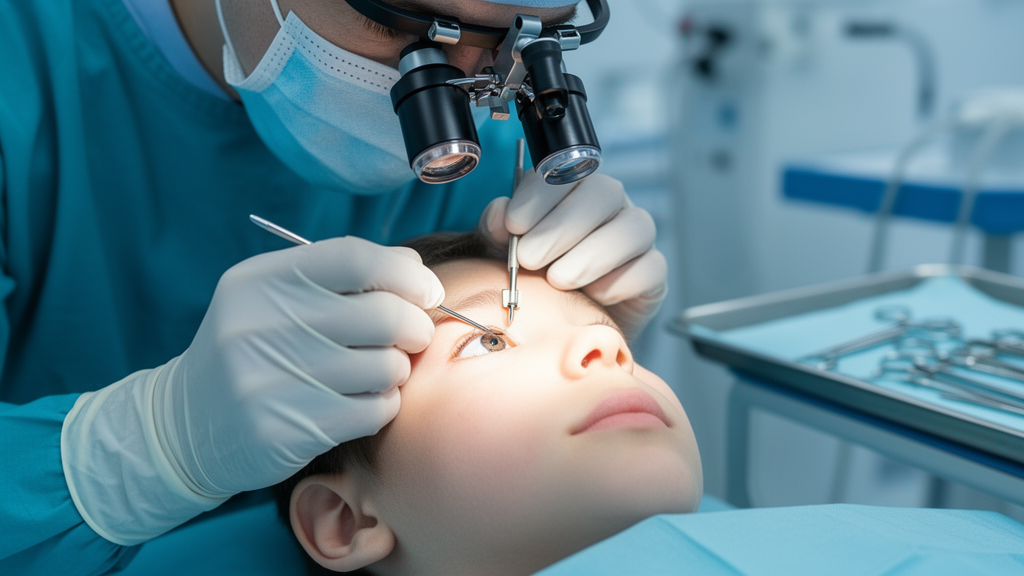
A nine-year-old girl in Riyadh with a lifetime of eye surgeries behind her has become the first reported child to have a failing PAUL glaucoma implant rescued not with a repeat operation, but with a simple needle. Surgeons at the Glaucoma Division of King Khaled Eye Specialist Hospital, working with colleagues from Riyadh Second Health Cluster, used a fine 27-gauge needle to break open the scar capsule that had choked off the implant’s drainage plate, delivering a carefully dosed antifibrotic drug at the same time. The case, published in Frontiers in Ophthalmology, offers a glimpse of how minimally invasive techniques might spare young patients from yet another round of major surgery.
Primary congenital glaucoma is a rare but relentless disease. Present from birth, it arises when the eye’s natural drainage structures fail to develop properly, allowing fluid pressure inside the eye to climb to dangerous levels. In children, this pressure does more than threaten the optic nerve; it can physically stretch the growing globe, enlarging the cornea and leaving lasting scars known as Haab striae. Keeping the pressure under control often demands an escalating series of operations over many years, and even then, some eyes stubbornly resist every conventional approach.
When angle surgery and filtration procedures fail, ophthalmologists turn to glaucoma drainage devices, small silicone tubes that shunt excess fluid from the front of the eye to a reservoir, or bleb, beneath the conjunctiva. The PAUL glaucoma implant is one of the newest members of this family. Unlike the valved Ahmed device or the larger non-valved Baerveldt, it features a flexible plate and an ultra-thin tube with a smaller internal diameter, designed to provide controlled aqueous outflow while minimizing trauma to delicate pediatric tissue. Clinical studies have shown encouraging success rates in congenital glaucoma, with pressure control achieved in roughly 67 to 87 percent of eyes at one year after implantation.
But drainage implants share a common Achilles heel: the body’s own healing response. Aqueous humor is rich in pro-inflammatory signaling molecules, and when it flows into the subconjunctival space, it can trigger an aggressive wound-healing cascade. Fibroblasts multiply, transform into contractile myofibroblasts, and lay down dense extracellular matrix, encasing the implant’s plate in a thick, low-permeability collagenous shell. Clinicians call this encapsulation, and it behaves like a balloon in a steel jacket: fluid collects but cannot disperse, and the intraocular pressure climbs back up, sometimes dramatically, in what is known as a hypertensive phase.
The patient described in the report had already endured an extraordinary surgical journey. Diagnosed with bilateral primary congenital glaucoma, she underwent deep sclerectomies in both eyes beginning in 2017. When pressure control deteriorated, she received additional procedures on each side: repeat deep sclerectomy in her right eye in 2021 followed by four sessions of micropulse cyclophotocoagulation across 2022 and 2023, and a PAUL implant in 2023. Her left eye followed a similar path, with a second deep sclerectomy in 2024 and implant placement the same year. By the time she presented in 2025, she was juggling three topical medications in one eye, two in the other, and an oral carbonic anhydrase inhibitor, all aimed at holding back pressures that medications alone could no longer master.
On admission, her left eye told the classic story of a failing implant. The pressure measured 27 millimeters of mercury despite maximal therapy. Slit-lamp examination revealed a thick capsule over a well-covered implant plate, and baseline B-scan ultrasonography confirmed a patent tube surrounded by a loculated pocket of trapped fluid, evidence that the device was working but that its outflow reservoir had been sealed off by scar tissue. Her vision held at 20/40, and the optic nerve showed moderate cupping, but the clock was ticking: sustained pressure this high in a child’s eye risks irreversible damage.
Conventional answers to encapsulation are unsatisfying. Adding more medications rarely defeats the physical barrier of a dense fibrotic shell and can further irritate an already compromised ocular surface. Placing a second implant or turning to cyclophotocoagulation lowers pressure effectively but consumes the limited conjunctival real estate that future surgeries may need. A full surgical revision carries the morbidity of another operation in an eye that has already seen many. Needle revision offers a fourth path: mechanically fenestrate the capsule through the conjunctiva, break the trapped pocket open, and use an antimetabolite such as mitomycin C to suppress the fibrotic response that caused the problem in the first place. The technique has been used in adults for decades, and a 1997 randomized trial showed it outperforming medical therapy for encapsulated blebs, but it had never been reported for a PAUL implant in a child.
Under local anesthesia and sterile conditions, the surgical team localized the encapsulated capsule and began a stepwise needling procedure with a 27-gauge needle. Before puncturing, they injected 0.3 milliliters of mitomycin C at a concentration of 0.4 milligrams per milliliter, mixed with an equal volume of 2 percent lidocaine for comfort, into the sub-Tenon’s space around the plate. The needle was then advanced through the conjunctiva to disrupt the fibrous wall, and sweeping mechanical debridement with a cotton-tipped applicator helped mobilize the trapped fluid. Subconjunctival dexamethasone was instilled at the end of the procedure, and the eye was dressed with antibiotic-steroid ointment and a protective shield.
The results unfolded rapidly. On the first day after the procedure, the pressure had already fallen from 27 to 24 millimeters of mercury, with the anterior chamber remaining deep and quiet. Nine days later, the eye showed a well-formed, diffuse drainage bleb, and the pressure had dropped into the target range of 14 to 17 millimeters. At six weeks, stabilization was excellent: pressure of 10 millimeters of mercury, vision maintained at 20/40 with isolated letters reaching 20/30, a structurally patent tube, and no inflammation inside the eye. A transient pressure spike to 22 millimeters appeared at the two-month visit, but it settled within days to 13 millimeters. The only wrinkle was a secondary ocular surface problem, superficial punctate keratitis with pinpoint corneal scars, which the team managed successfully with aggressive topical lubrication.
The authors, Abdulrahman Kaki, Jumanah Qedair, Nouf Alzendi, and Konrad Schargel, emphasize that after searching PubMed, Google Scholar, Cochrane, and Web of Science in July 2026, they found no prior report of successful needling of a PAUL implant in a child with primary congenital glaucoma. The case echoes earlier pediatric successes, including a 2020 report in which a 14-year-old boy’s failed deep sclerectomy was rescued with needle revision plus an antimetabolite, achieving a pressure of 15 millimeters without medications at one year. Together, these cases suggest that needle revision of failed filtering surgeries is a viable, tissue-preserving option in congenital glaucoma, a population in which every remaining square millimeter of healthy conjunctiva matters.
Caution is nonetheless warranted. This was a single case with a follow-up of barely two months, enough to capture the critical early window and the resolution of one transient pressure spike, but not enough to establish long-term durability, sustained pressure control, or late safety. Antifibrotic agents such as mitomycin C carry their own risks, including potential damage to the corneal epithelium and conjunctival wound leaks, and children’s healing responses can differ substantially from those of adults. The authors themselves call for prospective studies with larger cohorts and extended follow-up before the technique can be considered standard of care.
Still, the message is compelling. For a child whose eye had already absorbed deep sclerectomies, laser treatments, and two drainage implants, a needle and a drop of drug achieved what escalating surgery threatened to require: a rescued device, controlled pressure, preserved vision, and a conjunctiva left intact for whatever the future may hold. As the PAUL implant spreads into pediatric practice worldwide, this report offers surgeons a concrete, conservative playbook for one of its most common failure modes, and it reminds the field that sometimes the least invasive tool, a fine needle wielded with precision, can be the most powerful one on the tray.
Subject of Research: Needle revision with mitomycin C to treat an encapsulated bleb after PAUL glaucoma implant surgery in a pediatric patient with primary congenital glaucoma
Article Title: Case Report: Successful needle revision of an encapsulated bleb following PAUL glaucoma Implant surgery in a pediatric patient
Article References: Kaki, A., Qedair, J., Alzendi, N., & Schargel, K. (2026). Case Report: Successful needle revision of an encapsulated bleb following PAUL glaucoma Implant surgery in a pediatric patient. Frontiers in Ophthalmology, 6, Article 1952678. https://doi.org/10.3389/fopht.2026.1952678
Image Credits: AI Generated
DOI: 10.3389/fopht.2026.1952678
Keywords: glaucoma, PAUL glaucoma implant, primary congenital glaucoma, bleb needling, needle revision, mitomycin C, encapsulated bleb, glaucoma drainage device, pediatric ophthalmology, intraocular pressure, minimally invasive surgery, case report
Cite Scienmag News
Ophelia Keating. (October 15, 2026). Needle Revision Rescues Failing PAUL Glaucoma Implant in a Child. Scienmag. https://scienmag.com/needle-revision-rescues-failing-paul-glaucoma-implant-in-a-child/
Ophelia Keating. "Needle Revision Rescues Failing PAUL Glaucoma Implant in a Child." Scienmag, 15 October 2026, https://scienmag.com/needle-revision-rescues-failing-paul-glaucoma-implant-in-a-child/. Accessed 15 October 2026.
Ophelia Keating. "Needle Revision Rescues Failing PAUL Glaucoma Implant in a Child." Scienmag. October 15, 2026. https://scienmag.com/needle-revision-rescues-failing-paul-glaucoma-implant-in-a-child/


