


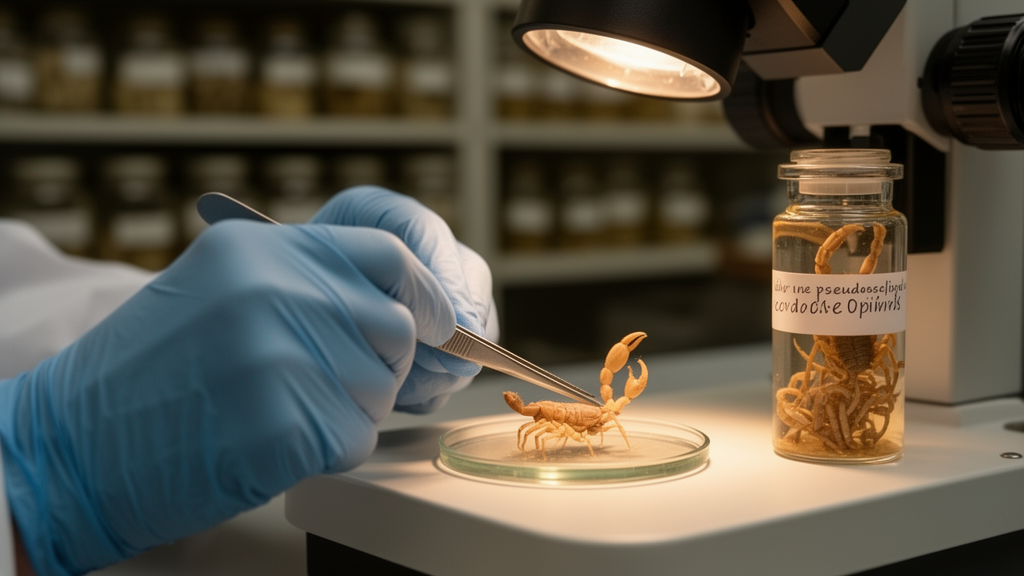
Deep in the grasslands of South Africa’s Free State province, a creature smaller than a grain of rice has been hiding in plain sight for years. Scientists have now formally described a new species of pseudoscorpion, Afrogarypus foordi, from specimens that sat in the wet collection of the National Museum in Bloemfontein, misidentified as a different species until a careful re-examination revealed their true identity. The discovery, published in the journal African Invertebrates, adds a remarkable new branch to the country’s already diverse pseudoscorpion fauna and offers a fascinating case study in how evolution can strip away body parts that most relatives retain.
Pseudoscorpions are ancient arachnids that resemble tiny scorpions without tails, complete with venomous pincer-like pedipalps used to subdue prey. The family Geogarypidae, to which the new species belongs, is well represented across the Afrotropical region and comprises two genera: the African-endemic Afrogarypus with 26 known species, and the cosmopolitan Geogarypus with 52 living species and three fossil species preserved in Eocene-age Baltic amber. South Africa alone hosts 12 valid species of Afrogarypus and nine species of Geogarypus, recorded from all biomes of the country, from the arid Karoo landscapes in the northwest to the more humid coastal slopes of the country’s mountains.
Geogarypids are four-eyed, rather flat pseudoscorpions that range in size from a few millimetres to almost a centimetre. They are typically collected from leaf litter habitats, though they can also be found under rocks and decaying tree bark. In South Africa, these animals can be locally abundant in the leaf litter of indigenous or undisturbed forests and are probably among the most common pseudoscorpions in the country. The new species, however, stands out for being among the smallest of its genus, with females measuring just 1.38 to 1.54 millimetres in body length and males 1.17 to 1.26 millimetres. The chela, the pincer-like claw of the pedipalp, is a mere 0.58 to 0.79 millimetres long depending on sex.
The specimens were obtained from the Arachnology wet collection of the Terrestrial Invertebrates department at the National Museum in Bloemfontein. While working through and updating the pseudoscorpion collection, the first author noted a number of Geogarypidae specimens originally identified as Afrogarypus subimpressus from three sites located in the interior of the country. Given that the type locality of that species is at Cape Point Nature Reserve in the Western Cape, the specimens were re-examined and found to belong to a novel Afrogarypus species. All specimens were deposited back in the museum’s Arachnology wet collection after identifications and descriptions were made.
The morphological analysis involved meticulous preparation techniques. Specimens were sorted, identified and sexed using a stereomicroscope, then cleared in 90 percent lactic acid. The desired structures, including the chelicerae, pedipalps, leg I and leg IV, were dissected under a stereomicroscope using fine pins. Dissected parts were kept in microvials and stored with the rest of the specimens, then individually mounted on standard microscope slides with small pieces of nylon fishing line used to elevate a coverslip above the structures. The slides were examined with a binocular microscope fitted with a digital imaging system, and high-resolution photographs and measurements were made using specialized imaging software. Extended focal range images were created via stacking of digital photographs, and these images were traced to produce line drawings.
The new species is named in remembrance of Professor Stefan Hendrik Foord, a South African arachnologist honoured for his contributions to arachnology and his outstanding work on the biodiversity and ecology of South African spiders. The holotype, a female, was collected on Bankfontein Farm near Fauresmith in the Free State at 1192 metres above sea level, from leaf litter sifting under hillside shrubs in April 2015. A male paratype came from the same data, and additional material was examined from Tussen die Riviere Nature Reserve near Bethulie and from Karoo National Park in the Western Cape, where specimens were collected from leaf litter beneath Karoo shrubs at Klipspringer Pass.
What makes Afrogarypus foordi particularly interesting to evolutionary biologists is a case of trichobothria reduction. Trichobothria are long, hair-like sensory structures on the chelae that detect air currents and vibrations, and pseudoscorpions typically have a full complement of these on their pincers. The new species lacks trichobothrium isb on the fixed chelal finger, meaning it has seven trichobothria on that finger rather than the usual eight. Such reductions might result from neoteny, the retention of juvenile characteristics into adulthood, and the loss of isb occurs independently in several pseudoscorpion genera belonging to the families Garypidae, Garypinidae, Geogarypidae, Neobisiidae, Sternophoridae and Syarinidae.
The species also shows tarsal reduction in legs I and II, which are monotarsate, meaning the tarsal segments are fused into one rather than divided as in most other species. Legs III and IV remain diplotarsate, with the segments divided. Tarsal reduction is less common in pseudoscorpions than the reduction of trichobothria but has been recorded in the families Garypidae and Geogarypidae. Both reductive features are recorded here for the second time in the South African geogarypid fauna, the first being Afrogarypus castigatus, described in 2016.
Ecologically, Afrogarypus foordi is currently known to inhabit the shaded leaf litter found under indigenous shrub and tree stands in the veld of the Free State, as well as those of larger Karoo bushes. Its known distribution falls outside both the Maputaland-Pondoland-Albany hotspot and the Cape Floristic Region, where the majority of South Africa’s Geogarypidae diversity is found. In contrast to the arboreal lifestyle of Afrogarypus castigatus, the other South African geogarypid exhibiting the same reductive features, all specimens of the new species have been found in leaf litter. Afrogarypus castigatus possesses much more compact bodies with comparatively shorter, more stout appendages, while the new species exhibits body proportions much less compact and more reminiscent of other ground-dwelling Geogarypidae. Specimens were collected during the months of April, October and November at elevations between 1187 and 1286 metres.
The discovery underscores how much biodiversity remains undocumented even in well-studied regions, and how museum collections can yield new species decades after specimens were first gathered. With recent taxonomic work including a detailed and illustrated revision of the South African fauna, an updated identification key and descriptions of three new species published recently, the family Geogarypidae continues to reveal surprises. The new species is described from both sexes and diagnosed against all other species of Afrogarypus in the country, ensuring that future researchers can reliably distinguish this tiny grassland dweller from its relatives across South Africa’s diverse landscapes.
Subject of Research: Taxonomy and biodiversity of pseudoscorpions in South Africa
Article Title: Afrogarypus foordi sp. nov. – a new pseudoscorpion species ( Pseudoscorpiones , Geogarypidae ) from South Africa
Article References: Neethling, J. A., & Harms, D. (2024). Afrogarypus foordi sp. nov. – a new pseudoscorpion species (Pseudoscorpiones, Geogarypidae) from South Africa. African Invertebrates, 65(2), 115-126. https://doi.org/10.3897/afrinvertebr.65.137694
Image Credits: AI Generated
DOI: 10.3897/afrinvertebr.65.137694
Keywords: pseudoscorpions, taxonomy, South Africa, new species, arachnology, Geogarypidae, biodiversity, museum collections, Afrogarypus, foordi, pseudoscorpion, species
Cite Scienmag News
Gavin Prescott. (October 18, 2026). Tiny New Pseudoscorpion Species Unearthed in South African Museum Collection. Scienmag. https://scienmag.com/tiny-new-pseudoscorpion-species-unearthed-in-south-african-museum-collection/
Gavin Prescott. "Tiny New Pseudoscorpion Species Unearthed in South African Museum Collection." Scienmag, 18 October 2026, https://scienmag.com/tiny-new-pseudoscorpion-species-unearthed-in-south-african-museum-collection/. Accessed 18 October 2026.
Gavin Prescott. "Tiny New Pseudoscorpion Species Unearthed in South African Museum Collection." Scienmag. October 18, 2026. https://scienmag.com/tiny-new-pseudoscorpion-species-unearthed-in-south-african-museum-collection/


