


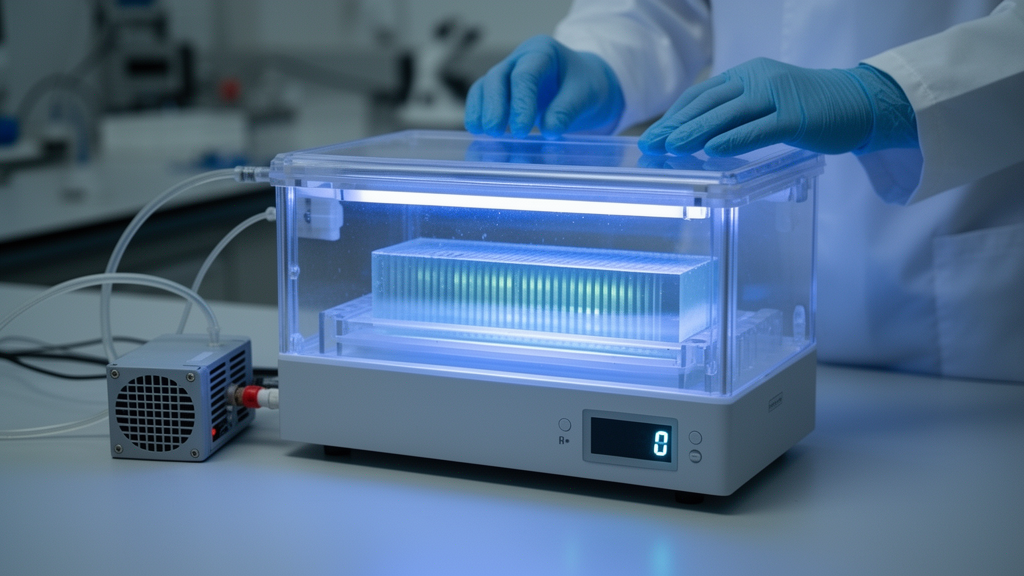
Gel electrophoresis has been a workhorse of molecular biology for decades, prized for its simplicity: charged molecules migrate through a porous gel matrix under an electric field, separating by size and shape. But a team at Brandeis University argues that the technique’s greatest limitation has been treated as a fixed feature rather than a solvable engineering problem. In a new open-source hardware publication in HardwareX, Rupam Saha and Seth Fraden introduce ARTGEL, an actively regulated temperature gel electrophoresis platform that transforms the gel from a passive readout of a pre-equilibrated sample into a precisely controlled reaction vessel whose internal chemistry can be measured, modeled, and compared directly with bulk solution behavior.
The conceptual shift is subtle but consequential. Conventional electrophoretic mobility shift assays, or EMSA, are designed to freeze the molecular population distribution established in bulk solution before loading. Association is suppressed by dilution or competitor molecules, dissociation is reduced by lowering temperature or chemical stabilization, and the gel is treated as kinetically silent. The assumption is that the population distribution prepared before loading remains unchanged during the 10 to 20 minutes required for sample entry into the gel and subsequent migration. In practice, Saha and Fraden note, that assumption is often difficult to justify, particularly when the gel is operated at a temperature different from the incubation condition, because re-equilibration can occur during loading and migration.
ARTGEL takes the opposite approach. Rather than trying to make the gel kinetically silent, the platform treats it as a well-defined and controllable reaction environment. Because confinement within the gel matrix may alter association rate constants, dissociation rate constants, and equilibrium dissociation constants, the instrument enables two complementary types of measurement. First, electrophoretic separation spatially resolves monomers, dimers, fragments, aggregates, and higher-order assemblies, directly testing whether an assumed association model is adequate. Second, by operating at the same temperature as matched bulk measurements, ARTGEL allows in-gel equilibrium and rate constants to be extracted and compared with their solution values, revealing how confinement modifies reversible self-assembly.
Meeting these goals demanded solving several engineering problems that conventional electrophoresis systems were never designed to address. Joule heating in salt-containing buffers, including the magnesium chloride buffers used for DNA origami work, raises the gel temperature, broadens bands, and perturbs both mobility and reaction kinetics. Attempts to regulate temperature by adjusting electrophoresis power inherently couple thermal control to electric-field strength, preventing independent control of these variables. Prolonged electrophoresis in high-salt environments also promotes electrode fouling through electrochemical precipitation, which increases electrode resistance and alters the effective voltage across the gel over time.
The ARTGEL architecture addresses each of these challenges with a distinct subsystem. Thermal regulation uses a two-stage approach: coarse control comes from a large external buffer reservoir, roughly 7.6 liters, heated by a 150-watt immersion heater and continuously circulated through the gel box by peristaltic pumps, while fine adjustment is provided by a 24-watt thermoelectric Peltier module coupled to an aluminum heat-spreading plate beneath the gel. The buffer reservoir provides thermal stability and spatial uniformity, while the thermoelectric module enables rapid and precise temperature tuning. Multiple 100-kilohm thermistors, housed in nickel-tipped probes for thermal contact and electrical insulation, monitor temperature in the gel, the aluminum plate, the buffer reservoir, and the ambient environment.
Electrical stability is maintained by an automated electrode-wiping mechanism, perhaps the platform’s most distinctive feature. In magnesium chloride buffer, electrochemical deposition of magnesium hydroxide on the cathode increases electrode resistance, lowering the current and consequently the voltage drop across the gel. ARTGEL mitigates this with a custom-built reciprocating linear actuator that drives a scrubbing sponge along the negative electrode at a stroke frequency of roughly one pass every five to ten seconds. Three-dimensional printed plugs fitted into the gel wells prevent scraped salt particles from entering the gel. The effect is dramatic: without wiping, electrophoresis current fell from approximately 140 milliamperes to 80 milliamperes over 24 hours, while with wiping the current remained stable at 139.5 plus or minus 2.5 milliamperes throughout the experiment.
Control electronics are built around two independently operating Arduino microcontrollers. Arduino 1 regulates gel temperature via the thermoelectric module under proportional-integral feedback, while Arduino 2 regulates buffer temperature in the reservoir. Each microcontroller interfaces with an H-bridge motor driver that switches voltage polarity, enabling the Peltier module to both heat and cool. Pulse-width modulation at 976 hertz, far faster than the thermal response timescale of the gel box, means gel temperature is set by the PWM duty cycle rather than instantaneous power. A MATLAB graphical user interface provides real-time visualization of temperature, voltage, and current, along with manual, proportional, and proportional-integral control modes, and automatically logs all experimental parameters into structured data files.
Validation experiments demonstrate the platform’s performance across multiple dimensions. In a 16-hour electrophoresis run at 50 volts with a 1.5 percent agarose gel regulated at 30 degrees Celsius, the gel temperature held steady at 30.00 plus or minus 0.03 degrees Celsius after the initial two-hour equilibration, while the buffer reservoir held 31.0 plus or minus 0.2 degrees Celsius. Spatial temperature uniformity was measured at three locations within the gel, revealing a range of approximately 0.6 degrees Celsius at the 30-degree setpoint and 1.1 degrees Celsius at 40 degrees, substantially larger than the temporal variation at the feedback-control location but still reasonably uniform for quantitative work.
The biological payoff comes from experiments with DNA origami, the technique introduced by Paul Rothemund in which a long scaffold strand is folded by shorter synthetic strands into prescribed nanoscale geometries. Saha and Fraden used DNA origami building blocks as a model system for reversible monomer-dimer association. When reactive samples pre-incubated at temperatures from 40 to 30 degrees Celsius were loaded into an unregulated gel at room temperature, all samples converged to nearly identical intensity profiles dominated by dimers, demonstrating that re-equilibration during the 10 to 20 minutes of sample entry had erased the initial thermodynamic differences. Under ARTGEL’s actively regulated temperatures from 26 to 32 degrees Celsius, the initial states were preserved, with dimer population increasing monotonically as temperature decreased.
In the culminating demonstration, control and reactive samples pre-equilibrated at 28 degrees Celsius were loaded into adjacent lanes of a gel maintained at that same temperature, with samples introduced sequentially at multiple time points during a single run lasting up to nearly 25 hours. Control monomers and dimers separated into well-resolved peaks, while reactive samples exhibited continuous intensity distributions between those peaks, with characteristic asymmetric skewing and shoulders arising from ongoing monomer-dimer interconversion during migration. Fitting all concentration profiles simultaneously to reaction-diffusion-advection equations allowed extraction of in-gel kinetic and equilibrium parameters, which can be compared directly with complementary bulk light-scattering measurements performed at the same temperature. Because the gel resolves the spatial distribution of species present, it can also reveal side products, aggregates, or intermediates that ensemble-averaged bulk methods would miss.
ARTGEL is released as a fully documented open-source platform under CERN-OHL-P hardware, MIT software, and CC BY 4.0 documentation licenses, with a total bill of materials cost of approximately 2,460 dollars, dominated by the commercial electrophoresis power supply and gel box. The authors acknowledge that spatial temperature variation exceeds temporal stability, that thermistor probes may locally perturb electric and temperature fields, and that direct measurement of the voltage drop across the gel would provide more rigorous characterization than the current and migration-velocity proxies used here. Future extensions could integrate real-time fluorescence imaging and direct electric-field mapping. Even so, the platform establishes gel electrophoresis as a quantitative tool for reactive transport, reversible self-assembly, and temperature-sensitive nanoscale systems in porous media, opening a path toward systematic study of how confinement alters the fundamental constants of biomolecular association.
Subject of Research: A temperature-regulated open-source gel electrophoresis platform for quantifying reversible biomolecular association in gels
Article Title: ARTGEL: A temperature-regulated gel electrophoresis platform for quantitative studies of reversible association
Article References: Saha, R., & Fraden, S. (2026). ARTGEL: A temperature-regulated gel electrophoresis platform for quantitative studies of reversible association. HardwareX, Article e00847. https://doi.org/10.1016/j.ohx.2026.e00847
Image Credits: AI Generated
DOI: 10.1016/j.ohx.2026.e00847
Keywords: gel electrophoresis, ARTGEL, DNA origami, temperature control, electrophoretic mobility shift assay, reversible association, open-source hardware, reaction-diffusion-advection, Peltier thermoelectric, electrode fouling, biomolecular kinetics, Brandeis University
Cite Scienmag News
Denise Maddox. (October 18, 2026). ARTGEL: An Open-Source Temperature-Controlled Electrophoresis Platform Turns Gel Gels Into Quantitative Reaction Chambers. Scienmag. https://scienmag.com/artgel-an-open-source-temperature-controlled-electrophoresis-platform-turns-gel-gels-into-quantitative-reaction-chambers/
Denise Maddox. "ARTGEL: An Open-Source Temperature-Controlled Electrophoresis Platform Turns Gel Gels Into Quantitative Reaction Chambers." Scienmag, 18 October 2026, https://scienmag.com/artgel-an-open-source-temperature-controlled-electrophoresis-platform-turns-gel-gels-into-quantitative-reaction-chambers/. Accessed 18 October 2026.
Denise Maddox. "ARTGEL: An Open-Source Temperature-Controlled Electrophoresis Platform Turns Gel Gels Into Quantitative Reaction Chambers." Scienmag. October 18, 2026. https://scienmag.com/artgel-an-open-source-temperature-controlled-electrophoresis-platform-turns-gel-gels-into-quantitative-reaction-chambers/


