


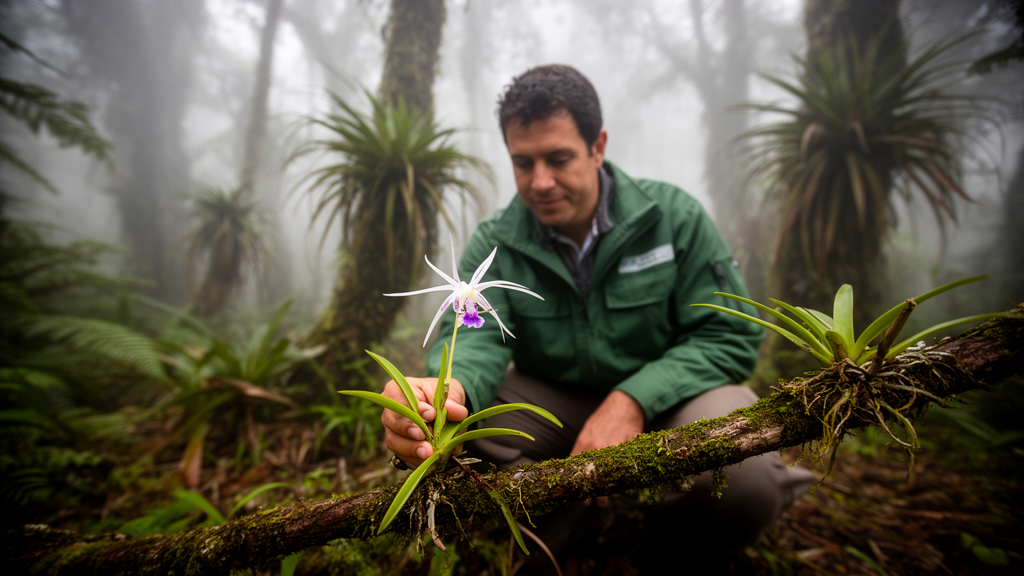
A newly described orchid species, Pleurothallis pembertonii, has been identified in the lower montane cloud forests of northwestern Ecuador, adding to the extraordinary botanical richness of the Tropical Andes Biodiversity Hotspot. The species, named in honor of biologist Robert Pemberton, was discovered within the Dracula Reserve, a privately protected area in the western Andean foothills of Carchi Province. This region is characterized by high levels of microendemism and increasing pressure from mining activities, making the discovery of such a narrowly distributed species particularly significant for conservation efforts. The new orchid belongs to the subgenus Pleurothallis, section Pleurothallis, subsection Acroniae, and series Amphigyae, a group known for its morphological complexity and taxonomic challenges.
The identification of Pleurothallis pembertonii highlights the ongoing difficulties in delimiting species within the Pleurothallidinae subfamily, where extensive morphological convergence often leads to confusion and misidentification. For years, specimens of this new species were misidentified as Pleurothallis forceps-cancri or P. amphigya in horticultural collections, online databases, and photographic records. This persistent taxonomic ambiguity underscores the need for rigorous, field-based taxonomic approaches that integrate morphological analysis with precise locality data. The new species is distinguished by its vinaceous, oblong-subsigmoid petals that are long-attenuate, and a sagittate-trilobed lip bearing a well-developed reniform glenion and two small divergent basal keels, features that remain stable across all examined individuals.
The discovery process involved a scientific expedition to the Dracula Reserve in 2022, where researchers documented the plant in situ using high-resolution photography and collected voucher specimens for herbarium deposition. The holotype specimen, collected at 1965 meters elevation, is deposited at the Ecuadorian National Herbarium under specific research permits. Additional paratypes were collected in 2024, further confirming the presence of the species in the reserve. To support detailed morphological analyses, floral material was preserved in ethanol and examined under a stereomicroscope, allowing for a comprehensive comparison with original descriptions and type material of morphologically similar species. A Lankester Composite Digital Plate was prepared to illustrate the diagnostic features of the new orchid, following standardized protocols for scientific documentation.
Morphologically, Pleurothallis pembertonii is an epiphytic, caespitose herb reaching up to 12 centimeters in height, with slender roots and terete ramicauls. The leaves are suberect, coriaceous, and elliptic-ovate, while the inflorescence consists of a single-flowered coflorescence surrounded by a papyraceous spathaceous bract. The flowers exhibit moderate variation in size and posture, with the dorsal sepal ranging from nearly straight to distinctly arcuate. However, the principal diagnostic characters, including the shape of the petals and the structure of the lip, remain consistent throughout the population. This stability in key morphological traits provides a reliable basis for distinguishing the new species from its close relatives in the series Amphigyae.
The habitat of Pleurothallis pembertonii is the Lower Montane Evergreen Forest of the Western Andes, an ecosystem characterized by high humidity, persistent cloud cover, and exceptional levels of plant endemism. This biogeographic transition zone between the Tropical Andes and the Chocó biogeographic region promotes high rates of diversification due to steep environmental gradients and historical isolation. The species occurs sympatrically with several other epiphytic orchids, including Dracula trigonopetala and various Lepanthes species, reflecting the high structural complexity and ecological stability of the forest. The presence of these specialized epiphytes underscores the importance of maintaining old-growth trees and stable humidity regimes for the survival of such narrow-endemic species.
Conservation concerns are paramount for Pleurothallis pembertonii, as its known distribution is extremely restricted to a single locality within the Dracula Reserve. The area of occupancy is estimated at just 4 square kilometers, placing the species in the Critically Endangered category under IUCN criteria. The primary threat to the orchid is the extensive overlap of its habitat with active and proposed mining concessions, which promote forest loss, fragmentation, and long-term alteration of the humid microclimatic conditions essential for epiphytic orchids. Land-use change in montane forests has been shown to cause severe declines in vascular epiphyte richness, particularly affecting species that depend on mature host trees. The omission of precise geographic coordinates in the published record is a deliberate measure to reduce collection pressure on this vulnerable population.
The case of Pleurothallis pembertonii illustrates a broader issue in the taxonomy of Neotropical orchids, where the international trade in plants has facilitated the circulation of undescribed taxa under misapplied names. Many species have entered commercial markets before formal taxonomic resolution, often lacking reliable locality data, which complicates conservation planning and threat assessments. When species are described without verifiable provenance, they remain invisible to spatial analyses and may be subject to unsustainable extraction from unknown or highly restricted wild populations. This highlights the urgent need for integrative taxonomic approaches that combine field observations with molecular phylogenetics to accurately delimit species and inform conservation strategies.
The discovery of this new orchid also emphasizes the critical role of private conservation initiatives in protecting biodiversity in the Tropical Andes. The Dracula Reserve, managed by Fundación EcoMinga, safeguards extensive tracts of well-preserved cloud forest that serve as refugia for numerous microendemic species. The occurrence of Pleurothallis pembertonii within this reserve demonstrates the effectiveness of such efforts in maintaining habitat continuity and protecting narrowly distributed epiphytic species. As environmental pressures continue to mount, the collaboration between scientists, conservation organizations, and local communities will be essential for preserving the unique flora of this region. The new species serves as a reminder of the hidden diversity that remains to be discovered and protected in the world’s most biodiverse ecosystems.
Future research on Pleurothallis pembertonii should focus on expanding the known distribution of the species and assessing its population dynamics in response to environmental changes. Continued monitoring of the Dracula Reserve will be crucial for detecting early signs of habitat degradation and implementing timely conservation interventions. Additionally, further taxonomic studies within the series Amphigyae may reveal additional cryptic species that have been overlooked due to morphological similarity. By addressing these gaps in knowledge, researchers can contribute to a more comprehensive understanding of orchid diversity in the Tropical Andes and develop more effective strategies for its conservation. The story of Pleurothallis pembertonii is a testament to the intricate balance between biodiversity, human activity, and the ongoing quest to document and protect the natural world.
Subject of Research: Pleurothallis pembertonii (Orchidaceae, Pleurothallidinae), a new species from northwestern Ecuador in the Tropical Andes Biodiversity Hotspot
Article Title: Pleurothallis pembertonii ( Orchidaceae , Pleurothallidinae ), a new species from northwestern Ecuador in the Tropical Andes Biodiversity Hotspot
Article References: Monteros, M. F., Holcomb, K., Baquero, L. E., & Wilson, M. (2026). Pleurothallis pembertonii (Orchidaceae, Pleurothallidinae), a new species from northwestern Ecuador in the Tropical Andes Biodiversity Hotspot. PhytoKeys, 276, 297-312. https://doi.org/10.3897/phytokeys.276.190930
Image Credits: AI Generated
DOI: 10.3897/phytokeys.276.190930
Keywords: Pleurothallis, pembertonii, Orchidaceae, Pleurothallidinae, species, northwestern, Ecuador, Tropical, Andes, Biodiversity, Hotspot, scientific research
Cite Scienmag News
Margaret Porter. (October 18, 2026). New Ecuador Orchid Species Revealed in Threatened Cloud Forests. Scienmag. https://scienmag.com/new-ecuador-orchid-species-revealed-in-threatened-cloud-forests/
Margaret Porter. "New Ecuador Orchid Species Revealed in Threatened Cloud Forests." Scienmag, 18 October 2026, https://scienmag.com/new-ecuador-orchid-species-revealed-in-threatened-cloud-forests/. Accessed 18 October 2026.
Margaret Porter. "New Ecuador Orchid Species Revealed in Threatened Cloud Forests." Scienmag. October 18, 2026. https://scienmag.com/new-ecuador-orchid-species-revealed-in-threatened-cloud-forests/


