


Across the cold deserts of the world, the ground between scattered plants is rarely bare. It is covered by a thin, living skin of mosses, lichens, cyanobacteria and fungi known as a biological soil crust, or biocrust. These inconspicuous communities, often only a few millimeters thick, have long been studied for their ability to stabilize soils, fix atmospheric carbon and nitrogen, and withstand some of the harshest conditions on Earth. A new long-term field study, published in Nature Geoscience and highlighted in a commentary by soil ecologist Angela Lafuente, reveals an unexpected and consequential role for these crusts: in cold desert environments, moss-dominated biocrusts substantially enhance the retention of snow, and in doing so sustain the biogeochemical machinery of the soil through the most challenging season of the year.
The finding matters because winter is not the dormant period it is often assumed to be. Beneath a blanket of snow, soils remain biologically active. Snow acts as an insulating layer, decoupling soil temperatures from frigid air temperatures and preventing the ground from freezing to depths that would kill or immobilize microbial communities. When snow lingers, microbes continue to decompose organic matter, respire carbon dioxide and transform nitrogen compounds at measurable rates throughout the cold season. In temperate and boreal forests, this winter-under-snow activity has been shown in earlier research to contribute a substantial fraction of annual carbon losses from soils. What the new study adds is evidence that in dryland systems — where snow is intermittent, thin and vulnerable — the presence or absence of a living soil surface can determine whether that insulating blanket persists at all.
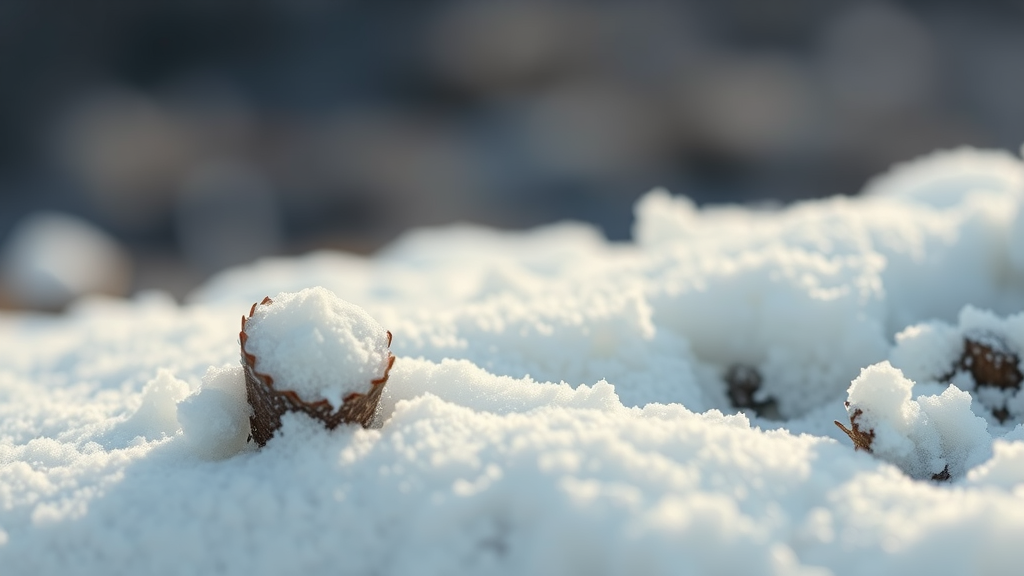
The research, led by Yuqing Cao, Bowker, Zhao, Chamizo, Delgado-Baquerizo and colleagues under the title ‘Moss biocrusts sustain snowpack and soil function in cold deserts’, draws on long-term field monitoring of how moss-dominated biocrust cover influences both the duration and the depth of snow cover. The authors document that surfaces clothed in moss biocrusts hold snow longer and maintain deeper snowpack than adjacent uncrusted ground. The mechanism is partly physical. Moss biocrusts create a rough, porous microtopography at the soil surface, with elevated tufts and hollows that trap drifting snow and reduce wind-driven sublimation and redistribution. In open cold deserts, where wind is a dominant agent of snow loss, this roughness effect can make the difference between a snowpack that survives weeks of winter and one that vanishes within days.
There is also a thermal dimension. By retaining snow, biocrusted surfaces maintain a more stable and generally milder soil temperature regime through winter. The snow layer itself acts as insulation, and beneath it the dark, structurally complex biocrust surface absorbs and redistributes energy differently than pale, bare sediment. The consequence, as the study and the accompanying commentary by Lafuente emphasize, is that microbial activity in the soil below biocrusts continues at meaningful levels during months when uncrusted soils may freeze solid. Soil biogeochemistry — the sum of decomposition, respiration, nutrient mineralization and microbial transformations — is thus sustained rather than suspended.
This sustained activity has direct implications for the carbon cycle of cold deserts. Drylands collectively store large reservoirs of organic carbon in their soils, and biocrusts themselves are significant contributors to those reservoirs, fixing carbon dioxide through photosynthesis during moist periods and delivering it to the soil as organic matter. Winter is a season in which the balance between carbon input and carbon loss is delicate. When snow insulates the surface, heterotrophic microbes respire stored carbon slowly but steadily; when snow is absent and soils freeze deeply, physical and biological processes change abruptly, and freeze-thaw cycles can release pulses of carbon dioxide and nitrous oxide while damaging microbial cells and destabilizing aggregates. By keeping snow on the ground, moss biocrusts appear to buffer these dynamics, maintaining conditions under which soil functions proceed in a more continuous, less perturbed fashion.
The broader context of this work is the well-documented vulnerability of snow cover in a warming climate. Satellite records and ground observations across the Northern Hemisphere have documented declining snowpack extent, depth and duration, and projections consistently indicate further losses as winters warm. Research on snow drought has shown that human-caused warming has already reduced snowpack in many mountain regions, and studies of radiative forcing by dust and dark particles on snow have long demonstrated how small changes at the snow surface can accelerate melt. What the new study makes clear is that snow loss in cold deserts is not only a story about climate and atmosphere; it is also a story about the ground surface itself. Losing biocrusts removes a biological mechanism of snow retention precisely when climatic change is already eroding snow cover from the other direction — a compounding of stresses that could accelerate the degradation of dryland soils.
Biocrusts are, in fact, among the most threatened surface communities on the planet. Syntheses of global change effects have documented their sensitivity to warming, altered precipitation, and especially physical disturbance from livestock trampling, off-road vehicles, energy development and human foot traffic. Recovery is slow: cyanobacteria-dominated crusts may re-form in years to decades, while moss and lichen communities characteristic of cooler, more stable drylands can require centuries. Global assessments estimate that a large fraction of the world’s biocrusted area is already degraded. The new findings give that loss an additional dimension of concern. If biocrust destruction shortens snow cover duration in cold deserts, it exposes soils to deeper freezing, suppresses winter microbial activity, and potentially diminishes the very carbon and nitrogen inputs on which dryland ecosystems depend — a feedback loop in which surface degradation and soil function decline reinforce one another.
The study also reframes how scientists and land managers should think about seasonality in drylands. Much biocrust research has focused on the growing and rainfall seasons, when crusts are photosynthetically active and most visible in their influence on erosion and nutrient cycling. The winter findings shift attention to a period that has been comparatively neglected in dryland research, in part because cold deserts sit at the intersection of two disciplines: snow hydrology, which has traditionally focused on forests, mountains and tundra, and dryland ecology, which has traditionally focused on heat and aridity. By demonstrating that the two domains are physically and biologically coupled through the soil surface community, the work argues for integrating biocrust cover into models of snow dynamics, soil frost and winter carbon flux in cold deserts — regions that include substantial areas of the intermountain western United States, central Asia and high-altitude plateaus.
Writing in Nature Geoscience, Lafuente situates the study within this larger agenda, noting that biocrusts can substantially enhance snow retention and thereby sustain soil biogeochemistry, microbial activity and soil ecosystem functions in cold deserts. The commentary, which accompanies the research under the title ‘Winter carbon cycling beneath biocrusts’, underscores that the findings emerge from a long-term field program — a point worth emphasizing, because capturing interannual variability in snow depth, snow duration and soil response requires years of patient measurement in environments that are logistically demanding to monitor. It is precisely this kind of sustained observation that allows the causal chain from surface cover, to snowpack persistence, to winter soil function to be traced with confidence.
The implications reach toward both conservation and climate science. For land managers in cold deserts, protecting biocrusts from trampling and disturbance acquires a new rationale that goes beyond erosion control: intact moss biocrusts are, in effect, natural snow-management infrastructure. For Earth system modelers, the study suggests that the representation of dryland winter processes is incomplete without a term for biological surface cover and its effect on snow retention and soil thermal regimes. And for carbon accounting, the message is that the winter months in cold deserts — long treated as a blank interval between growing seasons — host active, cover-dependent biogeochemistry that could shift substantially as both climate and land use change. A crust of mosses a few millimeters thick, the study shows, quietly governs whether the soil beneath it sleeps through winter or keeps working — and with it, whether carbon in cold desert ecosystems remains stored or begins to move.
Subject of Research: Influence of moss biocrusts on snow retention and winter soil carbon cycling in cold deserts
Article Title: Winter carbon cycling beneath biocrusts
Article References: Lafuente, A. (2026). Winter carbon cycling beneath biocrusts. Nature Geoscience, 19(9), 1004-1005. https://doi.org/10.1038/s41561-026-02084-0
Image Credits: AI Generated
DOI: 10.1038/s41561-026-02084-0
Keywords: biocrusts, cold deserts, snowpack, carbon cycle, soil biogeochemistry, microbial activity, moss, drylands, soil insulation, climate change, ecosystem ecology, Nature Geoscience
Cite Scienmag News
Morgan Morrow. (September 12, 2026). Tiny Desert Crusts Hold Winter Snow — and Carbon — in Place. Scienmag. https://scienmag.com/tiny-desert-crusts-hold-winter-snow-and-carbon-in-place/
Morgan Morrow. "Tiny Desert Crusts Hold Winter Snow — and Carbon — in Place." Scienmag, 12 September 2026, https://scienmag.com/tiny-desert-crusts-hold-winter-snow-and-carbon-in-place/. Accessed 4 October 2026.
Morgan Morrow. "Tiny Desert Crusts Hold Winter Snow — and Carbon — in Place." Scienmag. September 12, 2026. https://scienmag.com/tiny-desert-crusts-hold-winter-snow-and-carbon-in-place/


