


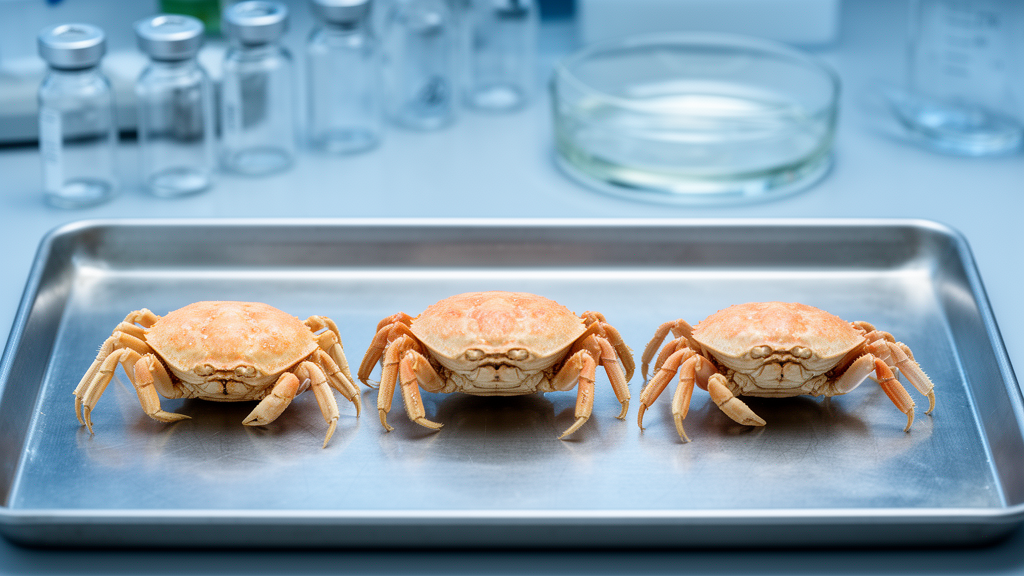
Marine scientists surveying the seabed of India’s exclusive economic zone have identified three previously unknown species of six-legged crabs, together marking the first records of the genera Mariaplax and Hexapinus from Indian waters. The tiny crustaceans were collected by the fishery oceanographic research vessel FORV Sagar Sampada during systematic exploratory cruises between 2015 and 2019, with two species hauled from the sandy shallows of the Arabian Sea off Kochi and one dredged from much deeper water off Tamil Nadu in the Bay of Bengal. The discovery, published in the journal ZooKeys, quietly reshapes what biologists thought they knew about the distribution of these elusive crabs in the Indian Ocean.
Hexapodid crabs are an odd bunch among brachyurans. Although they are true crabs in the family Hexapodidae, their name reflects the fact that the last pair of walking legs is reduced or absent, leaving them with only six visible ambulatory legs instead of the usual eight. They are small, delicate animals, often less than a centimetre across, and they typically live buried in soft sediments, sometimes in burrows shared with tube-dwelling worms. The Indo-West Pacific hexapodid fauna has been extensively revised in recent years, with 16 genera and 43 species currently recognised, but most of the recent taxa have been reported from the Pacific, with only a handful of records from the Indian Ocean.
Before this study, India could claim records for only two hexapodid genera with three species: Lambdophallus sexpes from the southwestern coast, Hexapus sexpes from the Bay of Bengal, and Hexapus bidentatus from the central-western coast. The new material, stored in the referral centre at the Centre for Marine Living Resources and Ecology in Kochi, doubles the generic diversity of the family in Indian waters overnight. The three new species are Mariaplax kochazhi, Mariaplax albucus, and Hexapinus clivus, each described and compared in detail with allied taxa from across the Indo-West Pacific.
Mariaplax kochazhi was collected off Kochi at a depth of 30 metres on a sandy bottom during cruise 343 in August 2015. The holotype is a male measuring just 5.5 by 3.5 millimetres, with paratypes including a female and a second male from the same grab sample. The species name honours its type locality, using the original Malayalam form Koch-azhi, meaning small sea. Kochi, historically known as the Queen of the Arabian Sea, now lends its name to a crab that is most similar to Mariaplax granulifera from Queensland, Australia, but can be distinguished by its proportionately wider carapace with larger granules on the dorsal surface, a pterygostomial region that is smooth with 5 to 7 striae, a rectangular ischium and more granulated merus of the third maxilliped, a subpentagonal male pleon telson, and a strongly curved S-shaped male first gonopod with a rounded distal tip.
The second new Mariaplax, M. albucus, was collected from the same station and cruise, with the holotype being a female of 6.2 by 3.5 millimetres. The species epithet derives from the Latin word albucus, meaning bulb of the lily, alluding to the bulging structure of the vulva that is diagnostic of the species. M. albucus is similar to M. sundaica, originally described from the Sunda Strait between Sumatra and Java, but can easily be differentiated by a carapace that is as wide as long rather than 1.7 times as long as wide, a pterygostomial region with 6 oblique striae, a relatively shorter and stouter fourth ambulatory leg merus that is 4.0 times wider than long, and the distinctive structure of the vulva. In M. albucus, the vulval operculum cover differs markedly from that of M. kochazhi, which is simple, rounded, and lacks a cover. Intriguingly, the male of M. albucus remains unknown, so the full suite of gonopod characters used to diagnose other species in the genus cannot yet be assessed for this species.
The third new species, Hexapinus clivus, was dredged from 433 metres off Tamil Nadu in the Bay of Bengal during cruise 392 in November 2019, with a juvenile female paratype recovered from trawl bycatch off the Shankarpur coast of West Bengal in March 2018. The name clivus is Latin for the sloping side of a mountain, referring to the gently sloping lateral margins of the fused first and second thoracic sternites, which form a subtriangular structure that is diagnostic of the species. H. clivus is morphologically close to the widely distributed H. simplex from the West Pacific, but it can easily be differentiated by weaker granulation on the carapace surface, a relatively shorter and stouter fourth ambulatory leg merus that is 2.5 times as long as wide, a proportionately wider male thoracic sternum with the fused sternites 1 and 2 being subtriangular with gently sloping lateral margins, and a semilunate vulva that is elevated and protruded, positioned adjacent to the suture between sternites 5 and 6.
The taxonomic detective work behind these descriptions relied on a battery of imaging and analytical techniques. Specimens were preserved in 5 percent formaldehyde before being transferred to 70 percent alcohol, photographed with a Leica S9i microscope, and illustrated using vector graphics in Adobe Illustrator. For scanning electron microscopy, specimens were cleaned manually with a soft brush in 70 percent alcohol, dehydrated in an ascending series of ethanol, and air-dried overnight in a desiccator before being mounted on silver stubs with carbon tabs. Micrographs were taken with an environmental SEM, a ZEISS EVO 15 with an extended-range cascade current detector set at 10 kilovolts. Notably, the specimens were not gold-coated, which is unusual for SEM work, allowing the material to be preserved in 90 percent alcohol and deposited in the museum after analysis rather than destroyed in the coating process.
The type specimens are deposited in the Bhavasagara Referral Centre, the national repository for reference collections of deep-sea fauna at CMLRE in Kochi, with comparative material retained in the Zoological Reference Collection of the Lee Kong Chian Natural History Museum at the National University of Singapore. The comparative material for H. clivus included specimens of H. simplex from Indonesia, Singapore, China, Hong Kong, and Japan, as well as photographs of the holotype of H. okinawa from Okinawa Island, described in 2025. The authors also flagged lingering uncertainty around Hexapus edwardsi, described from a single small subadult male from the Andaman Sea in 1976, noting that the male pleon as figured by Serène and Soh is unusual because somite 5 seems separate from fused somites 3 and 4, a condition atypical for the genus. Whether that figure is accurate will require re-examination of the specimen, and the authors concluded that H. clivus is clearly close to H. edwardsi but should be treated as a different species for the time being.
The discovery of three new species and two new generic records from Indian waters underscores how much of the region’s small-crustacean biodiversity remains undocumented, particularly in the poorly sampled soft sediments of the continental shelf and upper slope. The specimens came from routine grab and dredge sampling during fishery oceanographic surveys, suggesting that similar material may already sit unstudied in other reference collections across the Indo-West Pacific. With the genus Mariaplax now represented by 19 species and Hexapinus by eight, the Indian Ocean is beginning to catch up with the Pacific in hexapodid diversity, and the authors note that a tentative record of Hexapus granuliferus from the Andaman Sea by Serène and Soh in 1976 may actually belong to Mariaplax anfracta or even one of the new species described here, pending verification. For now, the sandy seabed off Kochi and the deep dredge sites off Tamil Nadu have yielded a reminder that even the most familiar coastlines can conceal crabs that science has never seen.
Subject of Research: Discovery of three new hexapodid crab species and first records of the genera Mariaplax and Hexapinus from Indian waters
Article Title: First records of the genera Mariaplax Rahayu & Ng, 2014 and Hexapinus Manning & Holthuis, 1981 from India, with descriptions of three new species ( Crustacea , Decapoda , Brachyura , Hexapodidae )
Article References: Prema, M., Cubelio, S. S., & Ng, P. K. L. (2026). First records of the genera Mariaplax Rahayu & Ng, 2014 and Hexapinus Manning & Holthuis, 1981 from India, with descriptions of three new species (Crustacea, Decapoda, Brachyura, Hexapodidae). ZooKeys, 1292, 349-372. https://doi.org/10.3897/zookeys.1292.204005
Image Credits: AI Generated
DOI: 10.3897/zookeys.1292.204005
Keywords: crabs, marine biology, taxonomy, new species, India, Arabian Sea, Bay of Bengal, hexapodidae, deep sea, biodiversity, First, records
Cite Scienmag News
Drew Townsend. (October 17, 2026). Three new six-legged crab species discovered in Indian waters. Scienmag. https://scienmag.com/three-new-six-legged-crab-species-discovered-in-indian-waters/
Drew Townsend. "Three new six-legged crab species discovered in Indian waters." Scienmag, 17 October 2026, https://scienmag.com/three-new-six-legged-crab-species-discovered-in-indian-waters/. Accessed 17 October 2026.
Drew Townsend. "Three new six-legged crab species discovered in Indian waters." Scienmag. October 17, 2026. https://scienmag.com/three-new-six-legged-crab-species-discovered-in-indian-waters/


