


Plant diseases can wipe out harvests long before farmers notice anything wrong, and spotting them reliably in the field has remained one of agriculture’s hardest computer vision problems. A research team led by Jipei Cao and Hanxiang Wang of Qufu Normal University, working with collaborators in China and Vietnam, has now introduced a detection framework called AgriEyeNet that tackles the two obstacles that have long frustrated existing algorithms: lesions on leaves that look confusingly similar to healthy tissue, and objects whose sizes and shapes vary wildly across real-world images. The work, published in October 2026 in the journal Applied Intelligence, describes both a new detection architecture and a new loss function designed to make training focus on the examples that matter most.
The challenge begins with the nature of the target. Crop disease symptoms rarely present themselves as clean, well-defined objects. A leaf spot may bleed gradually into healthy tissue, its boundary blurred by moisture, lighting, and the angle of the camera. Lesions of different diseases can look nearly identical to one another, while the same disease can appear dramatically different depending on the crop variety and the stage of infection. Standard object detectors, which excel at finding cars, pedestrians, and other sharply bounded objects, often struggle with this kind of ambiguity. The researchers argue that the problem is compounded by the datasets themselves: many existing collections of crop disease images contain samples that are inconsistent in quality, annotation style, and difficulty, which makes it hard for a detector to learn what actually distinguishes a diseased leaf from a healthy one.
To address the visual ambiguity, the team built a hybrid attention mechanism into the backbone of AgriEyeNet. The idea is to let the network weigh different kinds of visual information against one another, so that features useful for separating a lesion from healthy tissue are amplified while distracting background details are suppressed. Attention mechanisms of this kind have become a staple of modern computer vision, but the researchers combined them in a way intended specifically for the irregular, low-contrast boundaries that characterize plant disease symptoms. The result is a detector that can pick out subtle discolorations and texture changes that would otherwise be lost in the noise of a busy field image.
The second innovation addresses the geometry problem. Objects in agricultural scenes vary enormously in scale: a small early-stage lesion may occupy only a handful of pixels, while a large blighted region can span most of a leaf. Conventional detection heads, which predict bounding boxes at fixed scales, often fail to adapt to this variability. AgriEyeNet instead uses what the researchers call a slim dynamic head, a lightweight module that adjusts its receptive field and sampling strategy depending on the size and shape of the object it is examining. This adaptability allows the same network to handle both tiny specks and sprawling lesions without requiring separate models or heavy computational overhead, an important consideration for deployment on the modest hardware available in many farming operations.
Perhaps the most original contribution, however, is a new classification loss function the team calls medium-difficulty aware loss. In standard training, a detector learns from every example in the dataset, but the researchers observed that this approach wastes capacity on two extremes. Very easy examples, which the network already classifies correctly, contribute little new information during training. Very hard examples, which may be mislabeled, ambiguous, or simply uninformative, can dominate the gradient and pull the model in unproductive directions. The examples that offer the greatest training value, the team argues, are those of medium difficulty: images that the network gets partially right, where the gradient still carries meaningful signal about what separates a lesion from healthy tissue. The new loss function dynamically down-weights both extremes and concentrates the learning process on this productive middle ground.
The researchers validated their approach on a large collection of crop disease images, comparing AgriEyeNet against a range of established object detection frameworks. According to the paper, the model achieved higher detection accuracy than competing methods while maintaining a computational footprint light enough for practical field deployment. The improvements were particularly pronounced on the hardest categories, where lesions are small, irregular, or visually similar to healthy tissue, suggesting that the combination of hybrid attention and the dynamic head is doing exactly what the team intended.
The work also contributes a new dataset. The researchers assembled a large-scale collection of crop disease images designed to be more consistent and more challenging than existing alternatives, with careful attention to annotation quality and difficulty balance. They have made the dataset publicly available, along with the model code, in the hope that other teams will use it to benchmark future detectors. This kind of open contribution is increasingly seen as essential for progress in agricultural AI, where the scarcity of high-quality, well-annotated data has long been a bottleneck.
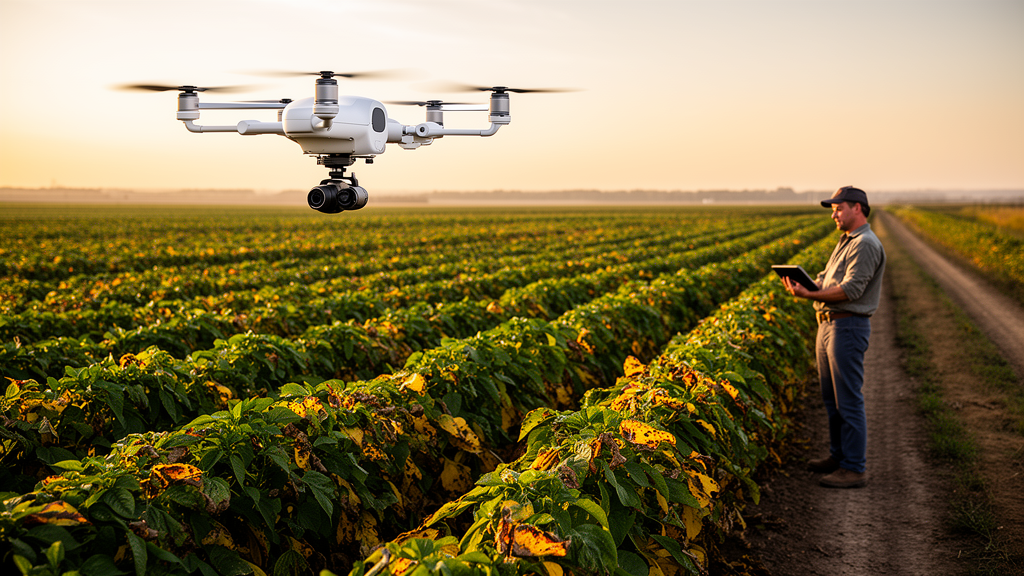
The implications extend beyond the laboratory. A detector light enough to run on modest hardware could be integrated into smartphone applications, drone-based survey systems, or fixed camera installations in greenhouses and orchards. Farmers could photograph a suspicious leaf and receive an immediate assessment, or drones could sweep entire fields and flag outbreaks before they spread. Early detection is one of the most effective tools for limiting crop losses, and the researchers argue that making such tools accessible to smallholder farmers, who often lack the resources for professional plant pathology services, is a central goal of the work.
The team acknowledges that challenges remain. Field conditions are far messier than curated datasets: lighting varies, leaves overlap, and diseases can present atypical symptoms depending on the crop and the environment. The researchers note that future work will need to test the framework across a wider range of crops, climates, and imaging conditions, and that integrating AgriEyeNet with other precision agriculture tools, such as yield prediction and irrigation optimization, could amplify its impact. They also point out that the medium-difficulty aware loss may prove useful beyond agriculture, in any detection task where the training data contains a mix of easy, hard, and ambiguous examples.
For now, the work stands as a careful piece of engineering aimed at a problem with enormous practical stakes. By combining hybrid attention, a slim dynamic head, and a loss function that concentrates learning on the most informative examples, the researchers have built a detector that is both more accurate and more adaptable than its predecessors. The open release of the model and dataset offers a foundation that other teams can build upon, and the framework’s light computational footprint brings the vision of accessible, real-time crop disease detection a step closer to the fields where it is needed most.
Subject of Research: AI-based crop disease detection using object detection architectures and loss function design
Article Title: AgriEyeNet: Seeing smarter in agriculture with medium-difficulty aware loss and lightweight adaptive detection
Article References: Cao, J., Wang, H., Ma, M., Li, Y., Qiu, D., Chen, Y., Nguyen, T. N., & Dang, L. M. (2026). AgriEyeNet: Seeing smarter in agriculture with medium-difficulty aware loss and lightweight adaptive detection. Applied Intelligence, 56(16), Article 502. https://doi.org/10.1007/s10489-026-07550-1
Image Credits: AI Generated
DOI: 10.1007/s10489-026-07550-1
Keywords: crop disease detection, object detection, attention mechanism, loss function, precision agriculture, computer vision, deep learning, Applied Intelligence, AgriEyeNet, Seeing, smarter, agriculture
Cite Scienmag News
Alan Morgan. (October 17, 2026). New AI Model Spots Crop Diseases With Unusual Accuracy in Complex Fields. Scienmag. https://scienmag.com/new-ai-model-spots-crop-diseases-with-unusual-accuracy-in-complex-fields/
Alan Morgan. "New AI Model Spots Crop Diseases With Unusual Accuracy in Complex Fields." Scienmag, 17 October 2026, https://scienmag.com/new-ai-model-spots-crop-diseases-with-unusual-accuracy-in-complex-fields/. Accessed 17 October 2026.
Alan Morgan. "New AI Model Spots Crop Diseases With Unusual Accuracy in Complex Fields." Scienmag. October 17, 2026. https://scienmag.com/new-ai-model-spots-crop-diseases-with-unusual-accuracy-in-complex-fields/


