


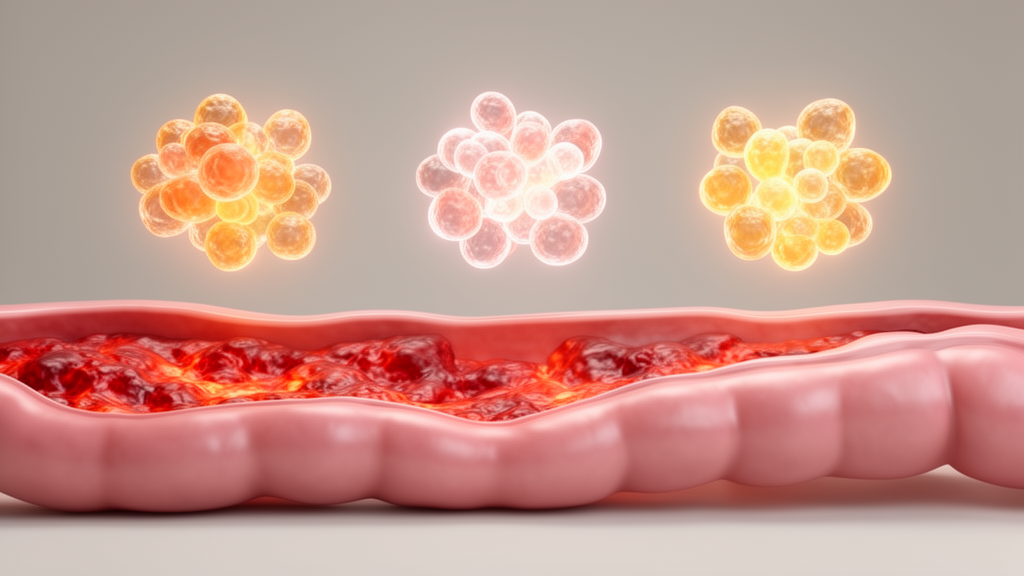
Researchers have identified three recurring gene-expression patterns in the intestinal lining of people with ulcerative colitis that are present before treatment begins, and these baseline molecular profiles track closely with how patients subsequently respond to biologic therapies. In an integrative reanalysis published in Frontiers in Pharmacology, Wen-biao Chen and Shiyong Zeng of Quanzhou Medical College pooled endpoint-linked baseline mucosal transcriptomes from seven public Gene Expression Omnibus series, covering 778 unique baseline samples, with three additional public accessions used for disease-activity and contextual analyses. Their stated goal was to establish a biologic-agnostic molecular baseline, because previously proposed transcriptomic signatures have frequently failed to transfer across cohorts due to platform heterogeneity, differences in endpoints and timepoints, and drug-specific biases.
The team applied unsupervised decomposition to the baseline gene-expression data and identified three endotypes. One, labeled EPITHELIAL_BARRIER, is dominated by epithelial barrier programs; the other two, MACROPHAGE_INFLAMMATION and LYMPHOID_COMPLEMENT_STROMAL, reflect macrophage-driven inflammatory activity and lymphoid, complement, and stromal axis activity respectively. The primary response and healing synthesis drew on five study slices spanning cohorts treated with anti-TNF agents, anti-integrin therapy, and etrolizumab.
For each cohort, the authors estimated the association between endotype scores and outcome as an odds ratio per one-standard-deviation increase, then summarized the estimates by random-effects cross-cohort pooling with heterogeneity reporting, rank and seed sensitivity analyses, endpoint-restricted summaries, and negative controls. The results were consistent in direction across the pooled slices. The epithelial barrier endotype was associated with higher odds of response or healing, with a random-effects pooled odds ratio of 3.171 (95% CI 1.491 to 6.744).
In contrast, the macrophage-inflammation endotype was associated with lower odds of response or healing (OR 0.359, 95% CI 0.175 to 0.735), as was the lymphoid-complement-stromal endotype (OR 0.378, 95% CI 0.220 to 0.651). The epithelial estimate was largest in the GSE73661 cohort, but the association remained significant in the five-study leave-one-out summary after that cohort was excluded, yielding an odds ratio of 2.547 (95% CI 1.271 to 5.105). This sensitivity check indicates that the pooled epithelial signal was not driven by a single dataset.
To test whether the endotypes generalize across different mechanisms of action, the researchers evaluated the UNIFI trial's ustekinumab arm at week 8 for mucosal healing, which included 358 patients in the treatment arm. There, the epithelial barrier endotype showed an even stronger association with mucosal healing (OR 4.483, 95% CI 2.263 to 8.881), and the etrolizumab cohorts showed directionally consistent effects. Independent support came from single-cell localization analyses, which confirmed that the endotype axes were spatially anchored in specific mucosal cell populations with a false discovery rate of 0.0026.
Together, these orthogonal lines of evidence suggest that the endotypes reflect genuine biological structure in the inflamed mucosa rather than artifacts of any single microarray platform or drug class. The authors are careful about what the study does not establish. Formal treatment-interaction tests were statistically imprecise and did not demonstrate drug-class-specific prediction, meaning the endotypes should be viewed as general outcome stratifiers rather than validated predictors of response to any particular biologic.
In cohort-held-out prediction, the area under the receiver operating characteristic curve ranged from 0.717 to 0.758, a moderate level of discrimination, but calibration was variable across cohorts. A network-based therapeutic prioritization analysis was enriched for ulcerative colitis-approved agents (AUC 0.741, permutation p = 6.0 x 10^-4), but the authors present it explicitly as hypothesis-generating rather than as a validated drug-selection tool. The practical implication is that a simple molecular snapshot of the colonic mucosa, taken before any therapy starts, may help clinicians and trial designers anticipate which patients are likely to achieve mucosal healing regardless of which biologic class is used.
Because the analysis relied entirely on public cohorts with heterogeneous platforms and endpoints, the authors emphasize that the endotypes now require prospective evaluation as biologic-agnostic outcome stratifiers.
Subject of Research: Baseline mucosal transcriptomic endotypes as biologic-agnostic stratifiers of healing and biologic therapy outcomes in ulcerative colitis
Article Title: Baseline mucosal transcriptomic endotypes stratify healing capacity and biologic therapy outcomes in ulcerative colitis: an integrative multi-cohort study
Article References: Chen, W., & Zeng, S. (2026). Baseline mucosal transcriptomic endotypes stratify healing capacity and biologic therapy outcomes in ulcerative colitis: an integrative multi-cohort study. Frontiers in Pharmacology, 17, Article 1931118. https://doi.org/10.3389/fphar.2026.1931118
Image Credits: AI Generated
DOI: 10.3389/fphar.2026.1931118
Keywords: ulcerative colitis, transcriptomics, endotypes, mucosal healing, biologic therapy, biomarkers, gastroenterology, Baseline, mucosal, transcriptomic, stratify, healing
Cite Scienmag News
Juliet Wilcox. (October 26, 2026). Three Baseline Gene-Expression Endotypes Track With Healing in Ulcerative Colitis. Scienmag. https://scienmag.com/three-baseline-gene-expression-endotypes-track-with-healing-in-ulcerative-colitis/
Juliet Wilcox. "Three Baseline Gene-Expression Endotypes Track With Healing in Ulcerative Colitis." Scienmag, 26 October 2026, https://scienmag.com/three-baseline-gene-expression-endotypes-track-with-healing-in-ulcerative-colitis/. Accessed 26 October 2026.
Juliet Wilcox. "Three Baseline Gene-Expression Endotypes Track With Healing in Ulcerative Colitis." Scienmag. October 26, 2026. https://scienmag.com/three-baseline-gene-expression-endotypes-track-with-healing-in-ulcerative-colitis/


