


Daya Bay is a representative semi-enclosed bay in the South China Sea, with a variety of ecosystems including mangroves, coral reefs, shelves, estuaries, salt marshes and quagmires. It is an important spawning ground, feeding ground and germplasm bank of main economic fish in the South China Sea. However, with the combined effects of multiple stressors such as human activities and climate change, especially environmental pollution, overfishing, and habitat fragmentation, fish resources in Daya Bay are in a state of decline. However, long-term variation in fish community structure in this Bay remains uncertain.

Credit: Jinfa Zhao
Daya Bay is a representative semi-enclosed bay in the South China Sea, with a variety of ecosystems including mangroves, coral reefs, shelves, estuaries, salt marshes and quagmires. It is an important spawning ground, feeding ground and germplasm bank of main economic fish in the South China Sea. However, with the combined effects of multiple stressors such as human activities and climate change, especially environmental pollution, overfishing, and habitat fragmentation, fish resources in Daya Bay are in a state of decline. However, long-term variation in fish community structure in this Bay remains uncertain.
To address this knowledge gap, we assessed the long-term changes in fish species composition, community structure, body size and important species by reviewing and analyzing fishery resources survey data and historical data in Daya Bay from the past 30 years (1989–2021).
The bottom trawl surveys were conducted by the South China Sea Fisheries Research Institute of the Chinese Academy of Fishery Sciences in years 1989-1992, 2002-2005, 2007-2008, 2015-2016, and 2019-2021 in Daya Bay. In addition, to improve the comprehensiveness and accuracy of the data, we conducted an extensive search of historical information on fish research in Daya Bay, including published literature, regional catalogues, reports and monographs.
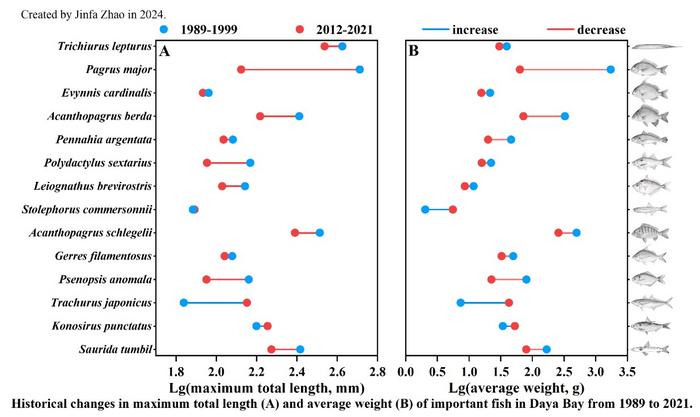
The findings revealed that a total of 544 species of fish were identified in the Bay, belonging to 24 orders and 125 families. Notably, the structure of the fish community in the bay has changed over time. First, there has been a clear decrease in the number of species and biomass of large fish. Second, the number of fish constituent orders and families has decreased. Moreover, both the average taxonomic distinctness and variation in taxonomic distinctness decreased from 1989–2021. Third, there is low similarity among fishes at different time phases and distinct changes in the composition of dominant species.
In general, the present results, published in Water Biology and Security, indicate that the fish community structure in Daya Bay has tended to reflect a decline in diversity, shifts in composition, and shrinking of fish body size in the past three deacdes. This study improves our understanding of fish species composition and its drivers over time in Daya Bay, providing important knowledge to support the protection and restoration of this ecosystem and the important ecosystem services it provides.
###
Contact the author: Contact author name: Teng Wang, Yong Liu;Affiliation: South China Sea Fisheries Research Institute, Chinese Academy of Fishery Sciences;Email address: wt3074589@163.com (TW); liuyong@scsfri.ac.cn (YL)
The publisher KeAi was established by Elsevier and China Science Publishing & Media Ltd to unfold quality research globally. In 2013, our focus shifted to open access publishing. We now proudly publish more than 100 world-class, open access, English language journals, spanning all scientific disciplines. Many of these are titles we publish in partnership with prestigious societies and academic institutions, such as the National Natural Science Foundation of China (NSFC).
Journal
Water Biology and Security
Method of Research
Survey
Subject of Research
Animals
Article Title
Thirty years of change: Assessing the dynamics of fish communities in Daya Bay, a semi-enclosed coastal ecosystem of the South China sea
COI Statement
The authors declare no conflict of interest.
Cite Scienmag News
Violet Maxwell. (June 25, 2024). Thirty years of change of fish communities in South China Sea. Scienmag. https://scienmag.com/thirty-years-of-change-of-fish-communities-in-south-china-sea/
Violet Maxwell. "Thirty years of change of fish communities in South China Sea." Scienmag, 25 June 2024, https://scienmag.com/thirty-years-of-change-of-fish-communities-in-south-china-sea/. Accessed 4 September 2026.
Violet Maxwell. "Thirty years of change of fish communities in South China Sea." Scienmag. June 25, 2024. https://scienmag.com/thirty-years-of-change-of-fish-communities-in-south-china-sea/

