


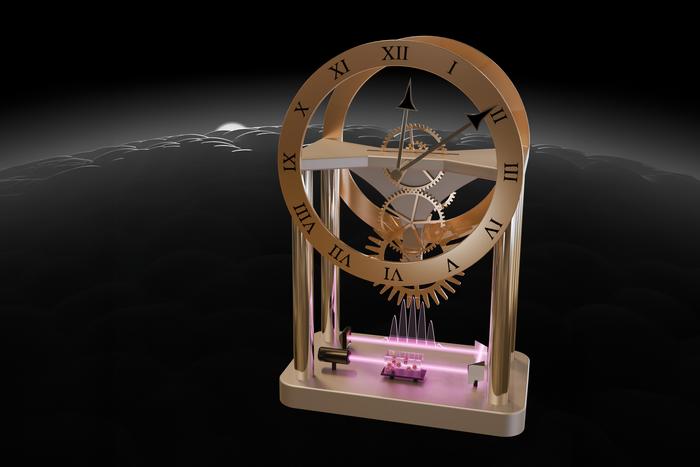
For many years, scientists all around the world have been working towards this goal, now suddenly things are happening very fast: it was only in April that a team led by Prof Thorsten Schumm (TU Wien, Vienna) announced a major success. For the first time, an atomic nucleus had been switched from one state to another using a laser – an effect that can be used for high-precision measurements. Now, just a few weeks later, this thorium transition was successfully applied in practice: TU Wien and JILA/NIST (USA) succeeded in combining a high-precision optical atomic clock with a high-energy laser system and successfully coupled it with a crystal containing thorium atomic nuclei. The thorium atomic nuclei can now be used as a time keeping device, making the clock even more precise – it is the world’s first nuclear clock.

Credit: Oliver Diekmann, TU Wien
For many years, scientists all around the world have been working towards this goal, now suddenly things are happening very fast: it was only in April that a team led by Prof Thorsten Schumm (TU Wien, Vienna) announced a major success. For the first time, an atomic nucleus had been switched from one state to another using a laser – an effect that can be used for high-precision measurements. Now, just a few weeks later, this thorium transition was successfully applied in practice: TU Wien and JILA/NIST (USA) succeeded in combining a high-precision optical atomic clock with a high-energy laser system and successfully coupled it with a crystal containing thorium atomic nuclei. The thorium atomic nuclei can now be used as a time keeping device, making the clock even more precise – it is the world’s first nuclear clock.
It does not yet deliver greater precision than an ordinary atomic clock, but that was not the aim in this first step. “With this first prototype, we have proven: Thorium can be used as a timekeeper for ultra-high-precision measurements. All that is left to do is technical development work, with no more major obstacles to be expected,” says Thorsten Schumm. The first nuclear clock has now been presented in the journal Nature.
The ticking of a laser beam
Every clock needs a timekeeper – for example the regular swinging motion of the pendulum in a pendulum clock. Today, high precision clocks use the oscillation of electromagnetic waves for this purpose; the oscillations of a laser beam are counted to measure time intervals. However, the frequency of a laser can change slightly over time, and so its frequency has to be to be readjusted.
“That’s why, in addition to the laser, you need a quantum system that reacts extremely selectively to a very specific laser frequency,” explains Thorsten Schumm (TU Wien). This could be caesium or strontium atoms, for example. When they are hit with laser light of a very specific frequency, the electrons of these atoms switch back and forth between two quantum states, and this can be measured. If the laser frequency changes, it no longer matches the natural frequency of the atoms exactly and the atoms are no longer excited as efficiently. In that case, the laser has to be readjusted. This technique makes it possible to keep the laser frequency extremely stable – this is the basic principle of an atomic clock.
From the atomic clock to the nuclear clock
However, an intriguing idea has been around for decades: if this trick could be performed not with an atom, but with an atomic nucleus, even greater precision would be possible. Atomic nuclei are much smaller than atoms and react much less strongly to disturbances, such as electromagnetic fields from outside. The only problem was that switching atomic nuclei back and forth between two states normally requires at least a thousand times more energy than the photons of a laser have.
The only known exception is thorium: “Thorium nuclei have two states of very similar energy, so you can switch them with lasers,” says Thorsten Schumm. “But for this to work, you have to know the energy difference between these two states very precisely. For many years, research teams around the world had been searching for the exact value of this energy difference in order to be able to switch thorium nuclei in a targeted manner – we were the first to succeeded, this is the result we published in April.”
An “optical gearbox” and the frequency comb
The atomic clock at JILA (a research institute of NIST and the University of Boulder, USA) has now been successfully coupled with thorium atomic nuclei. This required a few physical tricks: “The atomic clock works with laser light in the infrared range, which is used to excite strontium atoms. However, our thorium atomic nuclei need radiation in the UV range,” explains Thorsten Schumm. “We therefore need a way to turn infrared frequencies to UV frequencies, similar to a mechanical transmission that turns a slow rotational frequency into a faster rotation using suitable gears.”
Ultra-short infrared laser pulses consisting of a series of different infrared frequencies were used for this purpose. The distance between two neighboring frequencies is always the same, just like the distance between neighboring teeth of a comb, which is why this is also referred to as a “frequency comb”. This frequency comb of infrared light hits a xenon gas, the xenon atoms then react to the infrared light by producing UV light in a very precisely predictable way. This UV light is then sent onto a tiny crystal containing thorium nuclei. “This crystal is the central element of the experiment,” says Thorsten Schumm. “It was produced at TU Wien, in Vienna, and several years of development work were required to develop the necessary expertise.”
The coupling of these elements worked well – the result is the world’s first nuclear clock. This first prototype does not yet deliver an increase in precision, but that had never been intended. “Our aim was to develop a new technology. Once it’s there, the increase in quality comes naturally, that has always been the case,” says Thorsten Schumm. “The first cars weren’t any faster than carriages. It was all about introducing a new concept. And that’s exactly what we’ve now achieved with the nuclear clock.”
Record precision
This also made it possible to measure the energy of the thorium states with extreme precision, orders of magnitude higher than before. “When we excited the transition for the first time, we were able to determine the frequency to within a few gigahertz. That was already more than a factor of a thousand better than anything known before. Now, however, we have precision in the kilohertz range – which is again a million times better,” says Thorsten Schumm. “That way, we expect to overtake the best atomic clocks in 2-3 years.”
This technology should not only enable significantly more precise time measurements than previous clocks, but other physical quantities should also be able to be measured more precisely in the future. In many areas of research, from geology to astrophysics, thorium technology could deliver important advances. This extreme precision could now for example be used to study the fundamental laws of nature and investigate whether the constants of nature are perhaps not perfectly constant at all, but possibly change in space and time.
Journal
Nature
Method of Research
Experimental study
Subject of Research
Not applicable
Article Title
Frequency ratio of the 229mTh isomeric transition and the 87Sr atomic clock
Article Publication Date
4-Sep-2024
Cite Scienmag News
Denise Maddox. (September 4, 2024). The world’s first nuclear clock. Scienmag. https://scienmag.com/the-worlds-first-nuclear-clock/
Denise Maddox. "The world’s first nuclear clock." Scienmag, 4 September 2024, https://scienmag.com/the-worlds-first-nuclear-clock/. Accessed 3 September 2026.
Denise Maddox. "The world’s first nuclear clock." Scienmag. September 4, 2024. https://scienmag.com/the-worlds-first-nuclear-clock/

