


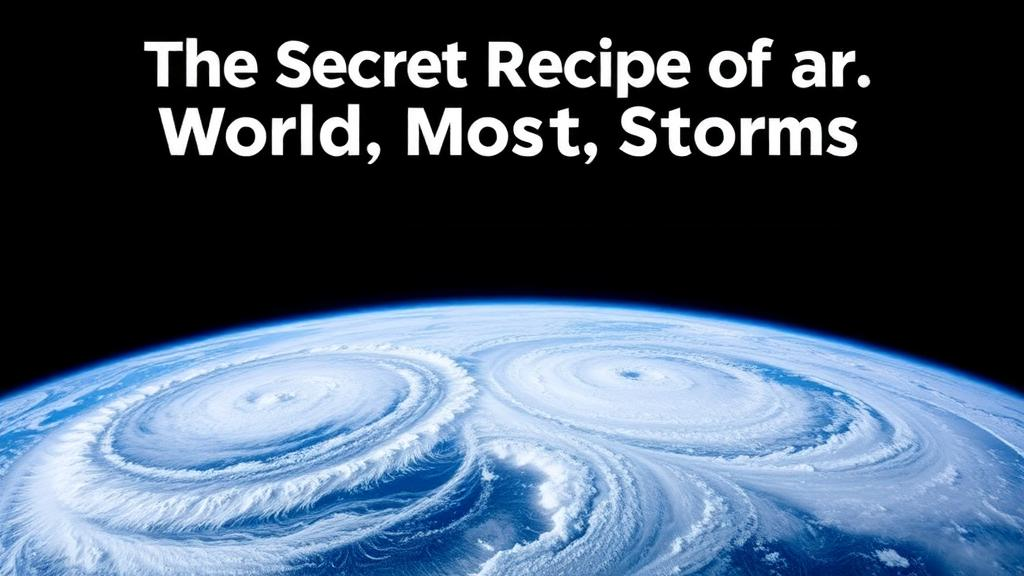
The fiercest winter windstorms on Earth share a hidden signature that spans the entire globe, according to a new study that compared the most extreme storms in the North Atlantic, North Pacific and Southern Ocean. By dissecting the 100 most violent surface wind events in each of these three storm track basins, researchers at Stockholm University and Uppsala University have found that the deadliest cyclones almost never form in isolation. Instead, they are typically born alongside a pre-existing storm already churning downstream, and the faster the new storm intensifies, the harder the winds it unleashes.
The study, published in the journal Weather and Climate Dynamics by Aleksa Stanković, Rodrigo Caballero and Gabriele Messori, tackles a long-standing puzzle in atmospheric science. By most bulk measures, such as zonally averaged eddy kinetic energy or median annual surface winds, the Southern Ocean is the stormier hemisphere. Its vast, unbroken expanse of water, largely free of continental barriers, allows storms to circle the planet with little interference. Yet when it comes to the extremes, the picture flips: the strongest surface winds consistently occur over the Northern Hemisphere oceans, and above all over the North Atlantic. Understanding why the hemisphere with the calmer average winds produces the fiercest storms is essential for improving projections of how wind extremes will change as the climate warms.
To answer the question, the team turned to ERA5, the most advanced atmospheric reanalysis produced by the European Centre for Medium-Range Weather Forecasts, which blends observations with a numerical weather model to create a physically consistent record of the atmosphere. The researchers focused on the winter months, December through February in the Northern Hemisphere and June through August in the Southern Hemisphere, when cyclones in both hemispheres reach their peak intensity. They restricted their analysis to the satellite era beginning in 1979, because satellite observations are crucial for reliably capturing the sparsely monitored Southern Ocean, and extended the record through 2020.
Identifying the top 100 extremes in each basin required a careful, two-step procedure. First, the team defined storm tracks as regions where the annual 98th percentile of daily maximum surface wind speed exceeds 18 metres per second, a criterion that isolates three comparable basins: the North Atlantic, the North Pacific and the Southern Ocean. Areas within 300 kilometres of the coasts of Greenland and Antarctica were excluded, since the ferocious winds there arise mainly from small-scale katabatic and barrier processes rather than the large-scale cyclone dynamics of interest. Then, for every winter day, the researchers computed a wind severity index over contiguous footprints of extreme winds. The index, widely used in insurance loss modelling, scales with the cube of the wind speed relative to the local climatological threshold, a choice with physical grounding because the cube of wind speed represents the flux of kinetic energy. The 100 days with the highest severity in each basin defined the top 100 extremes, and each event was linked to the nearest objectively tracked cyclone centre.
The heart of the analysis is a time-lagged composite technique. Rather than examining storms one by one, the researchers averaged the atmospheric fields of all 100 extreme events in each basin, aligning them by the location of the cyclone centre and the time of maximum surface winds. Because lines of latitude converge toward the poles, the fields were regridded onto radial grids centred on each storm. Statistical significance was assessed by generating 100 random composites for each basin, in which the real cyclone locations were paired with randomly chosen winter dates, yielding 10,000 random samples, with anomalies accepted as significant only after correction for false discovery.
The composites revealed a strikingly consistent large-scale recipe. A few days before the peak winds, a pre-existing cyclone is already present downstream, situated poleward and eastward of the developing extreme storm. The young cyclone begins as a weak, spatially limited pressure anomaly that grows in size and intensity as it approaches its older neighbour. By the time of maximum winds, the two systems merge into a broad area of low sea-level pressure. In fact, roughly half of the top 100 extremes in each basin, 49 in the North Atlantic, 53 in the North Pacific and 56 in the Southern Ocean, were formally classified as multi-centre cyclones by the tracking algorithm around the time of peak winds. The pre-existing storm is not a passive bystander: it advects high potential vorticity air equatorward, sharpening the upper-level potential vorticity gradients and strengthening the jet streak, the narrow band of ferocious winds near the tropopause, within which the new storm develops and crosses the jet.
Where the hemispheres diverge is in the numbers, not the narrative. Northern Hemisphere extremes develop under stronger upper-level potential vorticity gradients, more powerful jet streaks and broader regions of high mid-tropospheric Eady growth rate, a classical measure of how rapidly baroclinic instabilities amplify in a sheared, stratified atmosphere. Higher Eady growth rates signal a greater potential for rapid intensification, and the observations bear this out dramatically. The rate at which eddy kinetic energy rises in the two days before peak winds is far greater in the Northern Hemisphere, and explosively deepening storms, those whose central pressure falls by more than 24 hectopascals in 24 hours, account for 69 percent of North Atlantic and 75 percent of North Pacific extremes but only 38 percent of Southern Ocean ones. Since vertical wind shear below the jet is the main driver of the hemispheric difference in growth rates, the stronger jets of the Northern Hemisphere, reinforced by the pre-existing downstream cyclones, emerge as the key to the hemisphere’s more violent wind extremes.
To test whether these dynamical differences trace back to the underlying geography of each basin, the team ran sensitivity experiments with ISCA, an open-source intermediate-complexity climate model developed at the University of Oxford and collaborators. Encouragingly, even at the coarse T42 resolution used, ISCA reproduced both the hemispheric asymmetry in extreme winds and the correct ranking of basins, with the North Atlantic strongest, followed by the North Pacific and the Southern Ocean. This suggests the asymmetry is driven primarily by large- and planetary-scale processes rather than by fine-scale features the model cannot resolve. The researchers then systematically altered the model’s boundary conditions across 11 experiments, comparing a realistic control configuration with setups in which sea-surface temperatures were smeared into zonal bands, made hemispherically symmetric, and combined with a planet stripped of mountains.
The results were remarkably clean. When sea-surface temperatures were zonalized across the tropics and extratropics, the difference in extreme winds between the North Atlantic and North Pacific nearly vanished, shrinking by 82 percent, as warming spread over the Pacific storm track and cooling weakened the Atlantic jet. Removing the interhemispheric contrast in sea-surface temperatures and flattening the orography reduced the Atlantic–Southern Ocean asymmetry by 83 percent, through a combination of weaker Atlantic extremes and stronger Southern Ocean ones. Across all experiments and basins, the winter 98th percentile of mid-tropospheric Eady growth rate correlated with the 98th percentile of surface wind speed with a Pearson coefficient of 0.97, significant at the 1 percent level. In other words, one number, the potential for storms to grow quickly, largely determines how extreme the winds can become, regardless of which ocean they form over.
The study comes with honest caveats. The focus on large scales leaves out mesoscale and boundary-layer processes that can contribute to surface wind extremes, and the analysis deliberately set aside the detailed mechanics of cyclone merging and storm–storm interaction. ISCA, lacking a realistic representation of clouds, could not reproduce the pre-existing downstream cyclone in the evolution of its own most extreme individual storms, even though it captured the climatological relationship between growth rates and winds. Still, the broader message stands: the recipe for the planet’s most extreme oceanic windstorms is written once and applied everywhere, with a helper storm downstream, a strong jet overhead and a fast-deepening cyclone at the centre. The only thing that varies between hemispheres is how generously the ocean basins supply the ingredients, a conclusion that should help sharpen both weather forecasting and the climate models on which future windstorm projections depend.
Subject of Research: Large-scale dynamics of extreme surface winds in extratropical cyclones across the Northern and Southern Hemisphere storm tracks
Article Title: Interhemispheric perspective on the most extreme surface winds in the storm tracks
Article References: Stanković, A., Caballero, R., & Messori, G. (2026). Interhemispheric perspective on the most extreme surface winds in the storm tracks. Weather and Climate Dynamics, 7(3), 1507-1523. https://doi.org/10.5194/wcd-7-1507-2026
Image Credits: AI Generated
Keywords: extratropical cyclones, storm tracks, extreme winds, Eady growth rate, ERA5 reanalysis, jet stream, potential vorticity, Southern Ocean, North Atlantic, North Pacific, ISCA climate model, explosive cyclogenesis
Cite Scienmag News
Russell Cooper. (October 10, 2026). The Secret Recipe of the World’s Most Violent Storms: It Takes Two Cyclones to Make a Monster. Scienmag. https://scienmag.com/the-secret-recipe-of-the-worlds-most-violent-storms-it-takes-two-cyclones-to-make-a-monster/
Russell Cooper. "The Secret Recipe of the World’s Most Violent Storms: It Takes Two Cyclones to Make a Monster." Scienmag, 10 October 2026, https://scienmag.com/the-secret-recipe-of-the-worlds-most-violent-storms-it-takes-two-cyclones-to-make-a-monster/. Accessed 10 October 2026.
Russell Cooper. "The Secret Recipe of the World’s Most Violent Storms: It Takes Two Cyclones to Make a Monster." Scienmag. October 10, 2026. https://scienmag.com/the-secret-recipe-of-the-worlds-most-violent-storms-it-takes-two-cyclones-to-make-a-monster/


