


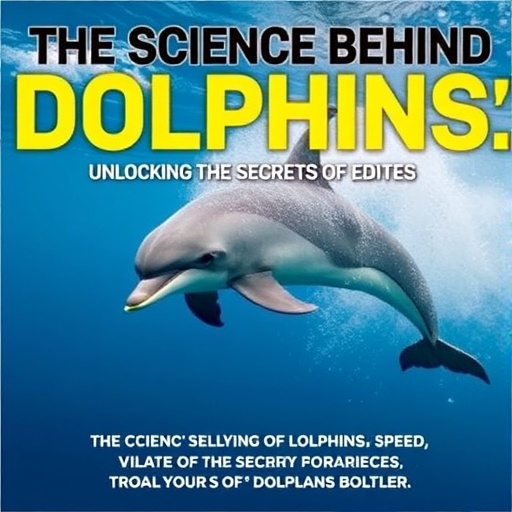
Dolphins have long mesmerized both scientists and the public with their remarkable ability to navigate and accelerate through water with a combination of elegance and power. The mystery behind their swift and agile swimming has captivated researchers striving to unravel the fundamental fluid dynamics that make such efficient propulsion possible. Recently, an innovative study involving state-of-the-art numerical simulations has illuminated the critical role played by complex vortex structures generated by dolphin tail movements, revealing fresh insights into aquatic locomotion mechanics.
At the heart of dolphin propulsion lies the oscillatory motion of the tail fluke, an up-and-down beating action which impels water backward, setting in motion a series of vortical flows. These flows are not merely random turbulence; instead, they form a structured hierarchy of vortices, ranging from large, powerful rings to a cascade of smaller swirling currents. Understanding how this hierarchy contributes to thrust has been a significant challenge in fluid dynamics, compounded by the difficulty of capturing detailed flow behavior around freely swimming marine mammals in natural conditions.
Researchers at The University of Osaka have harnessed high-resolution numerical models to simulate and deconstruct these complex fluid patterns with unprecedented precision. Utilizing vast computational power, their work has mapped the temporal and spatial dynamics of vortex generation as a dolphin’s tail moves through the water. The simulations vividly reveal that the principal source of forward thrust stems from the formation of large vortex rings, which effectively push substantial volumes of water rearward. In essence, these macro-scale patterns of swirling fluid impart the bulk of momentum transfer needed to propel the dolphin.
Beyond the initial creation of these dominant vortices, the simulations depict an energy cascade process, wherein the breakdown of large eddies spawns numerous smaller vortices. While these smaller structures substantially enrich the turbulence spectrum, the study demonstrates that their contribution to forward motion is minimal. They largely represent the dissipative by-products of the turbulent flow generated by the oscillating tail rather than drivers of propulsion themselves.
This breakthrough finding challenges prior assumptions that the multitude of smaller vortices play a significant role in thrust generation. According to lead researcher Yutaro Motoori, isolating and focusing on the fluid dynamics of large-scale vortices clarifies the mechanical basis of dolphin swimming speed and efficiency. This insight could catalyze the development of novel propulsion technologies inspired by natural aquatic locomotion, such as the next generation of underwater vehicles and biomimetic robots.
The research team’s use of a flexible computational framework allowed for extensive exploration of varying swimming speeds and tail-beat parameters. Across these diverse simulated conditions, the vortex hierarchy’s structure and role remained consistently critical, underscoring the robustness of these fluid dynamic mechanisms. Such versatility signifies a fundamental principle underpinning efficient propulsion in marine animals that rely on oscillatory thrust production.
Importantly, this study transcends the limitations inherent in physical experiments involving live animals or scaled laboratory models. Numerical simulations offer a non-intrusive window into the arrangement and interaction of fluid elements, enabling fine-grained analysis of vortex formation, interaction, and decay without disturbing the natural swimming behavior. This methodological advantage opens avenues for deeper inquiry into turbulence’s multifaceted role in aquatic locomotion.
Furthermore, the elucidation of vortex hierarchies has broader implications for the field of fluid mechanics and turbulence control. Insights into how energy is transferred and dissipated at various scales of vortical structures could inform methods to manipulate turbulent flows for engineering applications, ranging from reducing drag on marine vessels to enhancing mixing processes in industrial settings.
Senior author Susumu Goto emphasizes that appreciating the dominance of large vortices in propulsion sheds light on a universal dynamic within turbulent flows driven by biological movement. Small vortices, although visually complex and numerous, primarily emerge as secondary phenomena tied to energy dissipation rather than as fundamental contributors to thrust, a paradigm shift that refines existing theories of biological swimming.
The study’s findings also carry significant interdisciplinary potential, bridging biomechanics, computational physics, and robotics. By distilling the essential flow features responsible for thrust generation, engineers can design more streamlined and energy-efficient propulsion mechanisms that mimic dolphin tail motion, potentially revolutionizing underwater exploration and transportation technology.
Looking to the future, the researchers advocate for integrating their computational approaches with experimental observations, such as particle image velocimetry (PIV), to validate and further refine models under varied real-world conditions. Combining simulations with empirical data will facilitate a more comprehensive understanding of the interplay among biological morphology, kinematics, and fluid interactions.
In summary, this investigation represents a landmark advance in the physics of animal locomotion by revealing how a hierarchy of vortices sustains the reliable, high-performance swimming capabilities of dolphins. By pinpointing the dominant role of large-scale vortex rings in propulsion, the study not only deciphers a natural marvel but also lays groundwork for innovative bioinspired technologies, highlighting the profound benefits of combining computational science with fluid dynamic theory.
Cite Scienmag News
Audrey Campbell. (April 28, 2026). The Science Behind Dolphins’ Speed: Unlocking the Secrets of Eddies. Scienmag. https://scienmag.com/the-science-behind-dolphins-speed-unlocking-the-secrets-of-eddies/
Audrey Campbell. "The Science Behind Dolphins’ Speed: Unlocking the Secrets of Eddies." Scienmag, 28 April 2026, https://scienmag.com/the-science-behind-dolphins-speed-unlocking-the-secrets-of-eddies/. Accessed 3 September 2026.
Audrey Campbell. "The Science Behind Dolphins’ Speed: Unlocking the Secrets of Eddies." Scienmag. April 28, 2026. https://scienmag.com/the-science-behind-dolphins-speed-unlocking-the-secrets-of-eddies/


