


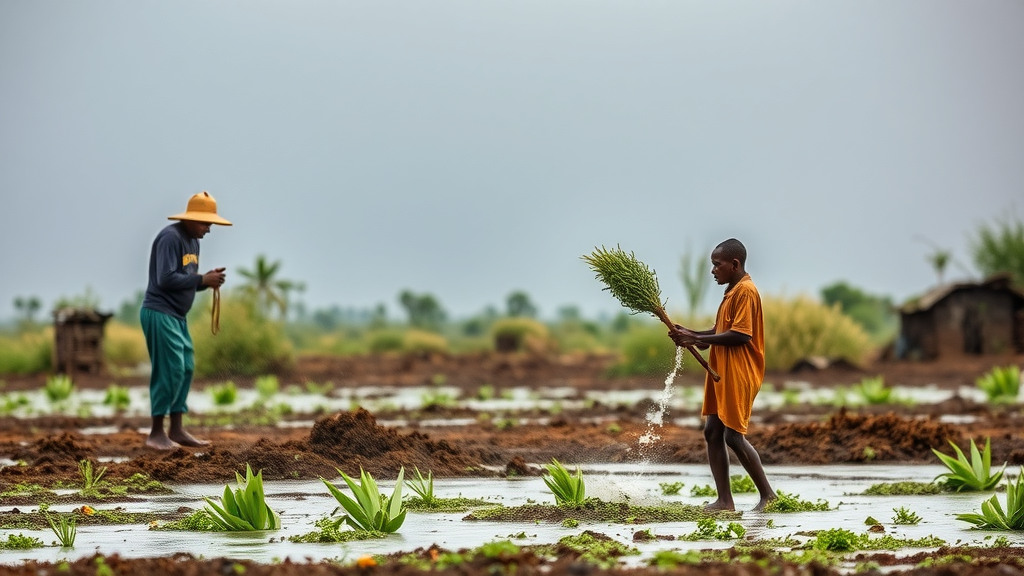
In the rolling highlands and dry lowlands of southern Ethiopia, farmers have spent years insisting that the rains are becoming less reliable, that droughts strike harder, and that the growing season is shrinking before their eyes. The rain gauges, however, tell a quieter story. A new 35-year analysis of climate records from the Sidama Regional State, published in Theoretical and Applied Climatology, confirms that annual rainfall in the districts of Boricha and Bilate Zuria has not shifted significantly since 1990. Yet almost nine in ten farmers surveyed in the region say the rainfall patterns they depend on have changed. The study’s authors argue that both groups are correct, because the real story of climate stress in this corner of sub-Saharan Africa is not written in the rain at all. It is written in the sky’s growing thirst.
The research, led by Hiwot Neway of Hawassa University together with colleagues in Ethiopia and Austria, stitched together meteorological station observations and the ERA5 reanalysis dataset to build a continuous hydroclimatic record from 1990 to 2024. Using the modified Mann-Kendall trend test, a non-parametric method robust to outliers and serial correlation, the team found that annual precipitation in both districts showed only weak, statistically insignificant positive tendencies, with Sen’s slope estimates of roughly 1.1 to 1.8 millimeters of additional rain per year. On paper, the water supply is holding steady. But the same analysis revealed something far more consequential: mean annual temperature rose significantly in both districts at nearly identical rates of about 0.017 degrees Celsius per year, and potential evapotranspiration climbed in lockstep at approximately 1.5 millimeters per year.
Potential evapotranspiration, or PET, is the amount of water that would evaporate from the soil and transpire from plants if water were freely available. It is the atmosphere’s demand side of the water ledger. As temperatures rise, PET rises with them, meaning crops and soils lose moisture faster even when every millimeter of rainfall stays the same. This is the thermodynamic mechanism the researchers believe explains the long-standing puzzle of perception-instrument divergence in East Africa, where smallholders routinely report worsening conditions that precipitation-only analyses fail to detect. Where the water balance between rainfall and evaporative demand tightens, effective moisture for crops declines, and the farmers feel it in wilting leaves and delayed planting, even if the annual rainfall statistics look reassuringly flat.
To capture drought in this warming context, the team computed the Standardized Precipitation-Evapotranspiration Index, or SPEI, at three-, six-, and twelve-month accumulation periods, fitting monthly water-balance series to a log-logistic distribution. Unlike rainfall-only indices, SPEI incorporates both supply and demand, making it far more sensitive to temperature-driven drying. The results revealed a landscape of dramatic swings: SPEI values ranged from extreme drought to severe wet conditions across the 35 years, with synchronized severe drought events standing out in 2009 and 2022-2023, the latter coinciding with the devastating El Nino-linked crisis that gripped the Horn of Africa. Yet, strikingly, no long-term drying trend reached statistical significance at any timescale. Drought in these districts, the study concludes, is a story of savage interannual variability layered on top of a slowly tightening water budget, not a steady march toward aridity.
The survey side of the study brought the human dimension into focus. Between September and December 2024, the researchers interviewed 204 households across both districts, selected through multistage stratified random sampling and limited to household heads aged thirty or older with long-term residence. The numbers were unambiguous: 89.7 percent of households reported perceiving shifts in rainfall patterns, 82.9 percent reported rising temperatures, 76.5 percent said droughts had become more frequent, and 72.5 percent observed a shortened rainy season. When asked about specific shocks, flooding topped the list at 67.6 percent, followed by land degradation at 48.5 percent and resource-based conflict at 43.5 percent. Focus group participants described maize yields collapsing to 60 to 70 percent below normal in shock years, with the drought events visible in the SPEI record matching the worst crop failures farmers remembered.
The paradox of flooding being the most-reported shock in a region without increasing rainfall resolves itself when one considers how a warming atmosphere behaves. Warmer air holds more moisture, concentrating precipitation into fewer, heavier events. Combined with severe land degradation, which strips soils of the organic matter and structure needed to absorb water, these intense downpours translate directly into flash flooding and erosion. The farmers’ accounts, in other words, describe precisely what climate physics predicts: not less rain overall, but rain that arrives more violently, soaks in less effectively, and evaporates faster afterward. Annual totals smooth all of this away, which is why the study’s authors argue that monitoring systems calibrated to precipitation deficits alone are structurally blind to the stressors smallholders actually experience.
The analysis also delivered a surprise on the question of who is most exposed. Using a Climate Perception Index built from ten binary indicators of climate-related shocks, and applying Poisson regression with robust standard errors, the researchers found that medium-wealth households reported 47 percent higher cumulative shock exposure than poor households, while district alone explained a 32 percent difference in shock rates. Bilate Zuria households in the lowland zone reported dramatically higher odds of flooding, land degradation, and conflict compared with their midland counterparts in Boricha, though they were far less likely to report erratic rainfall or famine. The authors suggest a provocative explanation for the wealth pattern: medium-wealth households own more assets worth losing, such as livestock and cropland, but lack the savings and off-farm income buffers of richer households, leaving them simultaneously more exposed and less protected. The finding challenges the reflexive assumption that the poorest always bear the greatest climate burden.
Amid these warnings, the study also surfaced a quieter source of resilience. In the midland enset-maize-coffee farming system, enset, a drought-tolerant banana relative often called Ethiopia’s tree against hunger, consistently buffered food security during maize failures. Households in the region harvest enset flexibly, drawing on its carbohydrate-rich corm and pseudostem in bad years, effectively storing food in the ground. Recent research elsewhere in Ethiopia shows that farmers expand enset cultivation after severe droughts and that enset-growing households display greater resilience to climatic shocks. The authors suggest that this indigenous crop functions as a low-cost, locally embedded biological buffer that could complement formal instruments such as weather-index insurance, and they call for formal cost-effectiveness comparisons between the two strategies across wealth groups.
The broader implication reaches well beyond two Ethiopian districts. If rising evaporative demand can erode agricultural water security while rainfall statistics remain flat, then drought early-warning systems, crop insurance schemes, and climate adaptation plans built on precipitation thresholds are measuring the wrong thing in warming regions. The study’s authors recommend sub-seasonal, growth-stage-specific drought indices to capture the dry-spell timing that farmers actually experience, panel datasets to disentangle wealth and exposure effects, and high-resolution water-balance mapping to locate hidden hotspots of evaporative stress. As global temperatures continue to climb, the gap between what the gauges record and what the fields endure will only widen, and this study makes a compelling case that closing it requires listening to both the instruments and the people who live under the same warming sky.
Subject of Research: Temperature-driven increases in potential evapotranspiration and farmer perceptions of drought in southern Ethiopia
Article Title: Increasing potential evapotranspiration despite non-significant rainfall trends: a 35-year hydroclimatic analysis and assessment of farmer perceptions in Southern Ethiopia
Article References: Neway, H., Mekuyie, M., Melka, Y., Abrha, H., & Abdi, A. T. (2026). Increasing potential evapotranspiration despite non-significant rainfall trends: a 35-year hydroclimatic analysis and assessment of farmer perceptions in Southern Ethiopia. Theoretical and Applied Climatology, 157(10), Article 677. https://doi.org/10.1007/s00704-026-06553-9
Image Credits: AI Generated
DOI: 10.1007/s00704-026-06553-9
Keywords: potential evapotranspiration, drought, Ethiopia, climate change, smallholder agriculture, SPEI, rainfall variability, water balance, farmer perceptions, Sidama, food security, enset
Cite Scienmag News
Violet Maxwell. (September 26, 2026). The Rains Are Not Failing, Yet Ethiopian Farmers Are Right: Warming Is Stealing Their Water. Scienmag. https://scienmag.com/the-rains-are-not-failing-yet-ethiopian-farmers-are-right-warming-is-stealing-their-water/
Violet Maxwell. "The Rains Are Not Failing, Yet Ethiopian Farmers Are Right: Warming Is Stealing Their Water." Scienmag, 26 September 2026, https://scienmag.com/the-rains-are-not-failing-yet-ethiopian-farmers-are-right-warming-is-stealing-their-water/. Accessed 4 October 2026.
Violet Maxwell. "The Rains Are Not Failing, Yet Ethiopian Farmers Are Right: Warming Is Stealing Their Water." Scienmag. September 26, 2026. https://scienmag.com/the-rains-are-not-failing-yet-ethiopian-farmers-are-right-warming-is-stealing-their-water/


