


A new comprehensive study by the ethologists of ELTE Eötvös Loránd University provides valuable insights into the olfactory abilities of dogs, revealing whether certain environmental and biological factors do indeed impact their performance as previously thought. The study was published in Scientific Reports.

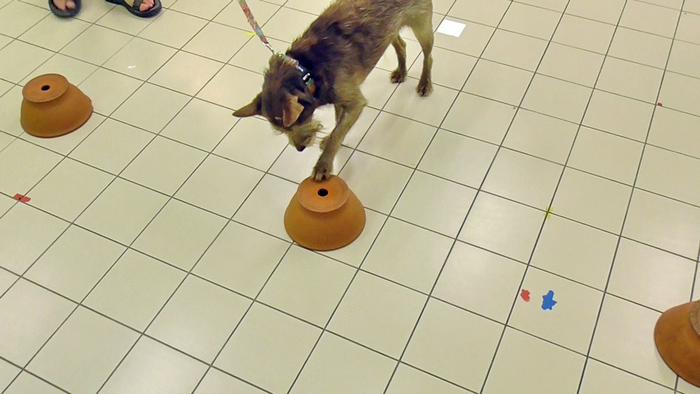
Credit: Photo: Attila Salamon / Department of Ethology, ELTE Eötvös Loránd University
A new comprehensive study by the ethologists of ELTE Eötvös Loránd University provides valuable insights into the olfactory abilities of dogs, revealing whether certain environmental and biological factors do indeed impact their performance as previously thought. The study was published in Scientific Reports.
Dogs’ olfaction have been used for various tasks from hunting to disease identification, sparking scientific interest in the factors that truly influence their olfactory performance. The first author, Attila Salamon from the ELTE NAP Canine Brain Research Group, said that „such tasks require specific training, but the outcomes of the tests conducted with these specially trained dogs cannot be generalized to the entire species.”
A team of researchers from the Department of Ethology, ELTE Eötvös Loránd University, Budapest, undertook the challenge of examining the olfactory performance of more than four hundred untrained family dogs of various breeds. This study aimed to provide a more comprehensive
understanding of dogs’ scent detection capabilities and determine whether specific environmental and demographic factors influence their performance in an olfactory task.
The study used the Natural Detection Task – developed by the team and already successfully applied even in the case of wolves – a simple search task, in which the dogs had to find a hidden dog treat in a line of pots. No training was necessary, as the test leveraged the dogs’ natural motivation for food. The task featured three difficulty levels; the first level acted as a pre-test to ensure the dogs understood the task, were motivated, and did not rely on alternative problem-solving methods. Dogs successfully completing the third level were considered to be the best.
During the test an experimenter – unaware of the location of the hidden food – was observing whether the dog spontaneously indicated a pot (e.g., licking the pot, placing the paw on the pot, poking or pushing the pot with the nose).
Contrary to common assumptions, temperature (ranging from 0 to 25 °C) and humidity (between 18 to 90%) were found to have no significant effect on the dogs’ ability to detect the target scent. However, the test location was an important factor; dogs tested indoors outperformed those tested outdoors, indicating that distracting stimuli in outdoor environments may significantly impact performance in olfactory tasks.
Considering the demographic factors,
there was no difference in olfactory performance based on the sex or neutering status of the dogs.
However, the study revealed that 2-3 year old dogs exhibited somewhat superior olfactory performance compared to dogs younger than 2 years and older than 6 years.
The researchers retested a subsample of the dogs to assess the reliability of the test and did not find a significant learning effect between the two test occasions, that is, the dogs did not perform better during the second test. This confirms the suitability of this method for testing the olfactory performance of untrained family dogs.
“By revealing the factors that really influence the effectiveness, our study can provide answers to important questions that have long concerned professionals using the olfactory abilities of dogs. Focusing on a large and diverse sample of untrained dogs, we can better generalize these findings to the broader canine population” – concluded Márta Gácsi, the lead researcher.
Journal
Scientific Reports
Article Title
Success in the Natural Detection Task is influenced by only a few factors generally believed to affect dogs’ olfactory performance
Article Publication Date
29-May-2024
Cite Scienmag News
Drew Townsend. (August 8, 2024). The olfactory performance of family dogs was tested by hungarian ethologists The olfactory performance of family dogs was tested by Hungarian ethologists. Scienmag. https://scienmag.com/the-olfactory-performance-of-family-dogs-was-tested-by-hungarian-ethologists-the-olfactory-performance-of-family-dogs-was-tested-by-hungarian-ethologists/
Drew Townsend. "The olfactory performance of family dogs was tested by hungarian ethologists The olfactory performance of family dogs was tested by Hungarian ethologists." Scienmag, 8 August 2024, https://scienmag.com/the-olfactory-performance-of-family-dogs-was-tested-by-hungarian-ethologists-the-olfactory-performance-of-family-dogs-was-tested-by-hungarian-ethologists/. Accessed 4 September 2026.
Drew Townsend. "The olfactory performance of family dogs was tested by hungarian ethologists The olfactory performance of family dogs was tested by Hungarian ethologists." Scienmag. August 8, 2024. https://scienmag.com/the-olfactory-performance-of-family-dogs-was-tested-by-hungarian-ethologists-the-olfactory-performance-of-family-dogs-was-tested-by-hungarian-ethologists/

