


For many individuals, sports have long served as a source of enjoyment and relaxation. Watching sports, particularly at large gatherings, goes beyond entertainment. It fosters a sense of community and belonging among audiences. This sense of connection not only makes individuals feel good but also benefits society by improving health, enhancing productivity, and reducing crime. Although it is popularly recognized for its positive effects, existing studies on the relationship between watching sports and well-being offer only limited evidence.

Credit: Shintaro Sato from Waseda University
For many individuals, sports have long served as a source of enjoyment and relaxation. Watching sports, particularly at large gatherings, goes beyond entertainment. It fosters a sense of community and belonging among audiences. This sense of connection not only makes individuals feel good but also benefits society by improving health, enhancing productivity, and reducing crime. Although it is popularly recognized for its positive effects, existing studies on the relationship between watching sports and well-being offer only limited evidence.
Recognizing this gap, a team of researchers led by Associate Professor Shintaro Sato from the Faculty of Sport Sciences, Waseda University, Japan, embarked on a groundbreaking study. Prof. Sato, alongside Assistant Professor Keita Kinoshita from Nanyang Technological University and Dr. Kento Nakagawa from the Faculty of Human Sciences, Waseda University, used a multi-method approach, combining secondary data analysis, self-reports, and neuroimaging measures to understand the connection between sports viewing and well-being in the general population. “A significant challenge in well-being research is the subjective nature of measurement procedures, potentially leading to biased findings. Therefore, our studies focused on both subjective and objective measures of well-being,” explains Prof. Sato. Their research was published online on 22 March 2024 in Sports Management Review.
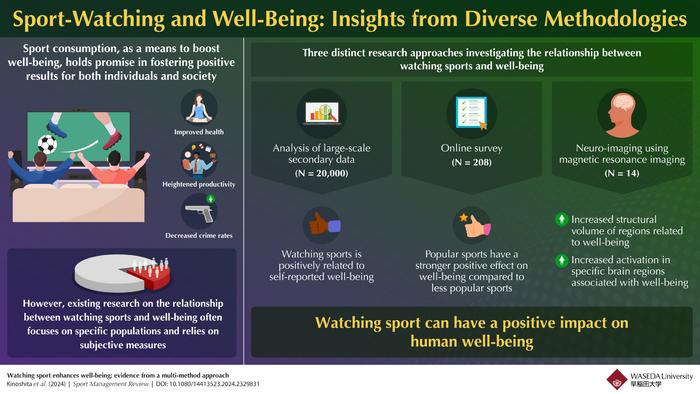
In the first study, the researchers analyzed large-scale publicly available data on the influence of watching sports on 20,000 Japanese residents. The results of this study confirmed the ongoing pattern of elevated reported well-being associated with regular sports viewing. However, this study was limited by its inability to provide deeper insight into the relationship between sports consumption and well-being.
The second study, an online survey aimed at investigating whether the connection between sports viewing and well-being varied depending on the type of sport observed, involved 208 participants. The experiment exposed them to various sports videos, assessing their well-being both before and after viewing. The findings underscored that widely embraced sports, like baseball, exerted a more significant impact on enhancing well-being compared to less popular sports, such as golf.
However, the most groundbreaking aspect of this research emerged in the third study. Here, the team employed neuroimaging techniques to scrutinize alterations in brain activity following sports viewing. Utilizing multimodal MRI neuroimaging measurement procedures, the brain activity of fourteen able-bodied Japanese participants was analyzed while they watched sports clips. The results of this investigation illuminated that, sports viewing triggered activation in the brain’s reward circuits, indicative of feelings of happiness or pleasure. Additionally, a noteworthy finding surfaced in the structural image analysis. It revealed that individuals who reported watching sports more frequently exhibited greater gray matter volume in regions associated with reward circuits, suggesting that regular sports viewing may gradually induce changes in brain structures. “Both subjective and objective measures of well-being were found to be positively influenced by engaging in sports viewing. By inducing structural changes in the brain’s reward system over time, it fosters long-term benefits for individuals. For those seeking to enhance their overall well-being, regularly watching sports, particularly popular ones such as baseball or soccer, can serve as an effective remedy,” comments Prof. Sato.
The study has profound implications and theoretical contributions to sports management literature. Existing literature has primarily focused on sports fans; however, this study has taken into consideration a larger general population irrespective of their relationship to sports consumption. This research can contribute significantly to sports management practices and policymaking for public health.
***
Reference
Authors
1Keita Kinoshita (Nanyang Technological University)
2Kento Nakagawa (Waseda University)
3Shintaro Sato (Waseda University)
Affiliations
- Physical Education and Sports Science, Nanyang Technological University, Singapore
- Faculty of Human Sciences, Waseda University, Tokorozawa, Japan
- Faculty of Sport Sciences, Waseda University, Nishitokyo, Japan
About Waseda University
Located in the heart of Tokyo, Waseda University is a leading private research university that has long been dedicated to academic excellence, innovative research, and civic engagement at both the local and global levels since 1882. The University has produced many changemakers in its history, including nine prime ministers and many leaders in business, science and technology, literature, sports, and film. Waseda has strong collaborations with overseas research institutions and is committed to advancing cutting-edge research and developing leaders who can contribute to the resolution of complex, global social issues. The University has set a target of achieving a zero-carbon campus by 2032, in line with the Sustainable Development Goals (SDGs) adopted by the United Nations in 2015.
To learn more about Waseda University, visit
About Professor Shintaro Sato
Shintaro Sato, Ph.D., currently serves as an Associate Professor at Waseda University’s Faculty of Sport Sciences and directs the Sport & Entertainment Management Lab. He earned his doctoral degree from the University of Florida and has held academic positions at institutions including Georgia Southern University and Feliciano School of Business, Montclair State University. Additionally, he served as a visiting researcher at the Baruch College, Zicklin School of Business and City University of New York, and as a Ph.D. supervisor at the University of Ottawa. With a strong commitment to leveraging the potential of sports, Prof. Sato has spearheaded numerous research endeavors and authored several papers in esteemed international academic journals.
Journal
Sport Management Review
Method of Research
Experimental study
Subject of Research
People
Article Title
Watching Sport Enhances Well-Being: Evidence from a Multi-Method Approach
Article Publication Date
22-Mar-2024
COI Statement
No potential conflict of interest was reported by the author(s)
Cite Scienmag News
Courtney Benton. (April 15, 2024). The joy of sports: How watching sports can boost well-being. Scienmag. https://scienmag.com/the-joy-of-sports-how-watching-sports-can-boost-well-being/
Courtney Benton. "The joy of sports: How watching sports can boost well-being." Scienmag, 15 April 2024, https://scienmag.com/the-joy-of-sports-how-watching-sports-can-boost-well-being/. Accessed 3 September 2026.
Courtney Benton. "The joy of sports: How watching sports can boost well-being." Scienmag. April 15, 2024. https://scienmag.com/the-joy-of-sports-how-watching-sports-can-boost-well-being/

