


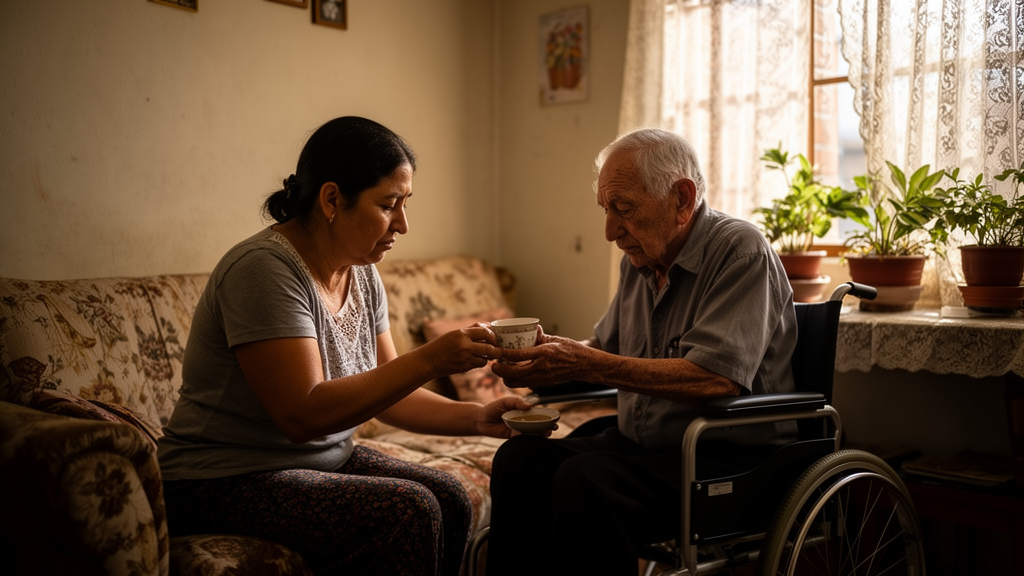
Across Colombia, millions of people quietly prop up the country’s welfare system every day. They bathe aging parents, administer medication to chronically ill relatives, and absorb the physical and emotional weight of care that no hospital or state agency provides. A new study published in Social Indicators Research offers the most nationally representative picture yet of what this invisible labor costs the people who perform it, and the findings are sobering: informal caregivers in Colombia report significantly lower life satisfaction and lower day-to-day happiness than otherwise comparable non-caregivers, even after extensive statistical adjustment.
The research, conducted by Deivy Fernando Vega-Herrera of the Unidades Tecnológicas de Santander and independent researcher Johana Marcela Vargas-Pérez, draws on microdata from Colombia’s National Quality of Life Survey (ECV) covering the period 2018 through 2024. This survey, administered by the country’s National Administrative Department of Statistics (DANE), is one of the few instruments in a middle-income country that captures both caregiving status and multiple dimensions of subjective well-being at the national level. The authors merged the household composition, health, labor force, and education modules of the survey using identifier keys provided by DANE, constructing an analytical dataset that they have made fully reproducible through a publicly available R script.
The methodological core of the study is a technique called entropy balancing, a reweighting method that has gained traction in observational social science for its ability to make comparison groups statistically equivalent. Unlike propensity score matching, which models who ends up in the treatment group and can discard data in the process, entropy balancing directly searches for weights on the non-caregiver comparison group so that its means, variances, and moments match those of caregivers across a broad set of covariates. The authors expanded this balancing set beyond the usual demographics to include the caregiver’s own education, employment status, household structure, and kinship ties to the care recipient, a choice that matters because these factors simultaneously influence who becomes a caregiver and how satisfied they are with life.
The headline results are consistent across both well-being outcomes. Informal caregiving is associated with a reduction in life satisfaction of 0.186 points on the survey’s scale, and a reduction in happiness yesterday of 0.233 points, both statistically significant at the conventional threshold of p less than 0.001. Expressed in standardized units, the effect sizes are small but real: Cohen’s d of 0.108 for life satisfaction and 0.114 for happiness yesterday. In practical terms, this means the average caregiver in Colombia experiences a measurable dip in subjective well-being relative to a statistically comparable non-caregiver, a dip that persists even when the two groups have been made nearly identical on observable characteristics.
What makes the study particularly valuable is what happens next. The authors deployed a KHB-type decomposition, a descriptive technique that partitions the total association between caregiving and well-being into the part explained by other measured factors and the part that remains after those factors are held constant. The results are striking: 73.4 percent of the total association with life satisfaction, and 57.4 percent of the association with happiness yesterday, is statistically co-explained by differences in satisfaction with health, income, and work. In other words, much of the well-being penalty of caregiving operates through channels that are, in principle, policy-addressable. Caregivers are less satisfied with their health, their income, and their work situations, and these dissatisfactions account for the majority of the observed gap in overall life evaluation.
This decomposition carries a direct policy implication. If the caregiving penalty flows substantially through health, income, and work arrangements, then interventions targeting those three domains, such as respite care, caregiver allowances, flexible employment protections, and access to formal health services for caregivers themselves, could plausibly narrow the well-being gap. The authors frame their findings as evidence of caregivers’ multidimensional vulnerability and argue for targeted policies within Colombia’s social protection system, rather than treating caregiving as a single-axis problem amenable to a single-axis fix.
One of the more provocative findings concerns gender. A large body of international literature, including meta-analytic work by Pinquart and Sörensen and more recent systematic reviews, suggests that women bear a disproportionate share of informal care and experience worse psychosocial outcomes as a result. Yet after the expanded covariate adjustment in this study, no statistically significant sex difference emerges for either life satisfaction or happiness yesterday. The authors interpret this carefully: the caregiving penalty is not distinctly gendered once compositional selection is accounted for. That is, the apparent gender gap in earlier studies may partly reflect the fact that women who become caregivers differ systematically from men who do, in terms of employment, household structure, and kinship position, rather than an inherently harsher effect of caregiving on women.
The study does not rest on a single specification. The authors report a sequential specification analysis showing that the estimated effect on life satisfaction declines monotonically from a raw gap of 0.225 to the fully adjusted 0.186, indicating that part of the raw difference reflects observable selection into caregiving, but that a substantial negative association remains after adjustment. Additional checks, including excluding employment status from the balancing model and adding log household labor income as a covariate, produce estimates of 0.198 and 0.178 respectively, both close to the main result and statistically significant, suggesting the findings are not an artifact of particular modeling choices.
Perhaps the most technically sophisticated element is a sensemakr sensitivity analysis, a framework developed by Cinelli and Hazlett that extends the logic of omitted variable bias to ask how strong an unobserved confounder would need to be to overturn the results. The answer: an unmeasured variable would need to explain at least 4.89 percent of the residual variance in life satisfaction, or 5.18 percent for happiness yesterday, to nullify the estimated effects. The adjusted estimates remain negative and substantial even when hypothetical confounding is simulated at one, two, and three times the strength of age or sex, providing a quantitative benchmark for how robust the findings are to unmeasured factors.
Because the study period spans the COVID-19 pandemic, the authors also confronted the possibility that pandemic-era shocks confound their estimates. Since entropy balancing operates within each cross-section rather than across time, it cannot remove time-varying shocks by design, so the researchers implemented three complementary strategies: re-estimating the effect excluding 2020, comparing pre-pandemic 2018 and 2019 with post-pandemic 2021 through 2024, and directly comparing two measurement regimes given that caregiver prevalence shifted from 5.22 percent in 2018 and 2019 to 3.01 percent from 2020 onward. Life satisfaction estimates remained stable across every subsample, ranging from 0.155 to 0.195 with no significant contrast. The affective gap, however, told a different story: it was smallest in 2020 and largest in 2021 through 2024, a significant difference suggesting that the emotional toll of caregiving compressed during the acute crisis and widened thereafter, a pattern the authors show is not an artifact of the change in caregiver prevalence between measurement regimes.
For a country navigating rapid population aging and a rising burden of chronic disease, the study arrives at a critical juncture. Colombia’s long-term care system remains nascent, and the informal care it implicitly relies upon is provided overwhelmingly by family members who receive little recognition, training, or financial support. By quantifying the well-being cost of caregiving at the national level and identifying the specific channels, health, income, and work, through which that cost operates, the research transforms an abstract moral claim about caregiver value into an empirical mandate for policy. The message for Colombian policymakers, and for middle-income countries facing similar demographic transitions, is that supporting caregivers is not merely a matter of social justice but a measurable investment in national well-being.
Subject of Research: The association between informal caregiving and subjective well-being in Colombia
Article Title: Informal Caregiving and Subjective Well-Being: Empirical Evidence from Colombia (2018–2024)
Article References: Vega-Herrera, D. F., & Vargas-Pérez, J. M. (2026). Informal Caregiving and Subjective Well-Being: Empirical Evidence from Colombia (2018–2024). Social Indicators Research, 185(2), Article 7. https://doi.org/10.1007/s11205-026-03955-0
Image Credits: AI Generated
DOI: 10.1007/s11205-026-03955-0
Keywords: informal caregiving, subjective well-being, life satisfaction, happiness, Colombia, entropy balancing, KHB decomposition, National Quality of Life Survey, caregiver burden, social protection, population aging, gender differences
Cite Scienmag News
Courtney Benton. (October 17, 2026). The Hidden Cost of Caring: Colombia’s Informal Caregivers Report Lower Life Satisfaction and Happiness. Scienmag. https://scienmag.com/the-hidden-cost-of-caring-colombias-informal-caregivers-report-lower-life-satisfaction-and-happiness/
Courtney Benton. "The Hidden Cost of Caring: Colombia’s Informal Caregivers Report Lower Life Satisfaction and Happiness." Scienmag, 17 October 2026, https://scienmag.com/the-hidden-cost-of-caring-colombias-informal-caregivers-report-lower-life-satisfaction-and-happiness/. Accessed 17 October 2026.
Courtney Benton. "The Hidden Cost of Caring: Colombia’s Informal Caregivers Report Lower Life Satisfaction and Happiness." Scienmag. October 17, 2026. https://scienmag.com/the-hidden-cost-of-caring-colombias-informal-caregivers-report-lower-life-satisfaction-and-happiness/


