


…
The choice of BCPD as the active material reflects a broader trend in molecular photonics, where chemists and device engineers collaborate to identify small organic molecules whose electronic structure can be deliberately modified by simple electrochemical means. Pyromellitic diimides belong to a family of imide compounds known for their electron-accepting character, and the addition of cysteine groups at the nitrogen positions introduces terminal sites that are chemically versatile. In the modeling framework described in the study, the molecule is treated as a chain of coupled sites terminated by nitrogen atoms, which conveniently serve as the connection points to electrodes in the conductance calculations. This dual role—optical phase shifter in the interferometer arms and molecular conductor between electrodes—illustrates how a single material can be evaluated simultaneously through optical and electronic formalisms, an approach that is increasingly common as quantum photonic devices demand components that respond predictably to electrical control.
The Hückel-based treatment of the absorption spectrum, while approximate, offers a transparent physical picture of why charging the molecule alters its refractive index. In the neutral state, the highest occupied molecular orbital is filled and the six unoccupied states define the allowed optical transitions that shape the absorption bands. When an electron is added, the occupation pattern changes and new transitions become available at different energies, redistributing the absorption spectrum. Because the real and imaginary parts of the refractive index are linked through the Kramers–Kronig relations, any redistribution of absorption necessarily produces a corresponding change in the dispersive part of the index. The constant offset of 1.5 applied to the real part accounts for experimental realities such as scattering and background contributions from the molecular environment, ensuring that the simulated index values remain anchored to measurable quantities rather than purely theoretical ones. The Gaussian linewidth of 0.1 eV used to construct the absorption peaks represents a pragmatic compromise between spectral resolution and computational simplicity.
The complementarity of the Hückel and density functional theory calculations deserves emphasis. Hückel theory, despite neglecting electron–electron interactions and fixing nuclear positions, captures the qualitative connectivity of the molecular orbitals and allows rapid exploration of how charging modifies the transition landscape. DFT calculations with the B3LYP functional and the Ahlrichs split valence basis set provide a more rigorous description of the electronic structure, including geometry optimization that Hückel theory cannot perform. Running both approaches on the same molecule allows the authors to cross-validate the spectral features that drive the refractive index change, lending confidence to the optical parameters that feed into the interferometer simulations. This layered modeling strategy—approximate theory for intuition, higher-level theory for refinement—is a hallmark of computational materials design for photonics.
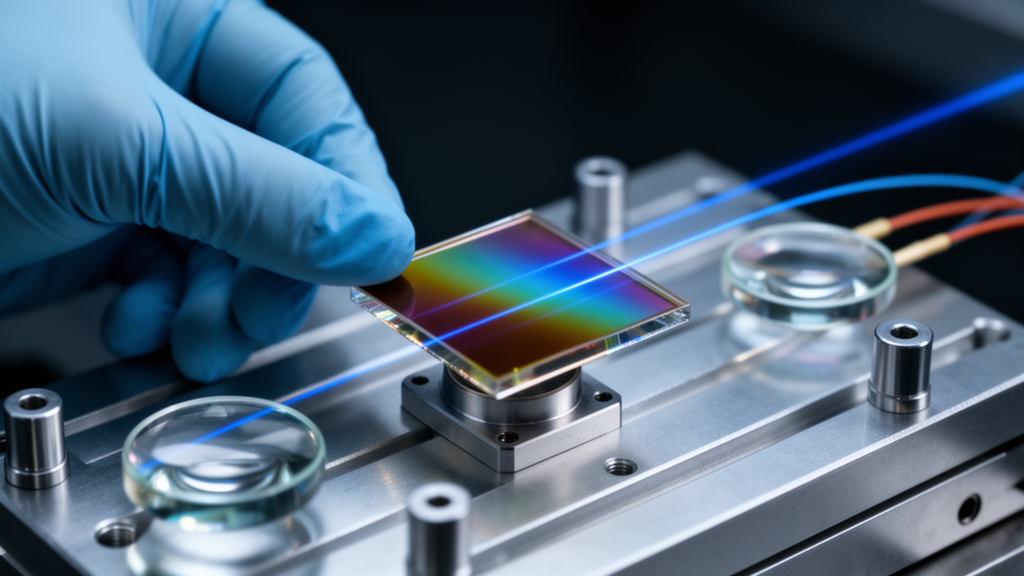
On the device side, the distinction between the two interferometer architectures has practical consequences for implementation. The free-space Mach–Zehnder configuration, with discrete beam-splitters and mirrors, is conceptually straightforward and maps directly onto the operator formalism used to describe photon propagation, where each mirror and beam-splitter is represented by a matrix acting on the photon state vectors. The 90-degree phase shift assigned to reflection is a standard convention that ensures the interference conditions at the second beam-splitter are correctly captured. In contrast, the waveguide-based version replaces bulk optics with two 3-dB couplers and channel waveguides, a geometry that is naturally compatible with integrated photonic platforms fabricated on glass or semiconductor substrates. The 2-micrometer thickness chosen for the BCPD layers was selected to produce a significant phase shift, balancing the strength of the electrochromic response against the practical constraints of depositing and addressing molecular films within an interferometer arm.
The non-equilibrium Green’s function calculations provide a bridge between the optical modeling and the electrical addressing of the molecule. By assuming that only a single site couples to each electrode—with the coupling strength set to −1 eV, a value consistent with prior studies of molecule–electrode junctions—the transmission function can be computed from the retarded Green’s function and the broadening matrices derived from the electrode density of states. The resulting elastic transmission connects directly to conductance through the quantum of conductance, giving an estimate of the current that would flow when a voltage is applied across the molecule. This is relevant because the electrochromic mechanism in the device relies on adding or removing charge from the molecule; the conductance calculation indicates how readily that charge exchange can occur through an electrode contact, which in turn determines the switching speed and energy cost of modulating the refractive index.
For quantum communication applications, the ability to electrically steer single photons between the two output detectors of a Mach–Zehnder interferometer is a foundational capability. Single-photon interferometers underpin protocols such as quantum key distribution, where the relative phase between interferometer arms encodes information, and photonic quantum gates, where conditional phase shifts implement logical operations. Conventional phase shifters in integrated photonics rely on thermo-optic effects or the plasma dispersion effect in semiconductors, both of which require careful thermal management or high drive voltages. Molecular electrochromic phase shifters offer an alternative in which the index change arises from a discrete change in molecular orbital occupation, potentially enabling compact, low-power modulation. The simulation framework presented—linking molecular electronic structure, complex refractive index, interferometer transfer matrices, and molecular conductance—provides a template for evaluating other electrochromic molecules, including viologens and polycyclic aromatic hydrocarbons, within the same device context.
The reversibility of the electrochromic change is central to the device concept. Unlike photochromic materials, where the index change is triggered by light absorption and may persist until reversed by another optical stimulus, electrochromic molecules respond to an applied electric potential and revert when the potential is removed or reversed. This reversibility, demonstrated experimentally for BCPD in prior work, means the interferometer can be cycled repeatedly between detection states, a requirement for any practical modulator or switch. The study’s treatment of the charged molecule as the model for the field-applied state is a simplification—real devices would involve partial charging depending on the applied voltage—but it captures the essential physics that the index change scales with the degree of molecular charging.
Looking ahead, the integration of molecular electrochromic layers into waveguide-based interferometers would require attention to packaging questions that the simulations do not address, such as how the molecular film is deposited on or within the waveguide structure, how electrodes are positioned to apply the field uniformly across the active arm, and how the optical loss introduced by the molecular layer affects the overall visibility of the interference fringes. The imaginary part of the refractive index, which corresponds to absorption, is particularly important here: excessive absorption in the active arm would degrade the contrast of the interference pattern and reduce the on-off ratio of the detection switching. The modeling approach, by tracking both the real and imaginary parts of the index through the Kramers–Kronig framework, allows these trade-offs to be quantified before fabrication, guiding the choice of layer thickness and operating wavelength.
The broader significance of this work lies in demonstrating that molecular-scale optical properties can be translated into device-level performance metrics through a coherent chain of calculations. Starting from the molecular Hamiltonian, the analysis proceeds through absorption spectra, complex refractive index, interferometer detection probabilities, and molecular conductance, each step building on the previous one. This end-to-end modeling capability is valuable not only for BCPD but for the growing catalog of electrochromic and redox-active molecules being explored for energy storage, displays, and smart windows, many of which could find secondary applications as active elements in photonic circuits. As quantum photonic systems mature and demand ever-finer control over single-photon routing, materials that combine optical modulability with electrical addressability at the molecular level are likely to play an expanding role.
Subject of Research: …
Article Title: Mach–Zehnder interferometers incorporating electrochromic molecules for controlled single-photon detection
Article References: Scotognella, F. (2026). Mach–Zehnder interferometers incorporating electrochromic molecules for controlled single-photon detection. Frontiers in Photonics, 6, Article 1685128. https://doi.org/10.3389/fphot.2025.1685128
Image Credits: AI Generated
DOI: 10.3389/fphot.2025.1685128
Keywords: Mach, Zehnder, interferometers, incorporating, electrochromic, molecules, controlled, single-photon, detection, scientific research
Cite Scienmag News
Katie Riggs. (October 17, 2026). Electrochromic Molecules Could Let Physicists Dial In Single-Photon Detection. Scienmag. https://scienmag.com/electrochromic-molecules-could-let-physicists-dial-in-single-photon-detection/
Katie Riggs. "Electrochromic Molecules Could Let Physicists Dial In Single-Photon Detection." Scienmag, 17 October 2026, https://scienmag.com/electrochromic-molecules-could-let-physicists-dial-in-single-photon-detection/. Accessed 17 October 2026.
Katie Riggs. "Electrochromic Molecules Could Let Physicists Dial In Single-Photon Detection." Scienmag. October 17, 2026. https://scienmag.com/electrochromic-molecules-could-let-physicists-dial-in-single-photon-detection/


