


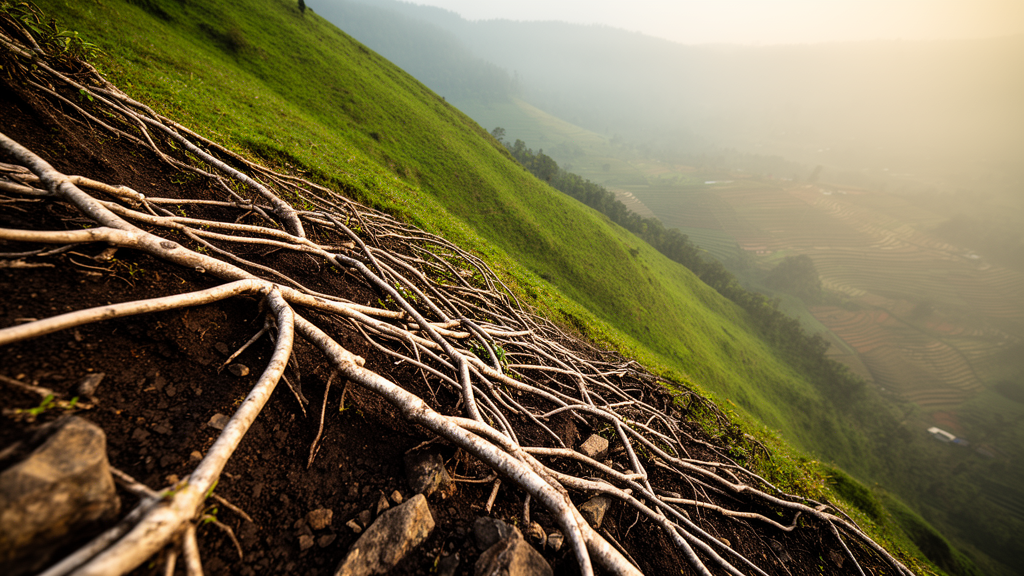
Deep in the mountains of northeastern Mexico, scientists have been pulling thin tree roots out of the soil and stretching them until they snap. What they found may change how engineers and ecologists stabilize the world’s steepest, most landslide-prone slopes. A new study published in the journal BioRisk measured the mechanical properties of roots from twelve tree species growing across three distinct vegetation communities in the Natural Protected Area Altas Cumbres, near Ciudad Victoria in Tamaulipas, Mexico. The research reveals that certain native species, notably Piper amalago and Pinus teocote, consistently outperform their neighbors in both tensile strength and elasticity, two qualities that together determine how well a living root system can hold a hillside together.
Shallow landslides, defined as the movement of soil along a slope with a sliding surface no deeper than two meters, are among the most dangerous hazards in mountainous terrain. They strike suddenly during heavy rainfall, threaten human lives, destroy infrastructure, and degrade the ecological fabric of entire landscapes. Conventional civil engineering solutions such as retaining walls and drainage systems can help, but they are expensive and often ill-suited to rural regions with limited resources. Soil bioengineering offers an alternative: using plants themselves as living structural elements that reduce erosion, slow sediment flows, and reinforce the soil matrix with their roots.
The science behind this approach is rooted, quite literally, in the mechanics of plant tissue. When soils are shallow, tree roots can penetrate down to more stable substrates, while dense lateral root networks in the upper soil horizons weave a mesh that binds the soil together. Thin roots, those under ten millimeters in diameter, act as flexible elements within this mesh, while thicker roots serve as structural pillars adding longitudinal strength. Remarkably, previous research has shown that some thin roots possess tensile strengths exceeding 700 megapascals, a figure that surpasses many grades of steel. This extraordinary strength comes largely from cellulose content, which is more concentrated per unit of cross-sectional area in thinner roots.
Despite decades of research, quantifying exactly how much additional shear strength roots confer on soil remains difficult. Many existing models overestimate the effect by assuming all roots break simultaneously during slope failure, or that roots are oriented perpendicular to the slip surface. These simplifications can lead to significant errors in predicting slope stability. Compounding the problem, soil characteristics vary widely across regions and can shift rapidly under human disturbance or extreme weather, meaning that assuming a plant species behaves identically across different soil types risks either underestimating or overestimating its true stabilizing capacity.
To address this gap, the research team focused on a rugged landscape where slopes range from nearly flat to a dizzying 58 degrees, creating zones of high landslide susceptibility. The Altas Cumbres protected area spans roughly 30,328 hectares of folded limestone formations, with elevations climbing from 350 to 2,180 meters above sea level. The climate is highly variable, ranging from humid subtropical conditions with average monthly temperatures between 20 and 35 degrees Celsius, to occasional extremes dipping to 10 degrees in January and soaring to 48 degrees in July. Within this gradient, the researchers established three sampling sites: a tropical semi-deciduous forest at 340 meters, a Tamaulipan thornscrub at 550 meters, and an oak-pine forest at 1,100 meters.
At each site, the team carefully excavated root systems from healthy, representative tree species, exposing the thin roots and selecting undamaged segments for mechanical testing. Using a digital dynamometer with a 500-newton capacity mounted on a clamp-based test stand, they pulled each root sample at a constant speed of 10 millimeters per minute until it broke. Diameters were measured with a digital caliper at three points along each sample to calculate a mean value at the breaking point. From these measurements, the researchers derived two key parameters: tensile strength, the maximum force the root could withstand before failure, and elastic modulus, a measure of stiffness that describes how much the root stretches under load before it deforms permanently or snaps.
In total, 224 roots from twelve species across eleven families were evaluated. The results revealed striking patterns. In the tropical semi-deciduous forest, Piper amalago, a small profusely branched tree known locally as cordoncillo, dominated the rankings for both tensile strength and elasticity across nearly all diameter categories. In the thornscrub community, Randia obcordata and Karwinskia humboldtiana alternated at the top of the lists, while in the oak-pine forest, Liquidambar styraciflua and Pinus teocote shared the highest values. Across all sites, elasticity showed the strongest and most consistent negative correlation with root diameter, confirming that thinner roots are not only stronger but also behave differently under mechanical stress than their thicker counterparts.
Perhaps the most surprising finding was what the researchers did not find. Despite well-documented evidence from other mountain regions that elevation shapes root properties through changes in temperature, precipitation, soil chemistry, and nutrient availability, this study detected no consistent altitudinal trend in the mechanical properties of thin roots. Some prior studies had suggested that roots at higher elevations develop greater tensile strength as an adaptation to harsher conditions, while others found that small-scale local heterogeneity matters more than broad environmental gradients. The Mexican data align with the latter interpretation: species identity and local site conditions appear to override any elevational signal at the spatial scale examined.
Statistical analysis reinforced this conclusion. A PERMANOVA test detected significant differences in species composition among all three sites, and a non-metric multidimensional scaling analysis showed that the plant communities formed clearly separate groups based on their root mechanical traits. The regression analysis for all three sampling sites fitted a power-law relationship, meaning that changes in mechanical properties occur proportionally to a power of root diameter rather than in a simple linear fashion. This mathematical structure is directly useful for parameterizing root-reinforcement models that engineers and land managers can apply to slope stability assessments.
The practical implications extend well beyond academic interest. By building local databases of root mechanical properties for native species, soil bioengineers can match the right tree species to the right slope, maximizing reinforcement where it is needed most. The study’s authors emphasize that both tensile strength and elasticity must be considered together, because a root that is strong but brittle may fail differently than one that is slightly weaker but more flexible. The balance between these two properties determines whether roots can anchor soil firmly while still adapting to the gradual ground movements that precede many shallow landslides. As climate change intensifies rainfall patterns in mountainous regions worldwide, understanding which species offer the best natural protection becomes not just an ecological question but a matter of public safety. The humble thin root, it turns out, may be one of nature’s most effective and underappreciated engineering materials.
Subject of Research: Mechanical properties of thin tree roots for soil bioengineering and shallow landslide protection along an altitudinal gradient in Mexico
Article Title: Mechanical properties of thin roots of tree species for shallow landslide protection along an altitudinal gradient
Article References: Sanchez-Castillo, L., Melendez-Jaramillo, E., Daniel Chicas, S., Segura Martinez, M. T. D. J., & Gonzalez-Delgado, M. (2025). Mechanical properties of thin roots of tree species for shallow landslide protection along an altitudinal gradient. BioRisk, 23, 93-109. https://doi.org/10.3897/biorisk.23.173254
Image Credits: AI Generated
DOI: 10.3897/biorisk.23.173254
Keywords: shallow landslides, soil bioengineering, root tensile strength, elastic modulus, altitudinal gradient, tree roots, slope stability, nature-based solutions, Mexico, erosion control, root reinforcement, mountain ecosystems
Cite Scienmag News
Gregory Coleman. (October 17, 2026). Thin Tree Roots With Steel-Like Strength Could Shield Mountain Slopes From Deadly Landslides. Scienmag. https://scienmag.com/thin-tree-roots-with-steel-like-strength-could-shield-mountain-slopes-from-deadly-landslides/
Gregory Coleman. "Thin Tree Roots With Steel-Like Strength Could Shield Mountain Slopes From Deadly Landslides." Scienmag, 17 October 2026, https://scienmag.com/thin-tree-roots-with-steel-like-strength-could-shield-mountain-slopes-from-deadly-landslides/. Accessed 17 October 2026.
Gregory Coleman. "Thin Tree Roots With Steel-Like Strength Could Shield Mountain Slopes From Deadly Landslides." Scienmag. October 17, 2026. https://scienmag.com/thin-tree-roots-with-steel-like-strength-could-shield-mountain-slopes-from-deadly-landslides/


