


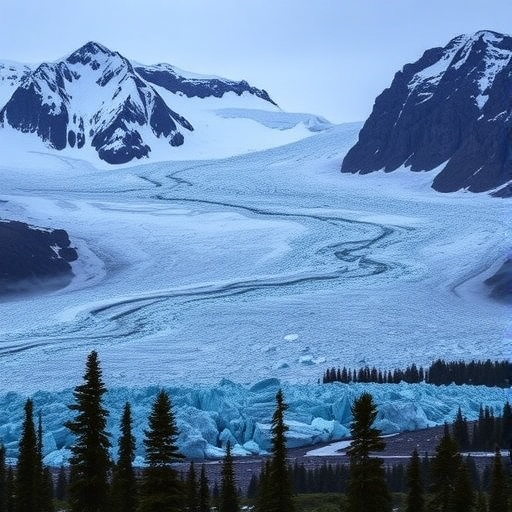
In the remote reaches of the northwestern Pamir Mountains of central Tajikistan, a silent crisis is unfolding that threatens the stability of one of the world’s most crucial natural water reservoirs. Recent research led by the Pellicciotti group at the Institute of Science and Technology Austria (ISTA) reveals that a persistent decline in snowfall is eroding glacier health and undermining meltwater resources. The research, conducted through a combination of rigorous field observation and advanced computational modeling, provides unprecedented insights into glacier dynamics in a region that has long eluded detailed scientific scrutiny due to limited data availability.
High-mountain Asia, often referred to as the “Third Pole,” harbors some of the planet’s largest reserves of frozen freshwater, second only to the Arctic and Antarctic polar ice caps. The Pamir Mountains, situated in Central Asia, have traditionally been considered a bastion of relative glacial stability. Unlike many rapidly retreating glaciers worldwide, some in the Pamir and neighboring Karakoram ranges exhibited resilience that puzzled glaciologists. This phenomenon, termed the Pamir-Karakoram Anomaly, suggested a counterintuitive stability or modest growth in ice mass despite global climate warming.
However, decades of geopolitical upheaval, including the collapse of the Soviet Union, disrupted scientific monitoring across Central Asia, creating an extended observational vacuum. This gap has hindered comprehensive understanding of glacial behavior and hydrological cycles in the region’s complex high-altitude environments. Addressing this void, the Pellicciotti group, in collaboration with an international consortium spanning institutions in Switzerland, Austria, France, the USA, and local Tajik research centers, has embarked on establishing a high-precision climate monitoring network on Kyzylsu Glacier, a representative glacier in the northwestern Pamirs.
Kyzylsu Glacier, perched at just below 3400 meters above sea level amid rugged mountain terrain, has now become a linchpin for glacier monitoring studies in Central Asia. Through extensive field campaigns—some with arduous treks through remote mountain landscapes—and installation of automated meteorological and hydrological sensors, researchers have gathered a robust dataset since 2021. These real-world measurements, capturing vital parameters such as snowfall, temperature, and meltwater discharge, serve as crucial inputs for detailed computational modeling efforts.
Using a suite of models integrating climate reanalysis data and localized field observations, the team reconstructed the glacier’s mass balance and catchment hydrology from 1999 through 2023. The simulations revealed a significant shift in glacier dynamics around 2018, marking a critical tipping point. Since then, decreased snowfall combined with increased ice melt has accelerated glacier mass loss, undermining the glaciers’ health and altering downstream water availability. Intriguingly, the models indicate that enhanced meltwater output currently compensates for approximately one-third of the diminished precipitation within the catchment, highlighting the fragile equilibrium between ice storage and meltwater contribution.
This transition underscores the cessation of the anomalous phase when some Pamir glaciers displayed unexpected stability amidst global warming. The newfound tipping point challenges previous assumptions about glacier resilience in semi-arid Central Asia and highlights the urgency for expanded monitoring. Yet, as lead author Achille Jouberton emphasizes, this study’s scope remains limited to a singular glacier catchment, cautioning that broader regional analyses are necessary to generalize findings. The scarcity of long-term observational datasets in the Pamirs continues to hinder precise calibration of predictive models.
Glacier mass balance is a complex interplay between accumulation of snow and ice and ablation processes, such as melting and sublimation. In the northwestern Pamirs, reduced snowfall diminishes accumulation rates, while rising temperatures intensify melting. The delicate snowpack serves as both a reservoir and buffer, modulating runoff and sustaining river flows critical for downstream ecosystems and human usage. This dynamic is particularly consequential given Central Asia’s reliance on snow and ice melt to feed major river systems like the Amu Darya, whose waters historically sustained agriculture and livelihoods across vast arid landscapes.
The researchers underline the formidable challenges encountered while collecting data in this region. Unlike Europe or North America, where dense networks of climate stations provide spatially abundant observations, the Pamirs present logistical hurdles including remoteness, extreme weather, and limited infrastructure. Field teams regularly traversed difficult terrain with equipment-laden backpacks, establishing research stations in isolated valleys. Their efforts were often augmented by valuable support from local shepherds and communities whose intimate knowledge of the landscape and environmental changes enriched scientific understanding.
The collaborative nature of this endeavor extends beyond data acquisition. Sharing knowledge on equipment maintenance and automating measurement systems aims to sustain continuous long-term monitoring without reliant periodic field visits. This strategy enhances project sustainability and empowers local stakeholders to participate directly in environmental stewardship. The researchers highlight that combining empirical measurements with computational modeling is essential to disentangle glacier systems’ complexities and extrapolate climate impacts beyond localized points.
Despite the glaciers’ increasing melt rates injecting greater volumes of water into river systems, the researchers caution that this does not translate into replenishment of larger regional water bodies such as the Aral Sea, which has experienced drastic desiccation over past decades. Changing glacier runoff pathways and historical human-driven diversions have permanently altered hydrological balances. Still, on smaller catchment scales, the accelerated melting impacts local ecosystems and water availability, with potential consequences reaching into agricultural productivity and regional water security.
The study’s publication in Communications Earth & Environment marks a significant stride in glaciological research within a previously under-observed yet climate-sensitive region. It serves as a call to action for the international scientific community to invest in expanding meteorological and glacial monitoring across Central Asia’s high mountains. This is vital to developing robust predictive frameworks that can inform climate adaptation strategies for the millions dependent on meltwater resources emanating from these towering “water towers” of Asia.
In conclusion, the findings from the Kyzylsu Glacier catchment highlight a critical inflection point for the Pamir’s glaciers, indicating that their past resilience may be waning under the relentless pressures of climate change. The decrease in snowfall—a phenomenon exacerbated by shifting atmospheric circulation patterns—directly undermines ice accumulation and destabilizes the delicate balance of high-altitude hydrological cycles. As glaciers shift from stable reservoirs to shrinking bodies of ice with accelerated melt, the cascading effects on regional water systems demand urgent scientific attention and policy-level interventions to address emerging environmental and societal challenges.
Cite Scienmag News
Russell Cooper. (September 2, 2025). The Collapse of the Final Resilient Glaciers. Scienmag. https://scienmag.com/the-collapse-of-the-final-resilient-glaciers/
Russell Cooper. "The Collapse of the Final Resilient Glaciers." Scienmag, 2 September 2025, https://scienmag.com/the-collapse-of-the-final-resilient-glaciers/. Accessed 3 September 2026.
Russell Cooper. "The Collapse of the Final Resilient Glaciers." Scienmag. September 2, 2025. https://scienmag.com/the-collapse-of-the-final-resilient-glaciers/


