


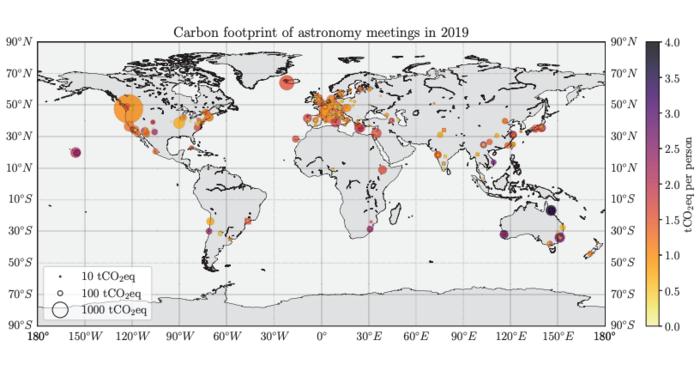
The carbon emissions associated with air travel to professional conferences make up a sizable fraction of the emissions produced by academia. Andrea Gokus and colleagues estimated the CO2-equivalent emissions for conference travel to all 362 open meetings in the field of astronomy in 2019. The total is an estimated 42,500 tCO2e, or about one ton per participant per meeting. According to the authors, networking and discussing new scientific developments at meetings is important for advancing the field, but adjustments can be made to reduce the hefty carbon cost. Holding meetings virtually almost completely eliminates emissions, but virtual meetings are often not regarded as efficient networking opportunities. Meeting organizers can also reduce carbon costs by preferentially locating venues as close as possible to the majority of participants, avoiding scenarios in which most participants are flying intercontinentally. However, the authors add, it is also important to provide opportunities for astronomers located far from today’s North American and European astronomy hubs. The authors also propose holding meetings at a small number of physical hubs, which are then virtually linked. As an example, if the American Astronomical Society meeting in 2019 was held in four global hubs (Seattle, WA; Baltimore, MD; Amsterdam, Netherlands; and Tokyo, Japan), attendance would generate 70% less carbon emissions than if it was held in Seattle alone. According to the authors, these approaches will also have the benefit of making astronomy meetings more inclusive, as traveling to meetings is often more difficult for astronomers from less-wealthy institutes; astronomers farther from North American and European hubs; astronomers who face complex visa bureaucracies; astronomers with disabilities; and women, who have disproportionately heavier childcare responsibilities.

Credit: Gokus et al
The carbon emissions associated with air travel to professional conferences make up a sizable fraction of the emissions produced by academia. Andrea Gokus and colleagues estimated the CO2-equivalent emissions for conference travel to all 362 open meetings in the field of astronomy in 2019. The total is an estimated 42,500 tCO2e, or about one ton per participant per meeting. According to the authors, networking and discussing new scientific developments at meetings is important for advancing the field, but adjustments can be made to reduce the hefty carbon cost. Holding meetings virtually almost completely eliminates emissions, but virtual meetings are often not regarded as efficient networking opportunities. Meeting organizers can also reduce carbon costs by preferentially locating venues as close as possible to the majority of participants, avoiding scenarios in which most participants are flying intercontinentally. However, the authors add, it is also important to provide opportunities for astronomers located far from today’s North American and European astronomy hubs. The authors also propose holding meetings at a small number of physical hubs, which are then virtually linked. As an example, if the American Astronomical Society meeting in 2019 was held in four global hubs (Seattle, WA; Baltimore, MD; Amsterdam, Netherlands; and Tokyo, Japan), attendance would generate 70% less carbon emissions than if it was held in Seattle alone. According to the authors, these approaches will also have the benefit of making astronomy meetings more inclusive, as traveling to meetings is often more difficult for astronomers from less-wealthy institutes; astronomers farther from North American and European hubs; astronomers who face complex visa bureaucracies; astronomers with disabilities; and women, who have disproportionately heavier childcare responsibilities.
Journal
PNAS Nexus
Article Title
Astronomy’s climate emissions: Global travel to scientific meetings in 2019
Article Publication Date
30-Apr-2024
Cite Scienmag News
Grant Pearson. (April 30, 2024). The carbon emissions of academic astronomy. Scienmag. https://scienmag.com/the-carbon-emissions-of-academic-astronomy/
Grant Pearson. "The carbon emissions of academic astronomy." Scienmag, 30 April 2024, https://scienmag.com/the-carbon-emissions-of-academic-astronomy/. Accessed 5 September 2026.
Grant Pearson. "The carbon emissions of academic astronomy." Scienmag. April 30, 2024. https://scienmag.com/the-carbon-emissions-of-academic-astronomy/

