

Friday, May 1, 2026
Science
No Result
View All Result
  • Login
  • HOME
  • SCIENCE NEWS
  • CONTACT US
  • HOME
  • SCIENCE NEWS
  • CONTACT US
No Result
View All Result
Scienmag
No Result
View All Result
Home Science News Medicine

Coal emissions reductions and mortality in China

April 30, 2024
in Medicine
Reading Time: 2 mins read
0
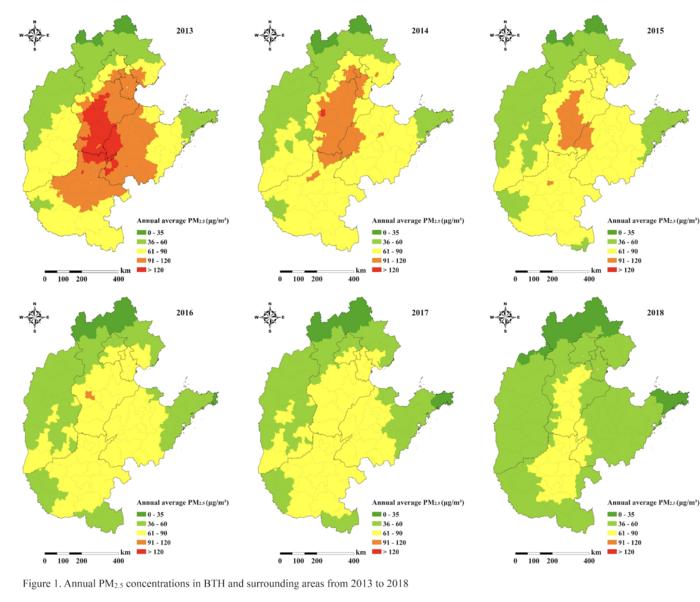
China coal Fig 1
66
SHARES
601
VIEWS
Share on FacebookShare on Twitter
ADVERTISEMENT

In 2012, China was the largest consumer of coal in the world. In 2013, the State Council of China issued the “China National Action Plan on Air Pollution Prevention and Control,” aiming to reduce emissions from coal combustion. The plan included renovations to small residential coal heating stoves as well as retrofits for coal-fired power plants, among other initiatives. Annual coal consumption fell between 2013 and 2017, which led to observed dramatic decreases in mean daily fine particulate matter (PM2.5) levels. In 2018, a new program, known as “Three-Year Action Plan for Winning the Blue Sky Defense Battle,” began, and in the same year, PM2.5 concentrations were further reduced by 9.3% from 2017 levels. In this context, Xiaoming Shi and colleagues used accountability analysis to assess whether the acute health effects of PM2.5 changed from 2013 to 2018 in the Beijing-Tianjin-Hebei area, which was the most heavily polluted region. The acute effects of PM2.5 were significantly decreased for total and circulatory mortality. A 10 μg/m3 increase in PM2.5 concentrations was associated with an increase of 0.16% and 0.02% in mortality from 2013 to 2015 and from 2016 to 2018, respectively. According to the authors, the reduced exposure-response relationship could be due to changes in particle toxicity, as PM2.5 from other sources may be less toxic than PM2.5 from coal. Behavioral changes to avoid air pollution may also have influenced the outcomes, the authors add.

China coal Fig 1

Credit: Li et al

In 2012, China was the largest consumer of coal in the world. In 2013, the State Council of China issued the “China National Action Plan on Air Pollution Prevention and Control,” aiming to reduce emissions from coal combustion. The plan included renovations to small residential coal heating stoves as well as retrofits for coal-fired power plants, among other initiatives. Annual coal consumption fell between 2013 and 2017, which led to observed dramatic decreases in mean daily fine particulate matter (PM2.5) levels. In 2018, a new program, known as “Three-Year Action Plan for Winning the Blue Sky Defense Battle,” began, and in the same year, PM2.5 concentrations were further reduced by 9.3% from 2017 levels. In this context, Xiaoming Shi and colleagues used accountability analysis to assess whether the acute health effects of PM2.5 changed from 2013 to 2018 in the Beijing-Tianjin-Hebei area, which was the most heavily polluted region. The acute effects of PM2.5 were significantly decreased for total and circulatory mortality. A 10 μg/m3 increase in PM2.5 concentrations was associated with an increase of 0.16% and 0.02% in mortality from 2013 to 2015 and from 2016 to 2018, respectively. According to the authors, the reduced exposure-response relationship could be due to changes in particle toxicity, as PM2.5 from other sources may be less toxic than PM2.5 from coal. Behavioral changes to avoid air pollution may also have influenced the outcomes, the authors add.


Journal

PNAS Nexus

Article Title

Accountability analysis of health benefits related to National Action Plan on Air Pollution Prevention and Control in China

Article Publication Date

30-Apr-2024

Share26Tweet17
Previous Post

The carbon emissions of academic astronomy

Next Post

Discovery of uranium-contaminated soil purification material without secondary environmental pollution

Related Posts

New Study Reveals Dangers of Driving After Consuming Cannabis Edibles and Alcohol — Medicine
Medicine

New Study Reveals Dangers of Driving After Consuming Cannabis Edibles and Alcohol

May 1, 2026
Chilly Extremities, Steamy Hearts: How Body Temperature Influences Disease from TRPM4 Mutations — Medicine
Medicine

Chilly Extremities, Steamy Hearts: How Body Temperature Influences Disease from TRPM4 Mutations

May 1, 2026
Medicine

Decoding Ketamine’s Mechanisms Could Unlock New Antidepressant Therapies

May 1, 2026
Glycated Markers Detect Dysglycemia in Older Adults — Medicine
Medicine

Glycated Markers Detect Dysglycemia in Older Adults

May 1, 2026
Dr. Hannah Cabré Named Assistant Professor and Director of Aging, Gynecology, and Endocrinology Lab at Pennington Biomedical — Medicine
Medicine

Dr. Hannah Cabré Named Assistant Professor and Director of Aging, Gynecology, and Endocrinology Lab at Pennington Biomedical

May 1, 2026
Study Finds That Nose Prominence Influences Facial Attractiveness, Reports Plastic and Reconstructive Surgery® — Medicine
Medicine

Study Finds That Nose Prominence Influences Facial Attractiveness, Reports Plastic and Reconstructive Surgery®

May 1, 2026
Next Post
The adsorption mechanism of uranium (VI) by hexagonal boron nitride (h-BN)

Discovery of uranium-contaminated soil purification material without secondary environmental pollution

  • Mothers who receive childcare support from maternal grandparents show more parental warmth, finds NTU Singapore study

    Mothers who receive childcare support from maternal grandparents show more parental warmth, finds NTU Singapore study

    27639 shares
    Share 11052 Tweet 6908
  • University of Seville Breaks 120-Year-Old Mystery, Revises a Key Einstein Concept

    1042 shares
    Share 417 Tweet 261
  • Bee body mass, pathogens and local climate influence heat tolerance

    677 shares
    Share 271 Tweet 169
  • Researchers record first-ever images and data of a shark experiencing a boat strike

    540 shares
    Share 216 Tweet 135
  • Groundbreaking Clinical Trial Reveals Lubiprostone Enhances Kidney Function

    527 shares
    Share 211 Tweet 132
Science

Embark on a thrilling journey of discovery with Scienmag.com—your ultimate source for cutting-edge breakthroughs. Immerse yourself in a world where curiosity knows no limits and tomorrow’s possibilities become today’s reality!

RECENT NEWS

  • New Study Reveals Dangers of Driving After Consuming Cannabis Edibles and Alcohol
  • Chilly Extremities, Steamy Hearts: How Body Temperature Influences Disease from TRPM4 Mutations
  • Using Epigenetics to Monitor Environmental Arsenic Exposure
  • Unseen Benefits of Inactivating Resistance Genes

Categories

  • Agriculture
  • Anthropology
  • Archaeology
  • Athmospheric
  • Biology
  • Biotechnology
  • Blog
  • Bussines
  • Cancer
  • Chemistry
  • Climate
  • Earth Science
  • Editorial Policy
  • Marine
  • Mathematics
  • Medicine
  • Pediatry
  • Policy
  • Psychology & Psychiatry
  • Science Education
  • Social Science
  • Space
  • Technology and Engineering

Subscribe to Blog via Email

Enter your email address to subscribe to this blog and receive notifications of new posts by email.

Join 5,145 other subscribers

© 2025 Scienmag - Science Magazine

Welcome Back!

Login to your account below

Forgotten Password?

Retrieve your password

Please enter your username or email address to reset your password.

Log In
No Result
View All Result
  • HOME
  • SCIENCE NEWS
  • CONTACT US

© 2025 Scienmag - Science Magazine

Discover more from Science

Subscribe now to keep reading and get access to the full archive.

Continue reading
