


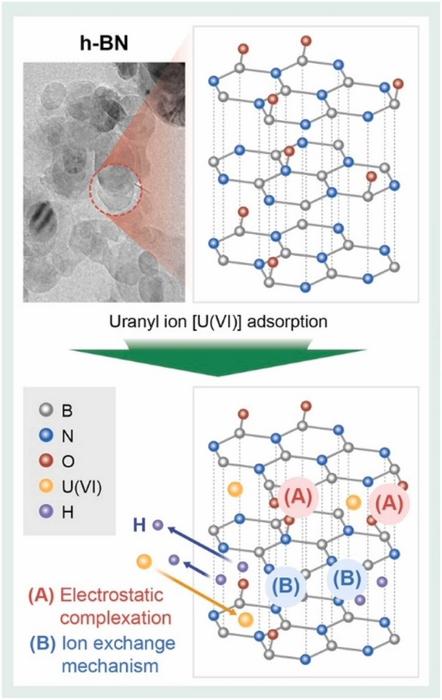
Nuclear energy has long been regarded as a next-generation energy source, and major countries around the world are competing to secure cutting-edge technologies by leveraging the high economic efficiency and sustainability of nuclear power. However, uranium, which is essential for nuclear power generation, has serious implications for both soil ecosystems and human health. Despite being a key radioactive material, uranium poses significant health risks due to its chemical toxicity to the kidneys, bones, and cells. As a result, both the U.S. Environmental Protection Agency and the World Health Organization recommend allowing and advocating for uranium concentrations in wastewater to be below 30 μg/L.

Credit: Korea Institute of Civil Engineering and Building Technology
Nuclear energy has long been regarded as a next-generation energy source, and major countries around the world are competing to secure cutting-edge technologies by leveraging the high economic efficiency and sustainability of nuclear power. However, uranium, which is essential for nuclear power generation, has serious implications for both soil ecosystems and human health. Despite being a key radioactive material, uranium poses significant health risks due to its chemical toxicity to the kidneys, bones, and cells. As a result, both the U.S. Environmental Protection Agency and the World Health Organization recommend allowing and advocating for uranium concentrations in wastewater to be below 30 μg/L.
The Korea Institute of Civil Engineering and Building Technology (KICT, President Kim, Byung-suk) has conducted research on a nano-material-based adsorption process to efficiently remove uranium wastewater extracted from actual radioactive-contaminated soil. They have also proposed its applicability to prevent secondary environmental pollutions.
Radioactive wastewater, an inevitable by-product of nuclear energy generation, requires post-treatment to minimize ecological impact and associated risks. Although this process involves intricate procedures and substantial costs, various methods have been employed to treat radioactive wastewater from uranium-contaminated soil. These methods include chemical precipitation, evaporation, electrochemical techniques, membrane separation, and adsorption/ion exchange. Among these, chemical precipitation using injected chemical agents is commonly employed in practical applications. However, considering factors such as cost-effectiveness, environmental friendliness, practicality, and renewability, adsorption processes emerge as particularly suitable for uranium wastewater treatment.
Boron nitride (BN), a material that has garnered attention as an effective adsorbent due to its high mechanical strength, acid resistance, and significant surface area, is renowned for its impressive performance in wastewater treatment through adsorption processes. However, research on the actual treatment of uranium wastewater using hexagonal boron nitride (h-BN) has not yet been conducted, leaving the applicability of boron nitride (BN) for real uranium wastewater treatment as an unknown factor.
The research team at the KICT, led by Dr. Rho, Hojung, has comprehensively evaluated the adsorption performance of h-BN nano-materials for uranium wastewater treatment. They explored various operating and water environmental conditions, including exposure time, temperature, initial uranium concentration, background ions (such as NaCl and MgCl2), and Humic acid (HA). The study suggests that boron nitride (BN) can be effectively applied for uranium wastewater treatment. Additionally, they conducted a reusability test on h-BN, which efficiently adsorbed dissolved uranium, further demonstrating its high reusability.
Furthermore, through the analysis of experimental variables such as initial uranium concentration, exposure time, temperature, pH, and the presence of background ions or organic matter, the research team conducted a ‘feature importance analysis’ using the artificial intelligence-based Random Forest algorithm. As a result, they discovered that temperature, cations, and organic matter have minimal impact on adsorption performance, marking this study as the world’s first of its kind.
This study is expected to contribute to minimizing potential harm to the environment and human health by enabling more efficient treatment of soil contaminated with radioactive wastewater generated from nuclear power plants.
Dr. Rho said, “The conventional precipitation method for purifying uranium-contaminated soil using chemical agents leads to secondary environmental pollution.” He further revealed that “utilizing boron nitride (BN) nano-adsorbents for uranium treatment ensures high reusability without the need for chemical agents, making it a novel environmentally friendly nuclear waste disposal method.”
###
The Korea Institute of Civil Engineering and Building Technology, a government-funded research institute with 40 years of extensive research experience, is at the forefront of solving national issues that are directly related to the quality of the people’s life.
This work was supported by the National Research Foundation of Korea (NRF) and Commercialization Promotion Agency for R&D Outcomes (COMPA) grant funded by the Korea government (MSIT) (RS2023-00233235), An article explaining the results of this research was published in the latest issue of Journal of Hazardous Materials, a renowned international journal in the Environmental Science field (IF:13.6).
Journal
Journal of Hazardous Materials
Article Title
Adsorption of uranyl ion on hexagonal boron nitride for remediation of real U-contaminated soil and its interpretation using random forest
Article Publication Date
5-May-2024
Cite Scienmag News
Russell Cooper. (April 30, 2024). Discovery of uranium-contaminated soil purification material without secondary environmental pollution. Scienmag. https://scienmag.com/discovery-of-uranium-contaminated-soil-purification-material-without-secondary-environmental-pollution/
Russell Cooper. "Discovery of uranium-contaminated soil purification material without secondary environmental pollution." Scienmag, 30 April 2024, https://scienmag.com/discovery-of-uranium-contaminated-soil-purification-material-without-secondary-environmental-pollution/. Accessed 7 September 2026.
Russell Cooper. "Discovery of uranium-contaminated soil purification material without secondary environmental pollution." Scienmag. April 30, 2024. https://scienmag.com/discovery-of-uranium-contaminated-soil-purification-material-without-secondary-environmental-pollution/

