


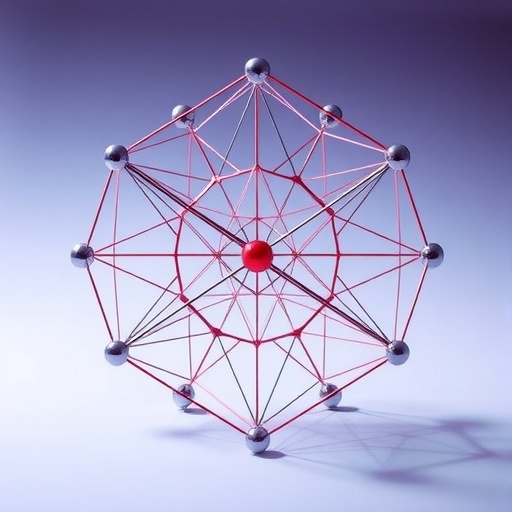
Quantum computers promise computational power far beyond anything classical machines can achieve, but that promise comes with a fragile catch: quantum information is exquisitely sensitive to noise. Every qubit in a quantum processor is constantly menaced by decoherence, the process by which interactions with the environment destroy the delicate superpositions and entanglement that quantum computation depends on. The discipline of quantum error correction exists to fight back, encoding logical information redundantly across many physical qubits so that errors can be detected and reversed without measuring—and thereby destroying—the data itself. Now, a team of researchers in China has delivered a significant advance in this ongoing campaign, forging a deep new connection between the geometry of a fundamental mathematical object, the symplectic group, and a powerful family of quantum error-correcting codes known as entanglement-assisted quantum error-correcting codes, or EAQECCs.
The work, published in the journal Quantum Information Processing by Ruihu Li and Yang Liu of Air Force Engineering University in Xi’an, Yuezhen Ren of Xi’an Polytechnic University, and Chaofeng Guan of Zhengzhou University, establishes a systematic correspondence between symplectic subspaces—geometric structures living inside the symplectic group over finite fields—and quaternary additive codes, the algebraic objects that encode the parameters of entanglement-assisted stabilizer codes. This correspondence is more than an aesthetic curiosity. It provides a constructive bridge that allows the authors to translate long-standing open problems about optimal EAQECCs into geometric questions about subspaces, where powerful counting and classification techniques become available. In doing so, the team has resolved several open problems concerning optimal entanglement-assisted codes and entanglement-assisted quantum maximum distance separable codes, a class of codes that achieve the best possible trade-off between length, dimension, and error-correcting capability.
To appreciate why this matters, it helps to trace the lineage of the field. Quantum error correction was born in the mid-1990s, when Peter Shor demonstrated in 1995 that a quantum state could be protected by spreading it across nine physical qubits, and Andrew Steane independently showed shortly afterward that error-correcting ideas from classical coding theory could be imported into the quantum setting. The modern framework of stabilizer codes, crystallized in Daniel Gottesman’s 1997 doctoral thesis, recast the problem in the language of the Pauli group: quantum states are protected by measuring operators that form an abelian subgroup, the stabilizer, whose eigenvalues reveal the syndrome of an error without revealing the encoded information. In 1998, Calderbank, Rains, Shor, and Sloane made a decisive connection to classical coding theory by showing that stabilizer codes over qubits correspond to self-orthogonal additive codes over the finite field GF(4). This correspondence turned the search for good quantum codes into a problem about classical codes satisfying a self-orthogonality constraint, and it has driven the field ever since.
But the self-orthogonality requirement is a straitjacket. Requiring the stabilizer to be an abelian group means the associated classical code must be self-orthogonal with respect to a suitable inner product, and many excellent classical codes fail that test. Entanglement assistance, introduced by Todd Brun, Igor Devetak, and Min-Hsiu Hsieh in a landmark 2006 paper in Science, removes this restriction. The central idea is elegant: if the stabilizer generators fail to commute, the anticommuting parts can be absorbed by sharing pre-existing entangled pairs—ebits—between the sender and receiver. With a supply of entanglement, essentially any classical quaternary code, self-orthogonal or not, can be converted into a quantum code. An EAQECC with parameters [[n, k, d; c]] encodes k logical qubits into n physical qubits, corrects errors of weight up to the floor of (d−1)/2, and consumes c shared ebits in the process. The entanglement acts as a catalytic resource, purchased in advance and consumed to buy superior error-correcting performance.
The cost of that resource makes the parameter c a central object of study. Researchers including Mark Wilde and Todd Brun derived optimal entanglement formulas that determine the minimum number of ebits a code needs, while Chi-Kwong Lai and collaborators developed duality theories and linear-programming bounds tailored to the entanglement-assisted setting. A rich landscape of bounds—the quantum Singleton bound, the quantum Hamming bound, and entanglement-assisted variants—governs what parameter triples are achievable, and codes that meet these bounds with equality are prized as optimal. Entanglement-assisted quantum maximum distance separable codes, or EAQMDS codes, are the quantum analogues of the celebrated classical MDS codes: they saturate the Singleton bound, meaning their minimum distance is as large as algebraically possible for their length and dimension. Constructing such codes explicitly, for many different lengths and over many field sizes, is one of the most active pursuits in quantum coding theory, and one where the new work makes its most striking contribution.
The key technical insight of the new paper lies in how it characterizes EA stabilizer codes. In the additive-code picture, an entanglement-assisted code is built from a pair of codes C and D over GF(4), or equivalently from a single additive code together with information about its symplectic dual. The number of ebits required, the dimension of the encoded space, and the minimum distance all translate into combinatorial properties of these codes. What Li and colleagues show is that these properties can be understood through the geometry of the symplectic group Sp(2m, q), the group of linear transformations preserving a symplectic form on a 2m-dimensional vector space over a finite field. Subspaces of this vector space come in families classified by their dimension and by how they intersect their own symplectic orthogonal complements—whether they are totally isotropic, nonisotropic, or something in between. The authors establish precise relations between such symplectic subspaces and the quaternary additive codes arising in EAQECC constructions, allowing parameters of EA stabilizer codes to be read off directly from geometric data.
This geometric dictionary pays off immediately. Counting arguments over families of symplectic subspaces—an approach pioneered by Zhexian Wan in his monograph on the geometry of classical groups over finite fields, and long a staple of finite-geometry-based coding constructions—let the researchers establish the existence of EAQECCs with parameter sets that had eluded previous constructions, and in several cases to prove optimality where only bounds existed before. The work also builds on the authors’ own earlier discoveries: in 2023, Guan, Li, Liu, and Ma showed in IEEE Transactions on Information Theory that certain quaternary additive codes genuinely outperform their linear counterparts, a finding that highlighted how relaxing linearity enlarges the space of good codes. The additive setting is technically delicate—quaternary additive codes need not be linear over GF(4), which complicates classical duality theory—but the symplectic geometric framework embraces them naturally, since symplectic orthogonality is defined at the level of vector spaces over the base field GF(2).
Beyond resolving existence and optimality questions, the authors point to a second, practical payoff: the design of encoding and decoding quantum circuits for EA stabilizer codes. The stabilizer formalism translates directly into Clifford-group circuits, with each stabilizer generator corresponding to a measured operator implemented by controlled-Pauli gates, and the symplectic representation makes these circuits explicit: Clifford operations act as symplectic transformations on the binary representation of Pauli operators. By grounding EAQECC parameters in symplectic subspace structure, the new framework provides a cleaner route from a code’s abstract definition to the concrete circuitry a hardware engineer would deploy, potentially easing the path from mathematical construction to working fault-tolerant logic.
The broader context makes the contribution timely. As quantum processors scale from hundreds toward thousands of qubits, the overhead of error correction dominates resource estimates for useful quantum computation. Entanglement-assisted schemes occupy an interesting position in this economy: they demand a communication and entanglement-distribution infrastructure, since ebits must be established between communicating parties before coding begins, but in exchange they relax the algebraic constraints on the underlying classical codes, often yielding shorter codes or larger minimum distances for the same block length. In settings where entanglement distribution is feasible—such as future quantum networks and quantum repeater chains, where entanglement is precisely the commodity being distributed—EAQECCs could be the natural encoding layer. Knowing exactly which parameter sets are attainable, and which are optimal, tells network architects what protection they can buy for a given budget of qubits and ebits.
The paper also contributes to a longer-running conversation about fundamental bounds. Recent years have seen intense scrutiny of the quantum Singleton bound and its entanglement-assisted generalizations, including entropic proofs by Markus Grassl, Florian Huber, and Andreas Winter, and results showing that entanglement can allow codes to beat the ordinary Singleton bound. Precise constructions that saturate or approach these bounds, anchored in firm geometric ground as the new work proposes, sharpen our understanding of the ultimate limits of quantum communication. With the field’s standard reference tables, maintained by Grassl at codetables.de, still containing many open entries for EAQECC parameters, techniques that systematically generate new codes and prove their optimality are exactly what the community needs to fill in the map.
The research was supported by the National Natural Science Foundation of China under Grant No. U21A20428 and by the Natural Science Foundation of Shaanxi Province. It arrives as part of a visible surge of mathematical sophistication in quantum coding theory, where finite geometry, combinatorial design theory, and algebraic curves over finite fields all supply construction tools. What distinguishes the present contribution is the systematic nature of the link it forges: rather than producing isolated parameter sets, it offers a framework in which entire families of entanglement-assisted codes can be analyzed, compared, and optimized through the lens of symplectic geometry. As the demand for efficient, hardware-compatible error correction intensifies, such unifying mathematical structures may prove to be among the most valuable assets the field has.
Cite Scienmag News
Katie Riggs. (September 7, 2026). Symplectic group geometry enables construction of optimal entanglement-assisted quantum codes. Scienmag. https://scienmag.com/symplectic-group-geometry-enables-construction-of-optimal-entanglement-assisted-quantum-codes/
Katie Riggs. "Symplectic group geometry enables construction of optimal entanglement-assisted quantum codes." Scienmag, 7 September 2026, https://scienmag.com/symplectic-group-geometry-enables-construction-of-optimal-entanglement-assisted-quantum-codes/. Accessed 7 September 2026.
Katie Riggs. "Symplectic group geometry enables construction of optimal entanglement-assisted quantum codes." Scienmag. September 7, 2026. https://scienmag.com/symplectic-group-geometry-enables-construction-of-optimal-entanglement-assisted-quantum-codes/


