


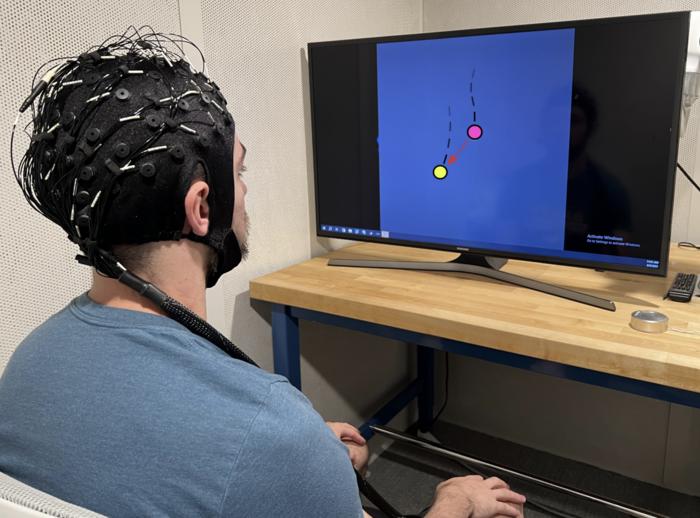
Brain-computer interfaces (BCIs) have the potential to make life easier for people with motor or speech disorders, allowing them to manipulate prosthetic limbs and employ computers, among other uses. In addition, healthy and impaired people alike could enjoy BCI-based gaming. Non-invasive BCIs that work by analyzing brain waves recorded through electroencephalography are currently limited by inconsistent performance. Bin He and colleagues used deep-learning decoders to improve a BCI’s performance responding to a user who is engaged in the task of tracking an object in two-dimensional space with a cursor. Twenty-eight adult participants were instructed to imagine moving their right hand to move the cursor right and their left hand to move the cursor left, moving both hands simultaneously to move upwards, and moving neither hand to go down, to enable continuous and sustained movement of a virtual object. The authors evaluated two different deep-learning architectures and a traditional decoder over seven BCI sessions. Both deep-learning decoders improved throughout the study and outperformed the traditional decoder by the final session. With the aid of deep-learning based decoders, human participants were able to control a fast and continuously moving computer cursor using an AI-powered non-invasive BCI that is solely based on sensor-space brain waves, tracking randomly moving objects with a high level of performance without moving a muscle, an accomplishment that could be an initial step towards neuro-assistive robotics, according to the authors.

Credit: Forenzo et al
Brain-computer interfaces (BCIs) have the potential to make life easier for people with motor or speech disorders, allowing them to manipulate prosthetic limbs and employ computers, among other uses. In addition, healthy and impaired people alike could enjoy BCI-based gaming. Non-invasive BCIs that work by analyzing brain waves recorded through electroencephalography are currently limited by inconsistent performance. Bin He and colleagues used deep-learning decoders to improve a BCI’s performance responding to a user who is engaged in the task of tracking an object in two-dimensional space with a cursor. Twenty-eight adult participants were instructed to imagine moving their right hand to move the cursor right and their left hand to move the cursor left, moving both hands simultaneously to move upwards, and moving neither hand to go down, to enable continuous and sustained movement of a virtual object. The authors evaluated two different deep-learning architectures and a traditional decoder over seven BCI sessions. Both deep-learning decoders improved throughout the study and outperformed the traditional decoder by the final session. With the aid of deep-learning based decoders, human participants were able to control a fast and continuously moving computer cursor using an AI-powered non-invasive BCI that is solely based on sensor-space brain waves, tracking randomly moving objects with a high level of performance without moving a muscle, an accomplishment that could be an initial step towards neuro-assistive robotics, according to the authors.
Journal
PNAS Nexus
Article Title
Continuous tracking using deep learning-based decoding for noninvasive brain–computer interface
Article Publication Date
30-Apr-2024
Cite Scienmag News
Cassandra Pierce. (April 30, 2024). Deep-learning decoding for a noninvasive brain-computer interface. Scienmag. https://scienmag.com/deep-learning-decoding-for-a-noninvasive-brain-computer-interface/
Cassandra Pierce. "Deep-learning decoding for a noninvasive brain-computer interface." Scienmag, 30 April 2024, https://scienmag.com/deep-learning-decoding-for-a-noninvasive-brain-computer-interface/. Accessed 4 September 2026.
Cassandra Pierce. "Deep-learning decoding for a noninvasive brain-computer interface." Scienmag. April 30, 2024. https://scienmag.com/deep-learning-decoding-for-a-noninvasive-brain-computer-interface/

