


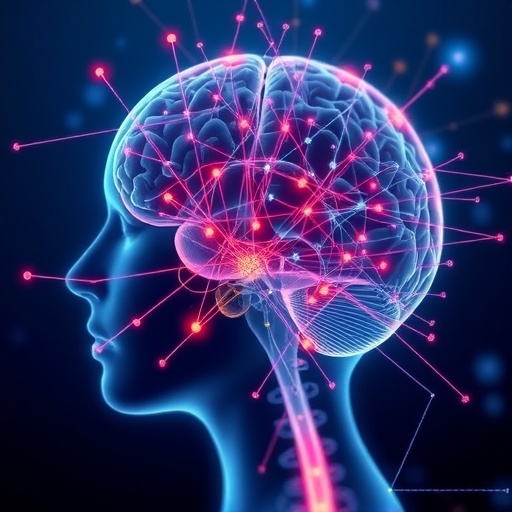
In a groundbreaking new study published in BMC Psychiatry, researchers have illuminated previously uncharted territory in the complex neural interactions underlying major depressive disorder (MDD). The study focuses intently on the thalamo-cortical circuit, a critical network facilitating communication between the thalamus and the cerebral cortex, and highlights how its disturbances are intricately tied to the cognitive and emotional dysfunctions typical in MDD. This pioneering investigation utilizes advanced neuroimaging and cutting-edge data analytic techniques to dissect these alterations not just spatially but temporally, offering a fresh lens through which to understand this pervasive mental health challenge.
At the heart of this research lies the concept of frequency-specific effective connectivity (EC), which captures how different brain regions influence each other over distinct frequency bands. Unlike prior standard approaches that often overlook temporal features of brain signaling, this analysis adopts spectral Granger causality methods, allowing the researchers to determine the direction and strength of information flow between the thalamic subregions and various cortical and subcortical areas over unique frequency ranges. These frequency bands—ranging from slow-5 (0.01–0.027 Hz) to slow-3 (0.073–0.185 Hz) and a classical network band (0.01–0.08 Hz)—serve as refined filters to detect nuanced disruptions in brain communication patterns associated with MDD.
The study leveraged an impressively large-scale, multicenter resting-state functional magnetic resonance imaging (fMRI) dataset, meticulously curated to include patients diagnosed with MDD alongside well-matched healthy controls. This expansive sample size and multicenter approach provide robust statistical power and improved generalizability over previous, smaller studies hampered by sample heterogeneity. The resting-state fMRI setting allowed the probing of baseline brain activity and connectivity dynamics without the confounding effects of task engagement, an ideal framework for assessing intrinsic network dysfunction in depression.
One of the most striking findings of the study is the identification of pronounced abnormalities in thalamocortical and thalamo-subcortical EC within the slow-5 frequency band. This low-frequency oscillatory activity is suspected to underlie fundamental integrative processes spanning large-scale neural networks. The observed disruptions in slow-5 connectivity patterns suggest that patients with MDD experience a critical breakdown in the foundational temporal scaffolding necessary for seamless communication between the thalamus and other brain regions, which likely manifests as cognitive and mood dysregulation.
Interestingly, these connectivity abnormalities were not diffusely distributed but originated from specific thalamic subregions, extending their pathological influence to multiple cortical and subcortical nodes. This spatial specificity underscores the heterogeneous nature of thalamic dysfunction in depression, and points to the potential existence of identifiable circuit-based subtypes within the disorder. By pinpointing these exact subregional sources of aberrant network activity, the study opens avenues for targeted neuromodulation strategies that could rectify dysfunctional signaling at its source.
Beyond mapping these neural circuit alterations, the researchers took a critical step further by linking the altered EC metrics with clinical symptom severity. Using sophisticated support vector regression (SVR) models—a form of supervised machine learning—the study demonstrated that abnormalities in slow-5 thalamo-cortical EC were highly predictive of patients’ clinical scores. This predictive capability not only reforges the connection between brain connectivity abnormalities and functional impairment but also hints at the promising utility of EC profiles as biomarkers for diagnosis and prognosis in MDD.
The implications of these findings extend well beyond academic interest. Traditionally, MDD has been diagnosed and treated based primarily on clinical symptomatology, a method both subjective and limited in guiding personalized treatment. The identification of a frequency-specific EC disruption tied directly to disease severity heralds a future where biomarkers derived from objective brain imaging could revolutionize diagnosis, track treatment response, and even inform individualized therapeutic interventions. Such precision psychiatry approaches could significantly improve outcomes for millions grappling with this debilitating disorder worldwide.
Notably, the emphasis on slow-5 frequency disruptions aligns with emerging perspectives that low-frequency neural oscillations play integral roles in coordinating large-scale brain networks. This insight dovetails neatly with growing evidence in cognitive neuroscience that depression may involve a core deficit in global information integration rather than isolated regional abnormalities. The study’s focus hence complements and extends contemporary network theories of psychiatric disorders, framing depression as a dysconnectivity syndrome with distinct temporal and spatial dimensions.
From a methodological perspective, the use of spectral Granger causality represents a sophisticated approach to unraveling directed brain connectivity. Unlike traditional correlation-based connectivity measures, Granger causality infers causal influence over time between neural signals, addressing vital questions about how information flows rather than merely identifying statistical dependencies. Applying this technique across multiple frequency bands enables a detailed mapping of how brain communication dynamics vary temporally—an essential element given that neural codes operate within specific frequency channels.
The inclusion of a comprehensive frequency-specific analysis contrasts with previous work that often employed broad frequency ranges, which risk conflating distinct neurophysiological processes. By dissecting the connectivity patterns at distinct frequency bands, the researchers could unmask how specific oscillatory activities contribute to functional disruptions in MDD, thereby providing richer mechanistic insights and more refined potential targets for intervention.
Moreover, their work illustrates the power of machine learning techniques, such as support vector regression, in bridging the gap between neuroimaging data and clinical outcomes. This integrative approach advances the field beyond mere description, offering practical tools for predicting individual symptom profiles from objective brain measures, which is crucial for tailoring treatments and monitoring disease progression with agility and precision.
In conclusion, this comprehensive study uncovers critical spatiotemporal alterations in thalamo-cortical effective connectivity in major depressive disorder patients. By spotlighting frequency-specific disruptions predominantly in the slow-5 band and demonstrating their relationship to clinical symptomatology, the research paves the way for novel neurobiological markers and potentially transformative diagnostic and therapeutic strategies. It represents a significant stride toward unraveling the intricate neural underpinnings of depression, transcending traditional notions of static brain deficits to embrace a dynamic, circuit-based understanding of mental illness.
As the field moves forward, these findings beckon further exploration into the mechanistic origins of frequency-dependent connectivity abnormalities and their modulation through interventions such as neurofeedback, transcranial magnetic stimulation, or pharmacotherapy. The integration of large-scale multimodal datasets, longitudinal designs, and personalized machine learning models promises to accelerate discoveries, ultimately translating these scientific insights into tangible benefits for those afflicted by major depressive disorder.
Cite Scienmag News
Glenn Wilkins. (October 2, 2025). Thalamo-Cortical Connectivity Shifts in Depression. Scienmag. https://scienmag.com/thalamo-cortical-connectivity-shifts-in-depression/
Glenn Wilkins. "Thalamo-Cortical Connectivity Shifts in Depression." Scienmag, 2 October 2025, https://scienmag.com/thalamo-cortical-connectivity-shifts-in-depression/. Accessed 4 September 2026.
Glenn Wilkins. "Thalamo-Cortical Connectivity Shifts in Depression." Scienmag. October 2, 2025. https://scienmag.com/thalamo-cortical-connectivity-shifts-in-depression/


