


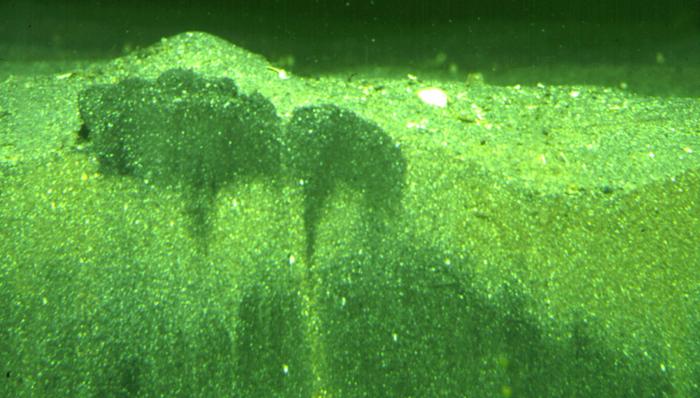
A pioneering study has used extensive global datasets and machine learning to map the activities of seafloor invertebrate animals, including worms, clams and shrimps, across the entire ocean, revealing for the first time critical factors that support and maintain the health of marine ecosystems.

Credit: Dr. Martin Solan, University of Southampton
A pioneering study has used extensive global datasets and machine learning to map the activities of seafloor invertebrate animals, including worms, clams and shrimps, across the entire ocean, revealing for the first time critical factors that support and maintain the health of marine ecosystems.
The international team, led by Texas A&M University and including investigators from Yale University and the University of Southampton, specifically focused on the unsung yet vital role burrowing animals play as “ecosystem engineers” in shaping nutrient cycling and ecosystem health — and, in turn, maritime economies and food security — throughout the oceans. The researchers used machine learning to map out a global picture of these animals’ activities and the environmental conditions that drive them.
Marine sediments cover the majority of the Earth’s surface and are extremely diverse. By stirring up and churning the seafloor — a process known as bioturbation — seafloor invertebrates play a significant role in regulating global carbon, nutrient and biogeochemical cycles, explains Texas A&M Department of Oceanography Assistant Professor Dr. Shuang Zhang, lead researcher and first author of the study, which is published May 22 in the Cell Press journal Current Biology.
“Knowing how bioturbation links to other aspects of the environment means that we are now better equipped to predict how these systems might change in response to climate change,” added Zhang, who is also a member of the CArbon Cycle and Earth Environment (CACEE) Lab at Texas A&M.
Working with trained models and global datasets of bioturbation, the team factored in seawater depth, primary productivity, sediment type and other criteria to investigate how the ocean environments in which these animals live influence how intensively and deeply mixed the seafloor is around the world.
“Through our analysis, we discovered that not just one, but multiple environmental factors jointly influence seafloor bioturbation and the ecosystem services these animals provide,” said Dr. Lidya Tarhan, an assistant professor in the Department of Earth and Planetary Sciences at Yale. “This includes factors that directly impact food supply, underlying the complex relationships that sustain marine life, both today and in Earth’s past.”
In addition to showing that current efforts to protect marine ecosystems have fallen short by not targeting these animals, the researchers note that their study has important ramifications for how we protect and conserve the ocean.
“We have known for some time that ocean sediments are extremely diverse and play a fundamental role in mediating the health of the ocean, but only now do we have insights about where, and by how much, these communities contribute,” said Dr. Martin Solan, a professor of marine ecology at Southampton. “For example, the way in which these communities affect important aspects of ocean ecosystems are very different between the coastlines and deep sea.”
Tarhan says the ability to anticipate these changes is vital for developing strategies to mitigate habitat deterioration and protect marine biodiversity.
“Our analysis suggests that the present global network of marine protected areas does not sufficiently protect these important seafloor processes, indicating that protection measures need to be better catered to promote ecosystem health,” she added.
According to Zhang, the team is already planning their next joint collaboration, building on the findings of the present study. Despite having a clearer picture of geographic patterns in bioturbation, he says major questions remain regarding how this translates into the many ecosystem services society relies upon, such as food security, climate regulation and biogeochemical cycling. Ultimately, Zhang asserts that researchers need to determine how best to protect seafloor communities and anticipate how these communities respond to a changing climate.
“Tackling these really big questions is vital, but as we have established here, it requires an international team with a diversity of expertise to fully address these problems,” Zhang added. “By working together as we have done here, we expect additional exciting findings shortly.”
The team’s research was funded in part by the Natural Environment Research Council and Yale, which is where Zhang earned his Ph.D. in 2017. Their paper, “Global distribution and environmental correlates of marine bioturbation,” can be viewed online along with related figures and captions.
By Shana K. Hutchins, Texas A&M University College of Arts and Sciences
###
Journal
Current Biology
Article Title
Global distribution and environmental correlates of marine bioturbation
Article Publication Date
22-May-2024
Cite Scienmag News
Margaret Porter. (May 28, 2024). Texas A&M-led team creates first global map of seafloor biodiversity activity. Scienmag. https://scienmag.com/texas-am-led-team-creates-first-global-map-of-seafloor-biodiversity-activity/
Margaret Porter. "Texas A&M-led team creates first global map of seafloor biodiversity activity." Scienmag, 28 May 2024, https://scienmag.com/texas-am-led-team-creates-first-global-map-of-seafloor-biodiversity-activity/. Accessed 3 September 2026.
Margaret Porter. "Texas A&M-led team creates first global map of seafloor biodiversity activity." Scienmag. May 28, 2024. https://scienmag.com/texas-am-led-team-creates-first-global-map-of-seafloor-biodiversity-activity/

