


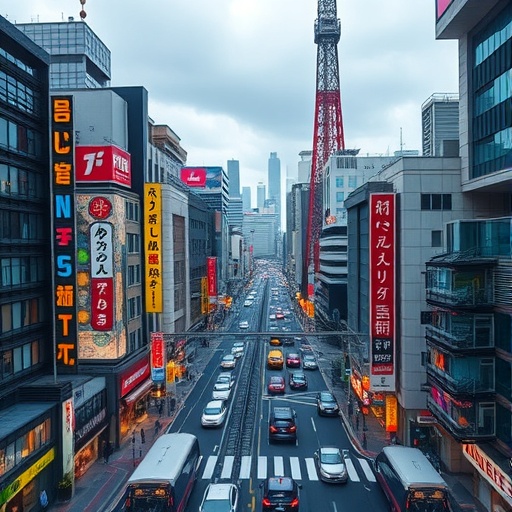
In the wake of the COVID-19 pandemic, the urban fabric of cities worldwide has been under unprecedented pressure and transformation. Among the most profound shifts witnessed has been the rapid adoption of teleworking, a phenomenon that has reconfigured where and how people choose to live. A groundbreaking study conducted in Tokyo by Yamazaki, Iida, and Ohkubo, published in the prestigious journal npj Urban Sustainability in 2026, reveals a complex new pattern in residential density preferences among teleworkers—a phenomenon the authors term the “double circle” of density preferences.
The research delves deeply into the urban behavioral shifts of teleworkers during the pandemic, highlighting how these shifts have not only altered commuting patterns and workplace dynamics but have also fundamentally reshaped housing demand and urban density gradients. Tokyo, a megacity famed for its high-density living and intricate public transportation networks, provides an ideal case study for exploring how remote work influences residential choices in dense metropolitan contexts.
Central to Yamazaki and colleagues’ findings is the identification of a bifurcated pattern in residential density preferences. The “double circle” concept encapsulates how teleworkers simultaneously gravitate toward two distinct urban density zones, diverging from traditional unidirectional preferences noted in pre-pandemic urban models. One circle encompasses the innermost urban core, characterized by extremely high density and ready access to cultural amenities and services. The other circle is located at the urban periphery, where residents seek larger living spaces and more greenery often unavailable at the city center.
This dual preference pattern reflects the competing needs that teleworkers face. On one hand, the urban core offers convenience and proximity to urban vibrancy. On the other, the outer suburbs or even exurban areas provide tranquility, space conducive to home offices, and perceived safety from contagion. The “double circle” model thus challenges traditional urban planning assumptions which often anticipate a single prevailing trend—either further urban sprawl or intensified infill development.
Throughout the study, the authors integrate quantitative data derived from extensive surveys administered to thousands of Tokyo teleworkers, coupled with spatial analysis utilizing Geographic Information Systems (GIS). This methodological blend enables the detailed mapping of density shifts and residential relocations with unprecedented granularity. It also facilitates an exploration of demographic correlates, uncovering, for example, how age, employment sector, and family composition modulate these density preferences.
One of the key implications underscored in the research is the powerful influence of teleworking on the urban housing market. The bifurcation in demand could intensify pressures on both highly dense central zones and expansive peripheral suburbs, posing significant challenges for urban planners and policymakers. To accommodate the dual demand, cities may need to reimagine zoning laws, infrastructure investment, and public transit services to balance density with liveability.
Moreover, the study speaks to a nuanced relationship between telework frequency and residential choice. Full-time teleworkers tend to favor peripheral living more strongly, exploiting the flexibility to abandon long-distance commutes and invest in spatial quality of life. Meanwhile, hybrid workers, who split time between home and offices, appear inclined to maintain proximity to central urban amenities, underscoring the continued importance of central business districts.
The authors also explore the environmental implications of these shifting density preferences. Increased peripheral settlement risks exacerbating urban sprawl, potentially increasing automobile dependence and infrastructure costs. Conversely, sustained demand in central dense zones could bolster sustainable transit-oriented development strategies aligned with climate mitigation goals. The “double circle” thus highlights a delicate balance between sustainability and emerging lifestyle demands.
Tokyo’s unique urban morphology—marked by an extensive rail transit network, mixed land uses, and a culturally ingrained preference for compact living—frames the particularities of the study’s findings. Yet, the “double circle” concept holds universal relevance as urban centers globally wrestle with similar pandemic-induced teleworking adaptations. Cities like New York, London, and Paris face analogous dilemmas about density and liveability in the post-pandemic era.
Several technical aspects of the study deserve attention. The research employs advanced statistical models including multi-level regression and cluster analysis to parse the heterogeneous preferences within the teleworker population. The inclusion of temporal data points pre-pandemic and during multiple pandemic waves allows for robust longitudinal insights, capturing both immediate shock effects and more stable long-term behavioral shifts.
The authors also stress the role of digital infrastructure quality in shaping residential decisions. Teleworkers highly value reliable high-speed internet connectivity, influencing their willingness to consider more suburban or rural locales. This intersection of urban form and telecommunication technology underscores a multidisciplinary nexus essential for future urban sustainability research.
Furthermore, the psychological dimensions revealed by the study deepen our understanding of urban space in the telework era. Feelings of social isolation, workspace adequacy, and access to nearby social networks emerge as critical determinants influencing density preferences. Such findings invite a broader discussion on how urban planners and architects might design environments conducive to both professional productivity and personal well-being.
Policy recommendations stemming from the article advocate for flexible, adaptive urban governance frameworks capable of responding to these multifaceted density shifts. Encouraging mixed-use developments that blend residential, commercial, and recreational uses within both inner-city and suburban zones may help reconcile the dual demands inherent in the double circle phenomenon.
In closing, Yamazaki, Iida, and Ohkubo’s study offers a compelling, data-driven vision of urban evolution in the telework era. It redefines established paradigms about density, challenging planners to grapple with more complex, layered urban geographies. Far from a temporary anomaly, the double circle of density preferences may well be an enduring feature of the post-COVID urban landscape, dictating new patterns of habitation, infrastructure, and sustainability.
This research injects vital empirical evidence into the debate about the future of cities, illustrating how technology, lifestyle changes, and public health crises intersect with the built environment. The double circle framework will doubtless inspire further studies and interventions aiming to forge more resilient, sustainable, and human-centric urban futures worldwide.
Cite Scienmag News
Kristina Jarvis. (February 12, 2026). Teleworkers’ Density Preferences in Tokyo During Pandemic. Scienmag. https://scienmag.com/teleworkers-density-preferences-in-tokyo-during-pandemic/
Kristina Jarvis. "Teleworkers’ Density Preferences in Tokyo During Pandemic." Scienmag, 12 February 2026, https://scienmag.com/teleworkers-density-preferences-in-tokyo-during-pandemic/. Accessed 3 September 2026.
Kristina Jarvis. "Teleworkers’ Density Preferences in Tokyo During Pandemic." Scienmag. February 12, 2026. https://scienmag.com/teleworkers-density-preferences-in-tokyo-during-pandemic/


