


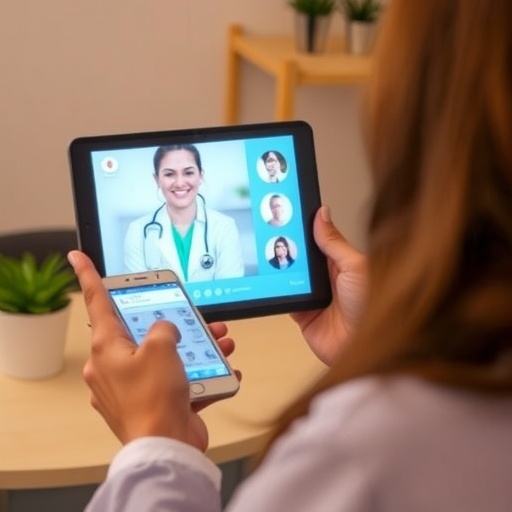
A groundbreaking study led by researchers at UCLA challenges widespread assumptions regarding the impact of telemedicine on healthcare utilization and expenditures in the United States. With the accelerated adoption of telemedicine triggered by the COVID-19 pandemic, policymakers and healthcare experts have grappled with concerns that this technology-driven shift might significantly increase medical visits and overall spending. However, comprehensive analysis of large-scale data spanning multiple payer types reveals a surprising stability in both visit frequency and associated costs from 2019 through 2023.
In early 2020, the Centers for Medicare & Medicaid Services (CMS) implemented pivotal policy changes in response to the public health emergency. These reforms granted telemedicine visits payment parity with in-person appointments, removed geographic restrictions that previously limited eligibility, and waived out-of-pocket cost-sharing for patients. These flexibilities, originally enacted as temporary measures, transformed healthcare delivery by eliminating many of the practical and economic barriers hindering widespread telehealth adoption. As the pandemic waned, legislative bodies have debated whether to embed these changes into permanent policy frameworks, amid unresolved questions about telemedicine’s long-term effects on healthcare systems.
The investigative team, led by Dr. John N. Mafi, Associate Professor-in-Residence at UCLA’s Division of General Internal Medicine and Health Services Research, sought to systematically quantify telemedicine’s influence across a representative cohort of more than three million adults. By leveraging the MedInsight database — a robust repository containing multi-payer claims data — the researchers examined records of individuals continuously enrolled in Medicare fee-for-service, Medicare Advantage, dual-eligible Medicaid plans, and commercial insurance over a five-year horizon from January 1, 2019, to December 31, 2023. This extensive dataset enabled population-level insights encompassing diverse insurance structures and demographic groups.
Contrary to expectations forecasting a surge in medical visits and spending due to increased telehealth availability, the results indicate that telemedicine’s expansion neither generated statistically significant increases nor decreases in overall ambulatory care utilization or expenditures. The analysis revealed a nominal 2.4% decline in visits and a marginal 0.5% reduction in spending, but these trends “crossed the null” threshold meaning the observed changes could plausibly be attributed to chance variation rather than true systemic effects. Crucially, the confidence intervals effectively ruled out substantial increases or decreases, implying any telemedicine-driven shifts in healthcare consumption or costs were modest at best.
Subgroup analyses probing demographic and geographic heterogeneity yielded similarly nuanced findings. Urban populations manifested a slight decrease in visits and spending, while rural counterparts experienced a small uptick in both metrics. Spending among Medicaid beneficiaries and dually eligible individuals exhibited minor non-significant reductions, paralleling similar patterns within Medicare Advantage enrollees and socially vulnerable cohorts. Conversely, commercially insured patients and the least socially vulnerable groups also displayed nominal spending increases without statistical significance. Collectively, these patterns suggest that telemedicine’s integration acts more as a substitute modality rather than an additive service amplifying healthcare utilization.
These findings carry substantial implications amid ongoing policy debates. Advocates heralded telemedicine as a promising solution to longstanding disparities in healthcare access, especially for populations facing geographic or logistical barriers. However, the data imply that telemedicine may predominantly replace in-person visits instead of broadening the overall reach of ambulatory care services, tempering expectations that it will drastically close access gaps. Simultaneously, the absence of escalating expenditures alleviates fears that telehealth expansion could nonsustainably inflate healthcare costs on a national scale.
Notwithstanding these insights, the study acknowledges several limitations inherent to its observational design and aggregated methodology. The expansive dataset, while representative, cannot capture granular individual-level variations or isolate causal relationships definitively. Moreover, uninsured populations were excluded, potentially skewing generalizability. The temporal scope concluding in late 2023 reflects a relatively early phase in telemedicine’s evolving utilization trajectory, underscoring a need for continued longitudinal research to ascertain enduring impacts on clinical quality, health outcomes, and cost containment.
Senior co-author Dr. Katherine Kahn, Distinguished Professor of Medicine at the David Geffen School of Medicine at UCLA and senior natural scientist at RAND Corporation, emphasizes the preliminary nature of these findings. She notes that telemedicine adoption appears to have stabilized into a new equilibrium following its precipitous rise during the pandemic’s acute phase, but stresses the necessity for vigilant policymaker surveillance and further study. Ongoing research should interrogate differential effects across diverse populations to ensure telehealth initiatives equitably enhance healthcare delivery without exacerbating existing disparities.
The study’s multidisciplinary authorship team combined expertise from UCLA, RAND, MedInsight (Milliman Inc.), Virginia Tech, and University of Michigan, reflecting its comprehensive analytic approach. Funding support stemmed from Arnold Ventures alongside significant backing by the National Institutes of Health and the National Institute on Aging, underscoring the study’s scientific rigor and societal relevance.
In summation, this extensive analysis compellingly suggests that telemedicine’s rapid integration into U.S. ambulatory care systems following the COVID-19 pandemic did not precipitate the feared surge in visit volume or medical spending through 2023. While telehealth has undeniably transformed healthcare delivery modalities, its effect thus far appears to be substitutive rather than additive, stabilizing rather than escalating utilization patterns. These findings provide a critical evidence base as policy frameworks governing telemedicine flexibilities approach a 2027 expiration, facilitating informed debate on how best to balance innovation, access, and cost containment in healthcare’s digital future.
News Publication Date: 11-May-2026
Web References:
References:
Mafi, J.N., Kahn, K., et al. (2026). Telemedicine Adoption, US Ambulatory Visits, and Total Medical Spending, 2019-2023. JAMA Network Open. DOI: 10.1001/jamanetworkopen.2026.11835
Cite Scienmag News
Ophelia Keating. (May 11, 2026). Telemedicine Does Not Drive Higher Medical Utilization or Health Care Costs, Study Finds. Scienmag. https://scienmag.com/telemedicine-does-not-drive-higher-medical-utilization-or-health-care-costs-study-finds/
Ophelia Keating. "Telemedicine Does Not Drive Higher Medical Utilization or Health Care Costs, Study Finds." Scienmag, 11 May 2026, https://scienmag.com/telemedicine-does-not-drive-higher-medical-utilization-or-health-care-costs-study-finds/. Accessed 6 September 2026.
Ophelia Keating. "Telemedicine Does Not Drive Higher Medical Utilization or Health Care Costs, Study Finds." Scienmag. May 11, 2026. https://scienmag.com/telemedicine-does-not-drive-higher-medical-utilization-or-health-care-costs-study-finds/


