


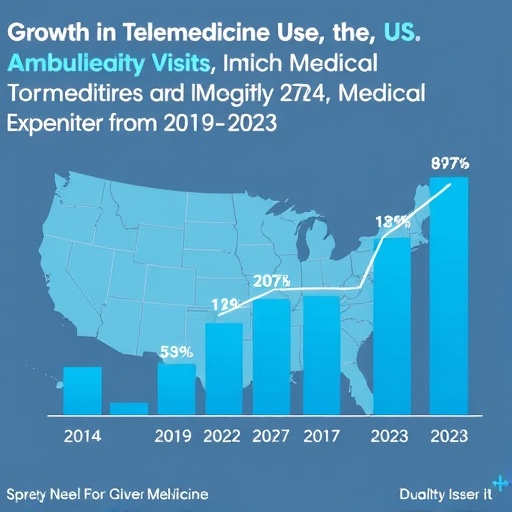
In a comprehensive nationwide evaluation published in JAMA Network Open, researchers have revealed intriguing insights into the impact of telemedicine adoption on healthcare utilization and expenditures across the United States. The study meticulously analyzed data spanning various demographic and socioeconomic contexts, and intriguingly, the findings demonstrate that the widespread embrace of telemedicine did not trigger significant increases in healthcare visits or spending. This revelation dispels lingering apprehensions about telemedicine potentially catalyzing uncontrolled healthcare utilization and financial burdens on the system.
The accelerated integration of telemedicine in recent years, particularly accelerated by the COVID-19 pandemic, has reshaped the health care delivery landscape. As medical providers rapidly deployed virtual platforms to maintain patient care continuity, critical questions emerged regarding how these digital interfaces might influence the frequency of clinical encounters and the associated healthcare costs. This study’s findings provide pivotal evidence suggesting that, at a macro level, telemedicine acts as a complement rather than a catalyst for increased healthcare consumption.
A nuanced aspect of the research was stratifying the dataset by urbanicity, payer type, and area-level social vulnerability indices. Urbanicity stratification involved comparing metropolitan regions with rural and suburban areas, testing the assumption that telemedicine might alleviate access barriers differentially. The data indicated no statistically significant variation in visit volume or spending in either urban or rural contexts, highlighting telemedicine’s role as a stable modality across diverse geographic landscapes.
Equally critical was the examination of payer types, encompassing private insurance, Medicare, and Medicaid. There had been concerns that shifts in reimbursement patterns and incentives might influence telemedicine utilization and resulting expenditures disparately across payers. Contrary to these speculations, the research delineated a consistent pattern of impartiality—telemedicine adoption did not lead to any discernible increase in spending regardless of the payer source.
Incorporating social vulnerability metrics such as income level, educational attainment, and access to resources, the study accounted for community-level disparities that potentially skew healthcare access and costs. Telemedicine was positioned as a possible amplifier of disparities if it disproportionately served less vulnerable populations while bypassing others. However, the lack of spending or utilization surges even in socially vulnerable areas corroborates telemedicine’s equitable integration, ensuring broad-based healthcare access without inflating costs.
Methodologically, the study employed robust analytic frameworks capable of capturing temporal trends and adjusting for confounding factors that influence healthcare utilization independently of telemedicine. By controlling for baseline variability and employing longitudinal observational data, the investigators ensured that observed stable spending and visitation rates accurately reflect telemedicine’s true impact rather than external factors.
These findings have profound policy implications amid ongoing debates surrounding the permanence of telemedicine reimbursements and regulatory flexibilities. Policymakers and stakeholders can draw confidence from this evidence that expanding telemedicine will not automatically fuel unsustainable healthcare spending, alleviating one critical argument against continued telehealth support.
Moreover, the study’s implications extend to healthcare providers and systems strategizing the optimal blend of in-person and virtual care. Demonstrating that telemedicine stabilizes rather than spikes visits and costs empowers providers to integrate telehealth thoughtfully without fearing unintended financial consequences or overutilization of services.
While the research sheds light on overarching trends, the authors also emphasize the need for continuous surveillance as telemedicine technologies and models evolve. The current findings provide a foundational benchmark but warrant monitoring over longer horizons and considering emerging digital health innovations that may differently influence utilization dynamics.
The study further encourages researchers to delve into patient-centered outcomes and quality metrics linked to telemedicine, bridging the gap between utilization data and health impacts. Understanding whether stable visit rates correspond with comparable or improved health outcomes remains a critical next step.
Importantly, the study underscores the capacity of telemedicine to democratize healthcare access without compromising economic sustainability. By avoiding cost surges, telemedicine can serve as a vital tool to enhance health equity, removing traditional barriers related to geography, transportation, and provider shortages.
In conclusion, the study published in JAMA Network Open provides compelling evidence that telemedicine adoption does not exacerbate healthcare utilization or spending nationally. This insight challenges prevailing presumptions about telehealth’s economic risks and supports its continued integration into the healthcare system as a cost-stable, accessible model. The research marks an important milestone in understanding digital health’s role and frames future investigations into optimizing virtual care delivery to benefit all population segments.
News Publication Date: Not provided.
Web References: Not available.
References: (doi:10.1001/jamanetworkopen.2026.11835)
Cite Scienmag News
Courtney Benton. (May 11, 2026). Growth in Telemedicine Use, US Ambulatory Visits, and Medical Expenditures from 2019 to 2023. Scienmag. https://scienmag.com/growth-in-telemedicine-use-us-ambulatory-visits-and-medical-expenditures-from-2019-to-2023/
Courtney Benton. "Growth in Telemedicine Use, US Ambulatory Visits, and Medical Expenditures from 2019 to 2023." Scienmag, 11 May 2026, https://scienmag.com/growth-in-telemedicine-use-us-ambulatory-visits-and-medical-expenditures-from-2019-to-2023/. Accessed 7 September 2026.
Courtney Benton. "Growth in Telemedicine Use, US Ambulatory Visits, and Medical Expenditures from 2019 to 2023." Scienmag. May 11, 2026. https://scienmag.com/growth-in-telemedicine-use-us-ambulatory-visits-and-medical-expenditures-from-2019-to-2023/


