


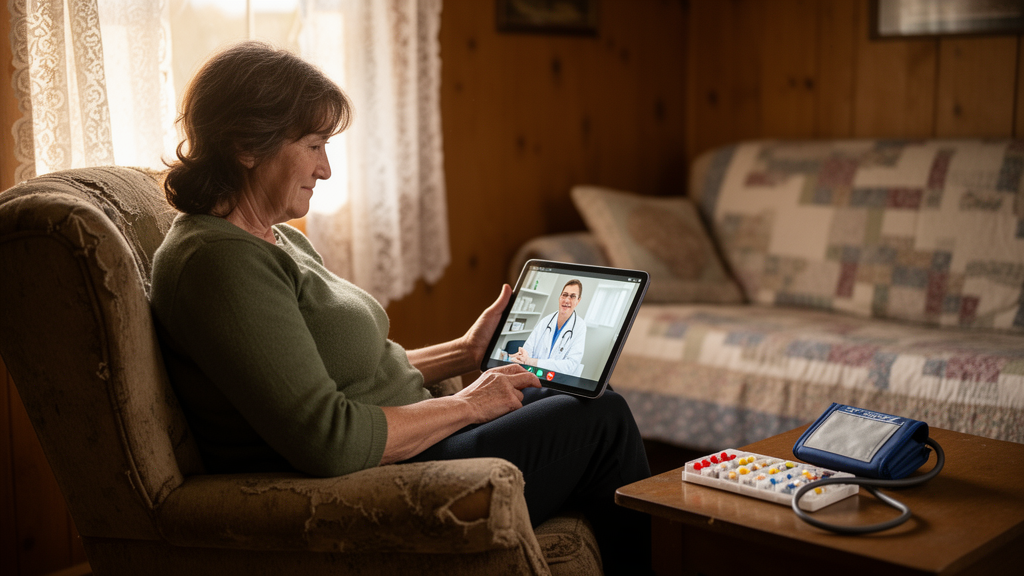
Chronic pain is one of the most common and disabling health conditions in the United States, and it hits rural communities harder than anywhere else. A new narrative review published in Frontiers in Pain Research by pain medicine specialists Jamal Hasoon of The University of Texas Health Science Center at Houston, Cyrus Yazdi of Beth Israel Deaconess Medical Center, and Christopher Robinson of Johns Hopkins examines whether telemedicine can close the widening gap between rural patients and the specialty care they need. The verdict is nuanced: telemedicine demonstrably improves access, psychological outcomes, and functional status while slashing travel burdens, but it does not consistently reduce pain intensity itself, and it can actually deepen health inequities when broadband access, devices, digital literacy, or privacy protections fall short.
The scale of the rural disparity is striking. Compared with urban residents, rural Americans experience higher rates of chronic pain, pain-related disability, and opioid utilization. The reasons are layered: rural populations skew older, work more physically demanding jobs in agriculture, construction, and manual labor, and show higher rates of obesity and tobacco use, all of which raise the risk of chronic musculoskeletal and neuropathic pain. Add reduced access to preventive care, which delays diagnosis and lets painful conditions progress, and the burden compounds. Meanwhile, pain specialists and multidisciplinary pain programs are concentrated almost entirely in urban academic centers. Rural patients routinely drive hours for appointments, absorbing transportation costs, lost wages, and missed workdays, which fuels delayed evaluation, interrupted treatment, and poor adherence. With physical therapy, behavioral health, and rehabilitation services scarce, rural patients lean heavily on primary care providers to manage complex pain conditions without specialty backup.
Telemedicine entered this landscape as a potential bridge, and the COVID-19 pandemic supercharged its adoption across virtually every medical specialty. The review maps the field across six modalities: synchronous video visits, telephone-based encounters, asynchronous electronic consultations, telerehabilitation, tele-delivered cognitive behavioral therapy, and mobile health applications. Each has distinct strengths. Video allows clinicians to observe affect, gait, gross motor function, and functional movement; telephone encounters offer a low-bandwidth fallback for straightforward follow-up and care coordination; e-consults let specialists review clinical information and respond asynchronously. A 2016 evaluation of a Massachusetts General Hospital telepain service linking Boston to Martha’s Vineyard completed 238 video evaluations over 13 months, with surveyed patients rating every satisfaction item above 4.3 out of 5. Conversely, a Swiss survey of 61 chronic pain patients found telemedicine acceptance averaged just 6.25 out of 10, with higher pain intensity and anxiety correlating with lower acceptance, and a slight majority preferring in-person visits. Notably, patients who had previously experienced telehealth were more willing to continue, suggesting familiarity itself dissolves hesitancy.
The strongest randomized evidence belongs to remotely delivered cognitive behavioral therapy for chronic pain. A phase 3 pragmatic randomized clinical trial by DeBar and colleagues, published in JAMA in 2025, enrolled more than 2,000 patients with high-impact chronic musculoskeletal pain across four geographically diverse U.S. health systems. Participants were randomized to one of two remote, eight-session cognitive behavioral therapy programs, one delivered by a health coach via telephone or video and one completed independently online, or to usual care. Both remote interventions produced clinically meaningful, sustained improvements in pain severity through 12 months, with the health coach-led arm showing the largest effect at the 3-month primary endpoint before the two active arms converged. These findings align with a Cochrane review concluding that remotely delivered psychological therapies likely reduce pain intensity and anxiety immediately after treatment. For rural patients who may live hours from any psychologist trained in pain, this is a scalable route to evidence-based nonpharmacologic care.
Telerehabilitation is the second pillar of strong evidence. Physical therapy is established as cost-effective for chronic low back pain, yet only an estimated 7 to 13 percent of people with low back pain ever receive it, and rural communities have roughly 40 percent fewer physical therapists per capita than metropolitan regions. The ARBOR-Telehealth trial, now enrolling 434 patients with chronic low back pain from rural primary care clinics, is testing whether telerehabilitation delivered by trained physical therapists over a web-based video platform can reduce disability and opioid utilization compared with standardized patient education. Earlier randomized evidence found exercise-based telerehabilitation for nonspecific chronic low back pain comparable to conventional outpatient physical therapy, with no significant differences in disability, pain intensity, or fear-avoidance outcomes at 8 weeks. A 2024 scoping review of 28 studies confirmed pain and disability as the most commonly assessed and most frequently improved outcomes, with smartphone apps the dominant asynchronous delivery mode. A longitudinal observational study of videoconferencing-based telehealth physical therapy showed significant improvements in disability, pain, pain interference, and physical function at 10 and 26 weeks, though only 39.5 percent of patients perceived the quality as equal to in-person care.
The Veterans Health Administration offers a real-world laboratory for rural telepain. Its TelePain program serves communities in Alaska, Washington, and Oregon through home-based video visits or telehealth rooms at community clinics. Qualitative evaluations found general satisfaction, appreciation for knowledgeable clinicians, and substantial value from reduced travel, alongside inconsistent follow-up, negative perceptions of behavioral health treatment, and preferences for in-person care among some veterans. The TelePain-Empower Veterans Program, which integrates Whole Health principles, Acceptance and Commitment Therapy, and Mindful Movement through interdisciplinary coaching, improved coping skills, sense of community, and interpersonal relationships, and significantly reduced pain catastrophizing from baseline, though those gains were not sustained at 26-week follow-up. Participants notably did not report self-perceived reductions in pain or medication use. Meanwhile, VHA e-consults completed over 3.1 million consultations across 41 specialties between 2012 and 2018, with only 21.5 percent resulting in an in-person visit within 12 months, and each e-consult saving patients approximately 84.3 miles of driving.
Mobile health applications add another layer. A 2024 systematic review spanning 25 years and 26,429 participants found mobile apps were the most common modality, with generally high usability and acceptability. A separate review of 22 randomized trials confirmed benefits for pain intensity, quality of life, and functional disability across low back pain, neck pain, fibromyalgia, and osteoarthritis. Digital pain diaries capture daily variability patterns tied to fatigue, mood, and morning stiffness that intermittent office visits miss entirely. Encouragingly, a longitudinal cohort study of nearly 10,000 patients found a fully remote multimodal digital care program for musculoskeletal pain achieved equivalent clinical outcomes in rural and urban populations, with rural residents actually showing higher engagement and completion rates. But the review cautions that smartphone-dependent programs are not universally equitable: rural older adults, patients with limited broadband, and those with visual, cognitive, or motor impairments may be excluded entirely, pointing toward stepped approaches using SMS reminders, telephone coaching, mailed materials, caregiver assistance, or loaner devices.
Telemedicine has hard limits. Palpation, assessment of warmth suggesting infection, hip range of motion, and tests for spasticity or rigidity are difficult or impossible remotely, and agreement between telehealth and in-person examinations drops most for palpation and precise range-of-motion measurements, especially in older patients with multiple comorbidities. Assessment of allodynia, hyperalgesia, and detailed sensory mapping remains substantially limited. Interventional procedures such as epidural steroid injections, nerve blocks, and spinal cord stimulation trials cannot be delivered remotely, though telemedicine excels at pre-procedural consultation and post-injection follow-up. Regulatory uncertainty looms largest around controlled substances: the Ryan Haight Act generally requires an in-person evaluation before internet prescribing, but COVID-era federal flexibilities permitting DEA-registered practitioners to prescribe Schedule II-V medications via telemedicine have been extended through December 31, 2026, while permanent special-registration rules remain under development. Privacy is another friction point, since patients may lack a private space to discuss substance use, mental health, or psychosocial stressors, and safety-net clinicians report difficulty monitoring opioid adherence remotely.
The authors propose a hybrid model as the most pragmatic framework for rural chronic pain care in the United States. It uses structured triage to route stable follow-up, behavioral treatment, rehabilitation, education, and routine medication review to remote care while reserving in-person visits for new undifferentiated pain, red flags, unreliable remote examinations, interventional procedures, and situations where opioid safety monitoring cannot be completed adequately. Technology-navigation support, low-bandwidth alternatives, interpreter services, device-loan programs, and standardized controlled-substance workflows round out the design. The review’s own limitations are candid: as a narrative rather than systematic review, study selection was purposive, the evidence is heterogeneous across intervention types and definitions of rurality, and the findings are predominantly U.S.-based and may not transfer directly to other countries. Still, the core message lands with force: telemedicine is not a replacement for multidisciplinary pain care but a component of it, and programs that combine patient choice, technology support, structured hybrid triage, and explicit safety escalation are most likely to expand access without sacrificing clinical quality or widening the digital divide.
Subject of Research: Health and Medicine
Article Title: Telemedicine for chronic pain management in rural populations: a narrative review
Article References: Telemedicine for chronic pain management in rural populations: a narrative review. (n.d.). https://doi.org/10.3389/fpain.2026.1907994
Image Credits: AI Generated
DOI: 10.3389/fpain.2026.1907994
Keywords: chronic pain, telemedicine, rural health, health disparities, telerehabilitation, cognitive behavioral therapy, opioids, digital health, chronic, pain, management, rural
Cite Scienmag News
Timothy Lambert. (October 15, 2026). Telemedicine Brings Chronic Pain Care to Rural America, But Not Without Caveats. Scienmag. https://scienmag.com/telemedicine-brings-chronic-pain-care-to-rural-america-but-not-without-caveats/
Timothy Lambert. "Telemedicine Brings Chronic Pain Care to Rural America, But Not Without Caveats." Scienmag, 15 October 2026, https://scienmag.com/telemedicine-brings-chronic-pain-care-to-rural-america-but-not-without-caveats/. Accessed 15 October 2026.
Timothy Lambert. "Telemedicine Brings Chronic Pain Care to Rural America, But Not Without Caveats." Scienmag. October 15, 2026. https://scienmag.com/telemedicine-brings-chronic-pain-care-to-rural-america-but-not-without-caveats/


