


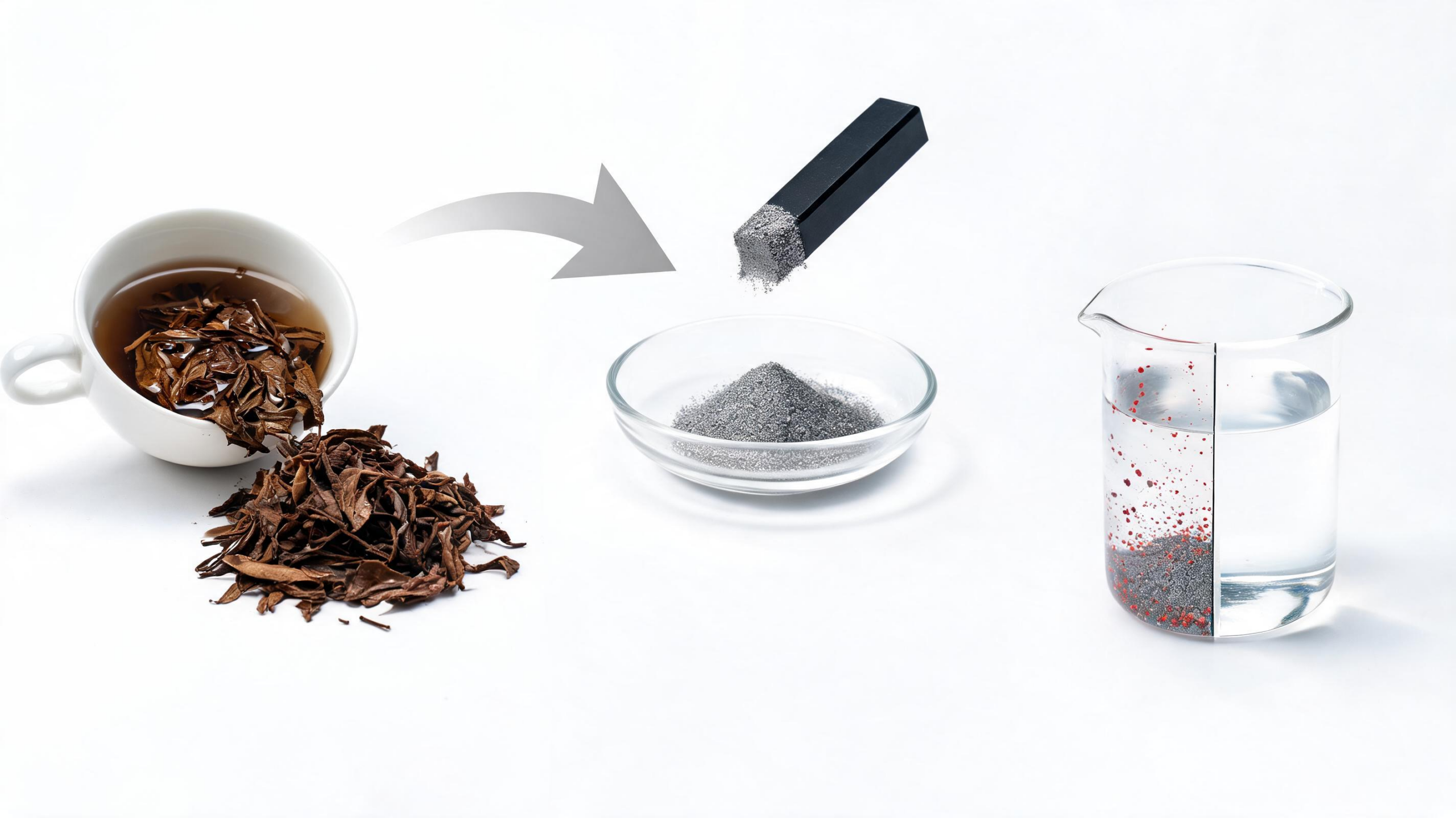
Discarded tea leaves could become an unexpected tool for cleaning polluted water. In a study published in the Journal of Saudi Chemical Society, researchers converted spent tea residues from a beverage factory into a nitrogen-doped magnetic biochar capable of removing hexavalent chromium from water. The material, called NMTB, combines a porous carbon framework with iron and nitrogen sites introduced during a single hydrothermal treatment. Under optimized conditions, it removed 96.90 percent of Cr(VI) from a laboratory solution and reached a maximum adsorption capacity of 63.03 milligrams per gram. The approach links two environmental problems that are expanding together: the accumulation of organic waste from the rapidly growing tea-beverage industry and contamination by a highly mobile, hazardous form of chromium. Rather than treating tea residues as a disposal burden, the researchers used them as a low-cost carbon precursor for an adsorbent that can be separated from water magnetically.
Hexavalent chromium is associated mainly with industrial activities and can enter water through wastewater from metal processing, mining, smelting, electroplating and related operations. Unlike many organic pollutants, heavy metals do not biodegrade and can persist in water, sediments and soils for long periods. Cr(VI) is particularly concerning because of its mobility and toxicity; prolonged or substantial exposure can contribute to inflammation, cancer and severe biological damage. Adsorption is widely investigated as a treatment strategy because it can be efficient and comparatively simple: contaminants attach to the surface of a solid material and are then removed with it. Biochar, a carbon-rich product made from biomass, is attractive because its feedstocks are renewable and inexpensive. Its performance, however, depends strongly on surface chemistry, pore structure and preparation conditions. The tea-waste study sought to improve those characteristics while also making the material easier to recover after treatment.
The researchers collected a mixture of spent green and black tea leaves after extraction and filtration at a tea-beverage factory in Xinyang, Henan Province, China. The wet material was washed, air-dried for 48 hours and ground into a fine powder. To produce the magnetic biochar, they combined five grams of tea powder with ferric chloride, zinc chloride and a five-percent urea solution in water. Zinc chloride acted as a pore-forming agent, urea supplied nitrogen, and ferric chloride provided iron for magnetization and additional reactive sites. The mixture was treated in a hydrothermal reactor, where biomass is carbonized in hot, pressurized water rather than in the oxygen-limited, higher-temperature conditions commonly associated with pyrolysis. This route is useful for wet biomass because it can reduce the energy needed for extensive pre-drying. The resulting solid was filtered, washed until neutral and dried before testing.
To identify the most effective processing window, the team varied the hydrothermal temperature between 180 and 220 degrees Celsius and the treatment time between four and 18 hours. Response surface methodology, a statistical optimization technique, was used to evaluate how those variables affected surface area and chromium removal. The models were statistically strong, with coefficients of determination of 0.9743 for surface area and 0.9705 for removal efficiency. Temperature had a greater effect than reaction time on both outcomes. The best overall preparation condition was 200 degrees Celsius for four hours, producing the material designated NMTB-200. This result illustrates why processing conditions matter for biochar: raising the temperature can open pores and release volatile components, but excessive heating can also damage or collapse parts of the carbon structure. At 220 degrees Celsius, the material’s performance declined rather than continuing to improve.
Microscopic and spectroscopic tests showed how the chemical treatment altered the tea-derived carbon. Untreated tea biochar had a relatively dense and smooth surface, whereas nitrogen-modified and nitrogen-iron-modified samples developed rougher, more visibly porous structures. The specific surface area of NMTB-200 reached 25.177 square meters per gram, compared with 7.185 square meters per gram for the pristine tea biochar. X-ray diffraction identified iron oxide phases, including magnetite, Fe3O4, and hematite, in the modified material. Fourier-transform infrared spectroscopy detected carbon-nitrogen and iron-oxygen groups, while X-ray photoelectron spectroscopy confirmed nitrogen and iron on the surface. NMTB contained 6.33 atomic percent nitrogen and 3.4 atomic percent iron in the reported surface analysis. Magnetic measurements showed that saturation magnetization increased with preparation temperature, reaching 5.95 electromagnetic units per gram for NMTB-220. Although NMTB-200 was not the most strongly magnetic sample, its balance of porosity and surface chemistry produced the best chromium uptake.
In controlled adsorption tests, the material’s performance depended on dosage, chromium concentration, contact time and pH. At a dose of 0.1 gram in 50 milliliters of a 50-milligram-per-liter Cr(VI) solution, NMTB-200 achieved 96.90 percent removal. Increasing the amount of biochar beyond the optimum raised the total number of available sites but reduced the adsorption capacity calculated per gram, partly because particles became less effectively dispersed and individual sites were not used as efficiently. As the starting chromium concentration increased, the amount captured per gram rose because more chromium was available to occupy active sites, but the percentage removed fell as those sites approached saturation. Uptake increased rapidly during the early stages of contact and began to level off after roughly six hours. The material performed best under strongly acidic conditions, with its capacity decreasing as pH rose from two to seven. At low pH, protonated surface groups carry positive charge and attract negatively charged chromate species such as HCrO4− and Cr2O7²−.
Equilibrium and rate analyses pointed to a chemically active surface rather than simple physical trapping. The Langmuir model described the data better than the Freundlich model, suggesting that adsorption was dominated by a relatively uniform layer of chromium-bearing species on available sites. The pseudo-second-order model provided the better kinetic fit, although the researchers noted that such a fit alone cannot conclusively prove chemisorption. Additional evidence came from spectroscopy, surface-charge measurements, chromium speciation and computational modeling. After treatment, the biochar surface contained both Cr(VI) and Cr(III), but Cr(III) was the dominant form detected by X-ray photoelectron spectroscopy. In the NMTB-200 experiment, the concentration of Cr(VI) in solution fell from 50 to 5.04 milligrams per liter, while approximately 7.72 milligrams per liter of Cr(III) remained in solution and the rest of the removed chromium was associated with the solid phase. These results indicate that the material does more than attract chromium: it helps reduce the more hazardous hexavalent form to trivalent chromium and then immobilizes the product.
The proposed mechanism unfolds in three connected stages. First, under acidic conditions, positively charged sites on the protonated biochar draw anionic Cr(VI) species toward the surface through electrostatic attraction. Next, electron transfer at iron-, nitrogen- and oxygen-containing sites reduces part of the Cr(VI) to Cr(III). Finally, the reduced chromium forms surface complexes with functional groups in the carbon matrix, including sites associated with nitrogen and iron-oxygen bonds. Density functional theory calculations supported this interpretation: the calculated adsorption energy for chromium at iron and nitrogen sites in NMTB was −3.409 electron volts, compared with −3.201 electron volts for corresponding sites in unmodified tea biochar. The stronger interaction and more pronounced charge transfer predicted for the modified material help explain why it performed well despite having a moderate surface area compared with some engineered adsorbents. In practical terms, the iron particles also offer a route to recover the spent material from water using a magnetic field.
Repeated-use tests provided an early indication of the material’s durability. NMTB-200 was regenerated with sodium hydroxide and reused five times; removal efficiency declined from 99.95 percent in the first cycle to 84.49 percent after the fifth. Iron release remained low, with dissolved iron concentrations below 1.32 milligrams per gram across the cycles, suggesting that much of the iron was retained within or strongly attached to the carbon structure. The researchers also tested a farmland surface-water sample containing 0.0454 milligrams per liter of Cr(VI). After 24 hours, the concentration fell to 0.0016 milligrams per liter, corresponding to 96.55 percent removal. The findings remain laboratory and small-scale demonstrations rather than proof of immediate treatment-plant readiness. Future work will need to assess higher chromium loads, competing ions, larger flow systems, regeneration chemistry, residual zinc and long-term stability. Even so, the one-step process demonstrates a compelling circular-economy concept: a wet, abundant beverage waste can be converted into a recoverable adsorbent that both captures Cr(VI) and promotes its chemical transformation into a less toxic form.
An important scientific feature of the work is that chromium removal was evaluated as both a separation and a chemical-transformation problem. Measuring total chromium alone could make adsorption appear successful even if the contaminant remained in a mobile or hazardous form. By combining solution measurements with surface-sensitive spectroscopy and chromium speciation, the study could distinguish chromium retained on the biochar from chromium that remained dissolved after reduction. That distinction is especially relevant for assessing treatment safety, because a material that transfers contaminants between phases without stabilizing them would provide limited environmental benefit.
The optimization results also illustrate a broader challenge in designing biomass-derived adsorbents. A preparation condition that increases magnetic content or produces more severe carbonization is not necessarily the one that delivers the best overall treatment. Adsorption performance reflects a balance among accessible pores, surface functional groups, iron-containing phases, charge behavior and the stability of those features in water. The researchers’ combined use of response-surface modeling and material characterization therefore connects manufacturing variables with chemical function rather than treating the biochar as an interchangeable carbon powder. Before such a material could be considered for continuous treatment, further testing would be needed in waters containing competing ions and fluctuating acidity, as well as studies of spent-adsorbent handling. The retained chromium and any dissolved iron or other residual process chemicals would need to be managed alongside the treated water itself.
Subject of Research: Tea waste-derived magnetic biochar for hexavalent chromium removal from water
Article Title: One-step synthesis of magnetic tea waste biochar for efficient hexavalent chromium adsorption: process optimization, characterization, and adsorption mechanism
Article References: Guo, S., Wang, P., Zhu, Y., Zhou, Y., Li, M., Lin, X., Xu, P., & Sun, M. (2026). One-step synthesis of magnetic tea waste biochar for efficient hexavalent chromium adsorption: process optimization, characterization, and adsorption mechanism. Journal of Saudi Chemical Society, 30(5), Article 63. https://doi.org/10.1007/s44442-026-00114-5
Image Credits: AI Generated
DOI: 10.1007/s44442-026-00114-5
Keywords: tea waste, magnetic biochar, hexavalent chromium, water treatment, hydrothermal carbonization, adsorption, nitrogen doping, iron oxide, circular economy, One-step, synthesis, magnetic
Cite Scienmag News
Bethany Barker. (August 29, 2026). Tea Waste Transformed into Magnetic Material That Captures Toxic Chromium. Scienmag. https://scienmag.com/tea-waste-transformed-into-magnetic-material-that-captures-toxic-chromium/
Bethany Barker. "Tea Waste Transformed into Magnetic Material That Captures Toxic Chromium." Scienmag, 29 August 2026, https://scienmag.com/tea-waste-transformed-into-magnetic-material-that-captures-toxic-chromium/. Accessed 5 October 2026.
Bethany Barker. "Tea Waste Transformed into Magnetic Material That Captures Toxic Chromium." Scienmag. August 29, 2026. https://scienmag.com/tea-waste-transformed-into-magnetic-material-that-captures-toxic-chromium/


