


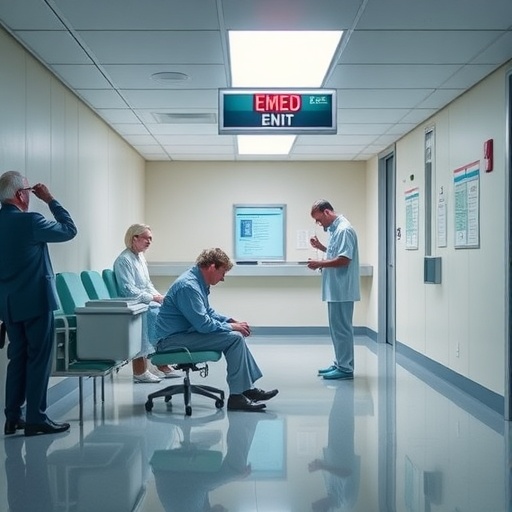
When someone arrives at a hospital in acute psychological distress, the emergency department is often the only immediately available doorway to care. Yet the same environment designed to manage heart attacks, serious injuries and medical emergencies can be profoundly unsuitable for a person experiencing suicidal thoughts, severe anxiety, agitation, hallucinations or overwhelming emotional distress. Emergency departments are typically noisy, crowded and brightly lit, with long waits and limited privacy. A new evaluation from Queensland, Australia, suggests that a different model—one built specifically for short-term mental health crises and shaped by people with lived experience—could offer a safer and more therapeutic alternative.
Researchers assessed the Gold Coast Hospital and Health Service’s Crisis Stabilisation Unit, or CSU, a 12-place facility operating around the clock at Robina Hospital. The unit is physically separate from the hospital’s emergency department but close enough to receive referrals from it, ambulance services, police, general practitioners and community mental health teams. Adults can receive care for up to 24 hours, although the average stay is approximately eight hours. In a survey of 657 people discharged from the unit between August 2021 and November 2023, overall experiences were rated 9.2 out of 10, while the reported impact on mental health and wellbeing averaged 8.8 out of 10.
The study, published in the Community Mental Health Journal, is the first published evaluation of a crisis stabilisation unit designed explicitly as an alternative to an emergency department that focuses on consumers’ perspectives. Its findings are based on a mixed-methods survey: participants answered structured questions that could be converted into numerical ratings and open-ended questions about what worked well and what could be improved. The survey was co-designed with lived- and living-experience peer workers employed in the service. Quantitative responses were analysed using averages, ranges, standard deviations and chi-square tests, while written responses were examined through thematic analysis, a method that groups recurring ideas into broader patterns.
The distinction between the CSU and an emergency department is not simply architectural. The unit was designed around a recovery-oriented, trauma-informed and least-restrictive approach. Instead of treating a crisis as a problem to be contained until a decision is made to admit or discharge someone, the service aims to reduce the intensity of the crisis through time, skilled conversation and targeted interventions. The multidisciplinary staff includes mental health nurses, allied health clinicians, medical officers, psychiatry trainees and consultant psychiatrists. Care may involve brief psychological interventions, safety and wellness planning, physical-health screening, substance-use support, mindfulness, breathing exercises, sensory modulation and help connecting with community services.
A central feature is the presence of peer support workers, who have their own experience of mental health crises or mental health services. They welcome people at the door, provide emotional support, explain available services, promote self-advocacy and help consumers identify pathways toward recovery. In the survey’s written responses, participants repeatedly described these workers as people who understood their experiences without judgment. The researchers argue that this lived-experience component distinguishes the Gold Coast CSU from many comparable short-stay services, where peer workers may not be integrated into the multidisciplinary team or available throughout the day and night.
The physical setting also appeared to shape the experience of care. The CSU includes open-plan seating, areas for families and carers, showers, bathrooms, laundry facilities, food and drinks, sensory tools, calming music, adjustable lighting features and wall art. People described it as quiet, comfortable, homelike, peaceful and safe. Many valued having space to talk, sleep, gather their thoughts or simply wait without the sensory overload associated with an emergency department. The mechanism may be straightforward but important: reducing noise, crowding and perceived threat can lower stimulation during a period when the brain’s capacity to regulate attention, emotion and arousal is already strained. A calmer setting may make it easier for someone to communicate, participate in assessment and use coping strategies.
Participants also emphasized dignity and personal agency. They rated safety, respect, compassion, privacy and peer-worker support at about 9.5 out of 10, and rated their experience compared with previous emergency-department care at 9.4 out of 10. Many said staff listened to them, learned their names and treated them as people rather than as problems. The unit follows a zero-seclusion and zero-restraint model, and consumers described appreciating the freedom to move around or leave when they requested. Several reported that the CSU helped them feel hopeful about recovery, empowered them to make decisions and restored a sense of respect that they had not experienced in other services.
The positive results were not universal, and the criticism offers a practical map for improving crisis care. The lowest average score concerned the time spent waiting to see a mental health clinician, which was still relatively high at 8.4 out of 10. Some people waited hours in the emergency department before being transferred, reporting that uncertainty and isolation intensified suicidal thoughts or distress. Others said they had to repeat the same story to multiple clinicians, received too little information about what would happen next or left without a clear understanding of follow-up arrangements. Some wanted longer stays or overnight beds, while others requested quieter music, dimmer lighting, more private spaces, improved seating for people with physical disabilities and more suitable food for allergies or dietary restrictions.
Access itself was another weakness. The CSU generally receives people after triage and, when necessary, medical stabilisation, meaning that not everyone can walk in directly. This protects the unit from being overwhelmed and ensures that people needing emergency medical or surgical treatment are cared for in the appropriate setting, but it can also create a barrier during a crisis. The service has responded by introducing training materials for ambulance and police staff and by adding a mental health emergency coordinator in the emergency department to speed transfers. The evaluation also found that consumers from several groups—including Aboriginal and Torres Strait Islander people, culturally and linguistically diverse communities, people with physical disabilities and LGBTIQAP+ people—rated the service highly overall, although individual comments still identified problems such as incorrect gendering, uncomfortable sleeping arrangements and the need for more private or culturally responsive spaces.
The findings arrive amid increasing pressure on emergency systems. Mental health presentations account for about 3 per cent of emergency-department visits in Australia, approximately 4 per cent in the United Kingdom, western Europe and Canada, and as much as 9 per cent in the United States, according to figures cited by the researchers. People experiencing mental health crises often remain in emergency departments longer than other patients because assessment may require careful evaluation of suicide risk, intoxication, physical illness, psychosis or co-occurring substance use. Long stays can strain emergency workflows, while the environment itself may feel frightening or retraumatising. Earlier research on short-stay psychiatric units has reported reductions in restraint, emergency-department waiting and hospital admission, but relatively few studies have examined how consumers themselves experience these services.
The Gold Coast findings therefore provide an important signal, but not a final verdict. The survey came from a single Australian site, and respondents were people who chose to complete a post-discharge questionnaire. That creates the possibility of self-selection bias: those with particularly positive or particularly negative experiences may have been more likely to respond than others. The study also measured satisfaction and perceived impact rather than comparing clinical outcomes with those from emergency-department treatment in a randomised design. It cannot by itself show whether CSUs reduce suicide attempts, repeat crises, hospital admissions or long-term healthcare costs. Eligibility restrictions also mean the model is not appropriate for everyone, including people who are medically unstable, severely agitated, delirious or experiencing an overdose requiring medical management.
Even with those limitations, the evaluation suggests that crisis care can be both clinically capable and humanely designed. The CSU does not replace emergency medicine; rather, it creates a parallel pathway for people whose immediate needs are primarily psychiatric and who can be safely treated without emergency medical intervention. Once a crisis resolves, staff arrange follow-up through community teams, primary care, home visits, specialist services or other supports. If the crisis persists, the person can be transferred to a mental health short-stay or acute inpatient unit. For consumers who described emergency departments as their only safe option, the model offers something potentially transformative: a place where acute distress is met not only with risk assessment, but also with time, privacy, practical support, peer understanding and a plan for what comes next. The authors report that similar models are now being rolled out across Queensland and argue that consumers’ strong endorsement should inform wider mental health-system reform.
Cite Scienmag News
Glenn Wilkins. (August 29, 2026). Patients Favor Consumer-Led Crisis Units Over Emergency Departments During Mental Health Crises. Scienmag. https://scienmag.com/patients-favor-consumer-led-crisis-units-over-emergency-departments-during-mental-health-crises/
Glenn Wilkins. "Patients Favor Consumer-Led Crisis Units Over Emergency Departments During Mental Health Crises." Scienmag, 29 August 2026, https://scienmag.com/patients-favor-consumer-led-crisis-units-over-emergency-departments-during-mental-health-crises/. Accessed 11 September 2026.
Glenn Wilkins. "Patients Favor Consumer-Led Crisis Units Over Emergency Departments During Mental Health Crises." Scienmag. August 29, 2026. https://scienmag.com/patients-favor-consumer-led-crisis-units-over-emergency-departments-during-mental-health-crises/


