


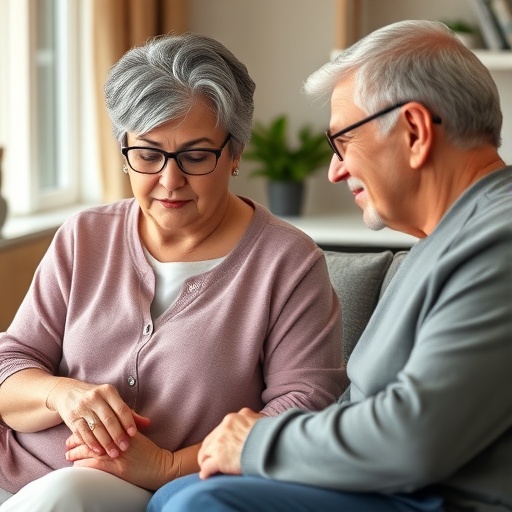
When a stroke strikes, its effects rarely stop with the person who suffers the neurological injury. In the weeks and months that follow, family members may become medication managers, mobility assistants, transportation providers, communication partners and round-the-clock observers of symptoms. A new study of 317 caregivers in China suggests that this expanding role can damage caregivers’ quality of life—but also identifies two psychological and social pathways that may soften the impact. Social support and self-efficacy, or the belief that one can successfully manage difficult tasks, partly mediated the relationship between caregiving burden and quality of life, according to research published in Current Psychology. The findings point to a potentially powerful shift in stroke recovery: supporting the caregiver may be an essential part of supporting the patient.
The study, led by Lulu Cao, Ji-Hong Wei, Xiao-Ming Mu, Cheng-Zhi Jiang, Qi-Zu Jin and colleagues including Mei He, examined patients with stroke and their caregivers recruited from four “third-class A” hospitals, a designation used in China for institutions providing highly advanced medical care. The researchers used questionnaires to assess four linked dimensions: caregiver burden, quality of life, perceived social support and self-efficacy. Caregiver burden refers to the physical, emotional, social and financial strain associated with looking after another person. Quality of life is broader, encompassing perceived physical health, mental well-being, social functioning and the ability to carry out ordinary activities. Rather than treating these factors as isolated measurements, the investigators tested how they interacted within a structural equation model, a statistical framework designed to estimate relationships among observed variables and underlying psychological constructs.
The central result was strikingly consistent: caregivers who reported heavier burdens also tended to report poorer quality of life. The correlation between the two measures was negative, with a coefficient of r = −0.501 and statistical significance at P < 0.01. In practical terms, the finding means that as the perceived demands of caregiving rose, caregivers’ assessments of their own health and daily lives generally fell. A correlation does not prove that burden directly causes every decline in well-being; caregivers facing poor health or limited resources may also perceive care demands as more overwhelming. Nevertheless, the strength and direction of the association support the study’s broader model, in which the work of caregiving is not simply an inconvenience layered onto recovery but a sustained stress exposure capable of reshaping the caregiver’s life.
The researchers then looked at two factors that might interrupt this downward pathway. Social support includes practical help, emotional encouragement, information and a sense that assistance is available from family, friends, health professionals or community networks. Self-efficacy is conceptually different: it concerns a person’s confidence in their ability to perform tasks, solve problems and cope with setbacks. A caregiver may have strong social support but feel uncertain about positioning a patient safely, managing swallowing difficulties or coordinating rehabilitation. Conversely, someone may feel highly capable yet lack anyone who can provide respite or financial and emotional assistance. The analysis treated both variables as mediators—factors through which an initial condition may influence an outcome—allowing the researchers to estimate how much of the burden–quality-of-life association was transmitted through each pathway.
Social support accounted for 29.76 percent of the effect of caregiving burden on quality of life, while self-efficacy accounted for 14.29 percent. The two pathways were described as multiple mediating effects, suggesting that burden may affect quality of life directly and indirectly by reducing access to support or undermining confidence. Social support showed a positive correlation with quality of life of r = 0.492, with P < 0.01, while self-efficacy was also positively correlated with quality of life, at r = 0.451 and P < 0.05. These figures do not mean that social support or confidence eliminates the strain of caring for someone after a stroke. Instead, they indicate that caregivers with more support and greater confidence tended, on average, to maintain better quality of life even when confronting substantial demands.
The study’s timing matters because the period soon after a stroke can be especially disorienting. Families may leave hospital with new responsibilities but limited preparation, uncertain knowledge about rehabilitation and little understanding of how long recovery might take. Stroke can impair movement, speech, memory, attention and swallowing, and the resulting needs can change rapidly. Caregivers must often learn technical routines while simultaneously processing fear, grief and financial pressure. The authors therefore suggest that interventions targeting external social support may be particularly beneficial during the early post-stroke period. Such interventions could, in principle, include structured education, accessible rehabilitation guidance, peer support, coordinated discharge planning, respite care and more direct communication with clinicians. The study itself did not test a specific intervention, so it cannot establish which programme would work best or how long benefits might last.
The analytical method offers a more detailed picture than a simple comparison between “stressed” and “unstressed” caregivers. In structural equation modelling, researchers specify a hypothesized network of relationships and assess whether the observed data are compatible with that network. A direct path can represent the association between burden and quality of life after accounting for mediators, while indirect paths represent routes through social support and self-efficacy. Partial mediation occurs when the mediators explain part, but not all, of the relationship. That distinction is important: it implies that improving support and confidence may help, but other mechanisms remain. Sleep disruption, depression, physical exhaustion, household income, the severity of the stroke, the patient’s dependence and the quality of family relationships could all contribute to caregiver well-being. Because the study used data collected at one point in time, its model describes patterns of association rather than a proven sequence of cause and effect.
The findings also highlight why caregiver care cannot be reduced to advice to “be more resilient.” Self-efficacy is not merely an individual personality trait. It can be strengthened or weakened by training, feedback, successful practice and the environment in which care takes place. A caregiver who receives clear demonstrations from a therapist, has a reliable number to call and can see gradual improvement may gain confidence through repeated mastery experiences. One left alone with conflicting instructions and no opportunity for rest may lose confidence even when deeply motivated. Social support similarly depends on infrastructure as much as goodwill. A sympathetic relative who lives far away may offer emotional reassurance but be unable to provide bathing assistance, transport or overnight relief. Effective stroke services therefore need to consider whether help is available, practical and timed to the moments when families need it most.
There are limits to how broadly the results can be generalized. All 317 patient–caregiver pairs came through four hospitals, and the source material does not specify the demographic composition, recruitment details or the precise instruments used for every measure in the study sample. Cultural expectations about family responsibility, healthcare access and community support may shape both burden and coping, meaning that results from hospitals in Sichuan Province may not translate directly to caregivers elsewhere. The use of self-reported questionnaires also means that the results reflect participants’ perceptions, which are clinically meaningful but not identical to objective measures of hours of care, medical complications or household costs. Future longitudinal studies could follow caregivers from hospitalization through the transition home, testing whether support and self-efficacy predict later outcomes and whether targeted programmes actually improve them.
Even with those caveats, the study delivers a message likely to resonate far beyond the hospitals in which it was conducted: the caregiver is part of the recovery system, not an invisible accessory to it. The negative association between burden and quality of life shows the cost of leaving families to improvise, while the mediation results identify plausible leverage points for care teams and health systems. Ensuring that caregivers have people to rely on and skills they trust may not remove the demands created by stroke, but it could make those demands more manageable. As stroke survival improves and more patients return home with long-term disabilities, the quality of recovery may increasingly depend on whether medicine treats the patient and caregiver as a connected unit.
Cite Scienmag News
Cassandra Pierce. (August 29, 2026). Social support, self-efficacy shape caregivers’ burden and quality of life after stroke. Scienmag. https://scienmag.com/social-support-self-efficacy-shape-caregivers-burden-and-quality-of-life-after-stroke/
Cassandra Pierce. "Social support, self-efficacy shape caregivers’ burden and quality of life after stroke." Scienmag, 29 August 2026, https://scienmag.com/social-support-self-efficacy-shape-caregivers-burden-and-quality-of-life-after-stroke/. Accessed 10 September 2026.
Cassandra Pierce. "Social support, self-efficacy shape caregivers’ burden and quality of life after stroke." Scienmag. August 29, 2026. https://scienmag.com/social-support-self-efficacy-shape-caregivers-burden-and-quality-of-life-after-stroke/


