


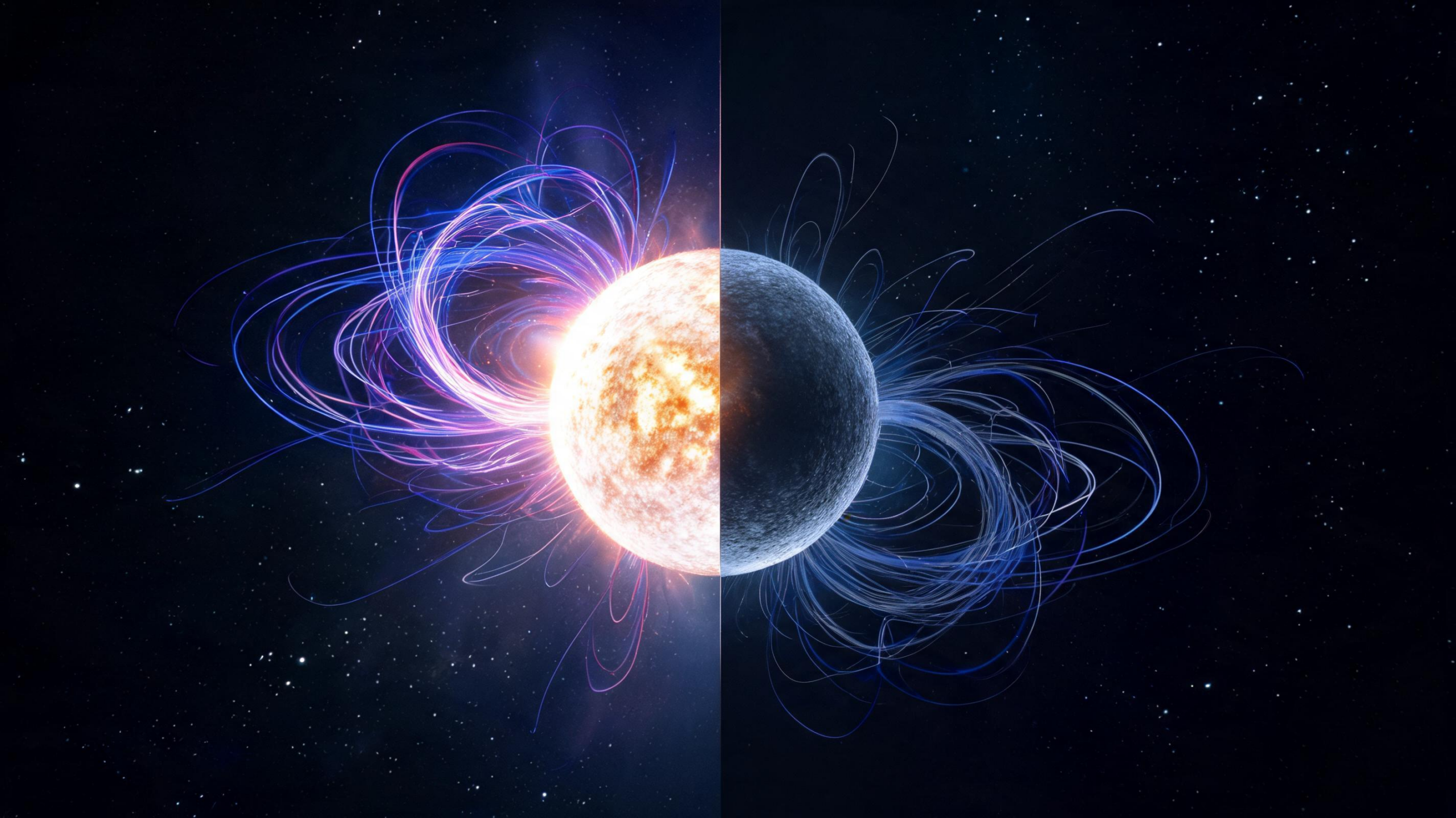
Neutron stars are the most extreme stable objects in the universe: city-sized remnants of massive stars where densities exceed those of atomic nuclei, magnetic fields can surpass a quadrillion times the strength of Earth’s field, and temperatures climb to billions of degrees in the moments after birth. A comprehensive open-access review published in Living Reviews in Computational Astrophysics, authored by José A. Pons, Clara Dehman and Daniele Viganò, now distills decades of theoretical work and numerical modeling into a unified picture of how these stellar corpses evolve magnetically, thermally and rotationally over millions of years. The updated review, which revises and extends an earlier version first published in 2019, comes at a moment when new observations and a new generation of three-dimensional simulations are transforming the field.
The central challenge the authors tackle is deceptively simple to state: neutron stars are born hot and magnetized, and every observable we measure — their X-ray glow, their spin periods, their sudden outbursts — is shaped by how heat and magnetic field decay and interact over time. Solving this problem requires numerically integrating two coupled families of equations: the heat transfer equation governing the cooling of the stellar interior, and the induction equation describing the evolution of the magnetic field. Both depend sensitively on microphysics such as thermal and electrical conductivities, neutrino emission rates and the behavior of superfluid and superconducting particles at densities found nowhere else in nature.
The cooling story begins dramatically. A newborn neutron star starts at more than ten billion kelvin, transparent only to neutrinos after roughly a minute, and shrinks from about a hundred kilometers to its final radius of ten to fourteen kilometers. Within the first year, its core — containing about ninety-nine percent of the mass — becomes nearly isothermal thanks to enormous thermal conductivity. Long-term cooling then proceeds over hundreds of thousands of years, with temperature gradients confined to the thin crust and envelope. Crucially, the absence of internal convection means that neutron stars cannot operate the kind of self-sustained dynamos that generate magnetic fields in planets and ordinary stars, so their fields must originate elsewhere and be preserved or dissipated over time.
One of the most consequential recent developments highlighted in the review concerns enhanced neutrino cooling. For decades, theorists have debated whether neutron stars cool via ‘minimal’ channels involving modified Urca processes or whether some stars undergo dramatically faster ‘direct Urca’ cooling, possibly triggered by exotic matter such as hyperons or quarks. The Vela pulsar’s anomalously low temperature hinted at such processes, but definitive evidence was elusive. A recent analysis of three young, nearby and extremely cold neutron stars now shows that their properties require enhanced cooling, allowing researchers for the first time to place meaningful constraints on the dense-matter equation of state directly from thermal observations.
The same cooling physics reaches into particle physics beyond the Standard Model. Because hypothetical light particles such as axions would drain energy from a neutron star’s interior, cooling measurements can bound their properties. Studies cited in the review use the thermal behavior of young neutron stars to constrain the QCD axion mass, and more recent work incorporating envelope structure has tightened those limits further. Meanwhile, the famous case of the neutron star in the Cassiopeia A supernova remnant — once thought to show a rapid temperature decline signaling the onset of neutron superfluidity — illustrates the difficulty of the enterprise. The inferred cooling rate has shrunk from about four percent per decade to between roughly 1.6 and 2.2 percent as data and detector calibrations improved, and recent critical reanalyses question whether the decline is robust at all.
On the magnetic side, the review lays out the three dominant interior processes. Ohmic dissipation, the slow diffusion of currents through the highly conductive crustal lattice, acts on timescales of hundreds of thousands to millions of years. The Hall drift, a nonlinear advection of magnetic field by the electron fluid, becomes dominant in magnetars and can transfer magnetic energy from large scales to small scales, accelerating dissipation. Ambipolar diffusion, the coupled drift of charged particles relative to the neutron superfluid, may dominate in the cores of strongly magnetized stars during their first hundred thousand years, though its exact role in superfluid and superconducting conditions remains actively contested. Newer ingredients — including the chiral magnetic effect, in which a tiny imbalance between left- and right-handed electrons can amplify fields, and crustal failure mechanisms ranging from brittle starquakes to plastic flow — are given detailed treatment, with the authors cautioning that some widely used failure criteria may overestimate how often the crust actually cracks.
Numerical methodology occupies a substantial portion of the review, and for good reason: the equations are stiff, nonlinear and span many orders of magnitude in the relevant coefficients. Older simulations relied on spectral methods elegant in accuracy but fragile near the discontinuities that the Hall term inevitably produces. Recent codes have shifted toward finite-difference and finite-volume schemes borrowed from high-resolution shock-capturing techniques in computational fluid dynamics. The new three-dimensional code MATINS, developed by members of the review team, goes further by adopting a cubed-sphere grid that sidesteps the numerical pathologies of the polar axis, while incorporating realistic microphysics throughout the crust. Benchmark tests against analytical solutions confirm accuracy at the sub-percent level.
What happens when such codes are initialized with realistic, turbulent magnetic fields inherited from the proto-neutron star dynamo phase is striking. Fully three-dimensional simulations starting from complex fields dominated by small and intermediate scales show that the tangled structure persists for hundreds of thousands of years, with the Hall term continuously feeding energy from large scales while Ohmic dissipation erodes the small scales. These turbulent initial conditions naturally reproduce the observed properties of central compact objects and the so-called low-field magnetars — stars that erupt in magnetar-like bursts despite possessing relatively weak large-scale dipoles. However, the simulations still struggle to generate the ultra-strong, dominant dipole that classical magnetars require, leaving the origin of magnetar-strength dipolar fields an open question. One provocative possibility explored in recent work is that the chiral magnetic effect could grow the dipolar component to magnetar strengths within fifty to a hundred years of birth, driven by an extraordinarily small but persistent chiral imbalance sustained by the star’s magnetic helicity.
The final piece of the puzzle is rotation. Spin period and its derivative are the most precisely measured neutron star observables, and they encode the electromagnetic torque exerted by the magnetosphere. The review emphasizes that the familiar textbook formula for inferring magnetic fields from timing data, based on a vacuum dipole, systematically overestimates the true field strength. Plasma-filled force-free magnetospheres exert torques even on aligned rotators, and general relativistic effects near the stellar surface further amplify the spin-down luminosity. A properly relativistic formula yields dipolar field estimates roughly a factor of four lower than the classical expression, potentially reshaping how the entire neutron star population is classified — including how many objects truly qualify as magnetars.
As instruments such as the Square Kilometre Array Observatory prepare to detect many thousands of new pulsars and X-ray observatories continue to monitor magnetar outbursts, the theoretical framework assembled in this review provides the essential bridge between microphysics and observation. The authors’ outlook is clear: the future lies in fully three-dimensional, self-consistent magneto-thermal simulations coupled to dynamical magnetospheres, with machine-learning solvers such as physics-informed neural networks emerging as a computationally efficient complement to traditional schemes. What emerges from the review as a whole is a picture of neutron stars not as static lighthouses but as dynamic, evolving systems in which magnetism, heat and rotation are inseparably entangled — a picture that is only now becoming possible to compute.
Beyond the theoretical machinery, the review situates itself within a rapidly growing observational census. Nearly four thousand rotation-powered radio pulsars are now catalogued, a number set to multiply as the Square Kilometre Array Observatory comes online, while high-energy instruments have identified several hundred gamma-ray pulsars and roughly a hundred X-ray sources. Only a few dozen neutron stars show the soft, thermal surface emission in X-rays that directly probes interior cooling, making each detection disproportionately valuable for constraining the underlying microphysics.
Magnetars, the extreme end of this population, remain scarce — a few dozen confirmed candidates — but their energetic output is extraordinary. Their persistent X-ray luminosities of 10^33 to 10^35 erg per second routinely exceed their rotational energy loss rates by orders of magnitude, implying that magnetic energy, not spin-down, powers their emission. The most violent events, giant flares, release up to 10^46 erg in under a second; only three have ever been recorded. This magnetic reservoir interpretation, first advanced by Thompson and Duncan in the mid-1990s, now underpins most theoretical modeling of magnetar activity.
Perhaps the most significant conceptual shift the review documents is the blurring of historical subclass boundaries. Low-field magnetars — nominally ordinary pulsars that occasionally erupt in bursts — and some central compact objects demonstrate that a strong surface dipole is not the decisive ingredient for magnetar-like behavior. Instead, attention has turned to the hidden internal field architecture: how magnetic energy is partitioned between toroidal and poloidal components and across spatial scales, where electrical currents reside, and how helicity is transported outward into the magnetosphere. These questions set the agenda for the three-dimensional simulations and future code development efforts the review outlines.
Subject of Research: Magneto-thermal and rotational evolution models of isolated neutron stars
Article Title: Magnetic, thermal and rotational evolution of isolated neutron stars
Article References: Pons, J. A., Dehman, C., & Viganò, D. (2026). Magnetic, thermal and rotational evolution of isolated neutron stars. Living Reviews in Computational Astrophysics, 12(1), Article 5. https://doi.org/10.1007/s41115-026-00028-4
Image Credits: AI Generated
DOI: 10.1007/s41115-026-00028-4
Keywords: neutron stars, magnetars, pulsars, magnetic field decay, neutron star cooling, neutrino emission, Hall drift, Ohmic dissipation, ambipolar diffusion, magneto-thermal simulations, dense matter equation of state, numerical astrophysics
Cite Scienmag News
Katie Riggs. (September 10, 2026). Cracking the Code of Neutron Star Evolution, From Magnetic Fields to Cooling. Scienmag. https://scienmag.com/cracking-the-code-of-neutron-star-evolution-from-magnetic-fields-to-cooling/
Katie Riggs. "Cracking the Code of Neutron Star Evolution, From Magnetic Fields to Cooling." Scienmag, 10 September 2026, https://scienmag.com/cracking-the-code-of-neutron-star-evolution-from-magnetic-fields-to-cooling/. Accessed 5 October 2026.
Katie Riggs. "Cracking the Code of Neutron Star Evolution, From Magnetic Fields to Cooling." Scienmag. September 10, 2026. https://scienmag.com/cracking-the-code-of-neutron-star-evolution-from-magnetic-fields-to-cooling/


