


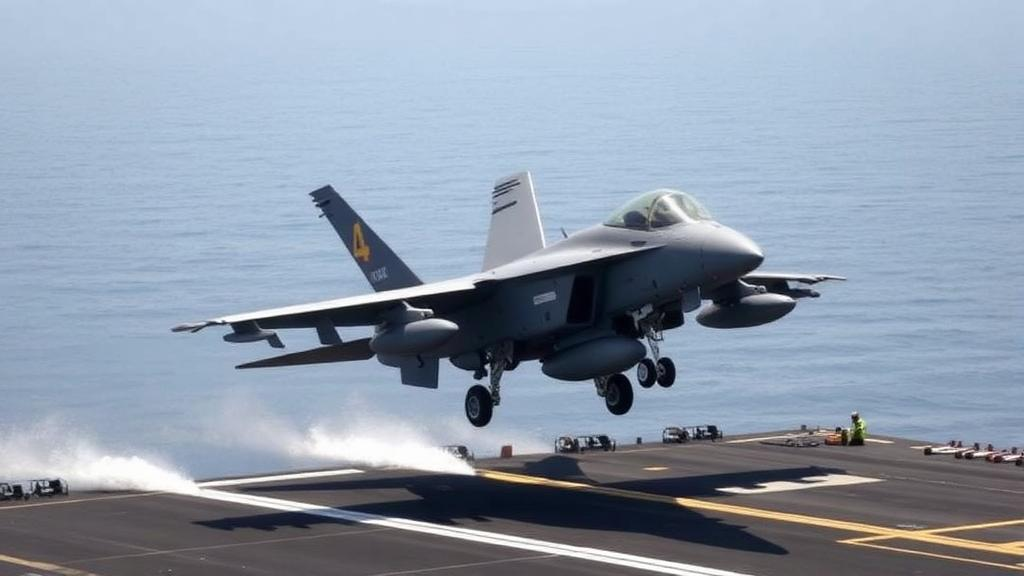
Landing a fighter jet on the heaving deck of an aircraft carrier remains one of the most demanding tasks in all of aviation. The pilot, or in this case the autopilot, must guide a high-performance aircraft down a steep glide slope toward a deck that is moving, pitching, and rolling, all while the air flowing over the ship’s superstructure churns into turbulent wakes that can shove the aircraft off course in an instant. A research team at Harbin Engineering University in China has now unveiled a new control architecture designed to make automatic carrier landings faster, more accurate, and more robust against exactly these hazards. The work, published in the International Journal of Aeronautical and Space Sciences, introduces a scheme the authors call flexible predefined-time prescribed performance control, or FPTPPC, and simulation results suggest it outperforms several established alternatives.
The central challenge the researchers tackled is a fundamental tension in flight control. On one hand, engineers want to guarantee that the aircraft’s tracking errors stay within strict bounds, a property known as prescribed performance, so that the jet never strays outside a safe corridor during its descent. On the other hand, the aircraft’s control surfaces and engine thrust are physically limited. When a controller demands more deflection or thrust than the actuators can deliver, a condition called actuator saturation, the aircraft temporarily stops obeying commands and the error can breach the very boundaries the performance function was designed to enforce. Once those boundaries are violated, many prescribed performance controllers fail catastrophically, because their mathematics assumes the error always remains inside a constrained domain.
The Harbin team’s solution is elegantly pragmatic: rather than pretending saturation will never happen, they built a controller that bends without breaking. At the heart of the method lies a predefined-time prescribed performance function, a mathematical curve that dictates how quickly and how tightly the landing error must shrink. Unlike conventional exponential convergence guarantees, which depend on initial conditions, a predefined-time guarantee ensures the error converges within a time chosen by the designer, no matter where the aircraft starts. This is a significant advantage in carrier operations, where the approach window is short and unforgiving and where an autopilot that converges ‘eventually’ is not good enough.
To work with these constraints mathematically, the researchers employed an error transformation technique that converts the constrained error domain into an equivalent unconstrained one. In essence, the transformation warps the coordinate system so that as long as the transformed error remains bounded, the physical landing error is guaranteed to stay inside its prescribed funnel. This allows standard control design tools to be applied to a problem that would otherwise involve hard, nonlinear boundaries. The transformed error then feeds into a nonsingular fast terminal integral sliding mode controller, a robust control strategy renowned for its ability to reject external disturbances. The ‘terminal’ component drives errors to zero in finite time rather than merely asymptotically, while the ‘nonsingular’ design avoids the mathematical pitfalls, such as division by zero, that plague naive terminal sliding mode formulations.
The truly novel ingredient, however, is the flexible adjustment mechanism embedded within the performance function itself. When the controller detects that actuators are saturating, meaning the aircraft cannot fully execute the commanded deflections, the mechanism adaptively relaxes the local performance boundaries, giving the aircraft room to recover rather than demanding the impossible. Once the saturation episode passes, the boundaries tighten again, and the landing proceeds with its original accuracy targets intact. This adaptive flexibility prevents the boundary violations that would otherwise cause the error transformation to blow up and the controller to fail. Complementing this mechanism, the team designed an auxiliary system that maintains stability during saturation events, a well-known strategy in the control literature that the authors integrated carefully with their performance framework.
Disturbance rejection receives equally thorough treatment. The turbulent airwake behind a carrier’s island superstructure is modeled in the study as a set of external disturbances acting on the aircraft’s translational and rotational dynamics, with components that vary sinusoidally over time to mimic the chaotic flow field. To counter these, the researchers developed a predefined-time disturbance observer, an algorithm that estimates the unknown disturbance signals and feeds the estimates directly into the control law as compensation. Because the observer converges in predefined time, the compensation kicks in quickly enough to matter during the brief final approach. The team also introduced a predefined-time reference model to generate the command signals that the inner control loops track. This choice eliminates a chronic computational problem in conventional backstepping control designs, where repeated differentiation of command signals leads to ‘explosion of complexity,’ an exponential growth in the analytic terms that must be computed at each step.
The aircraft model used in the study is a full six-degree-of-freedom representation of a carrier-based aircraft, complete with the coupling between roll, pitch, and yaw dynamics that arises from the aircraft’s inertia properties, aerodynamic coefficients for lift, drag, and side force, and the contributions of the elevator, aileron, rudder, and direct lift flap. The guidance problem is framed as following a moving deck landing path, with the controller tasked with tracking the ship’s motion while respecting output constraints on altitude and attitude errors. This comprehensive modeling matters, because simplified models often hide exactly the coupling effects that make real carrier approaches so treacherous, particularly the way lateral gusts induce rolling moments that must be countered within fractions of a second.
To benchmark their approach, the authors compared FPTPPC against three competing strategies in simulation: dynamic inverse control, a classical technique that cancels the aircraft’s nonlinearities through model inversion; predefined-time control without prescribed performance; and standard prescribed performance control without the flexible saturation mechanism. The results showed that the proposed method reduced path following errors and improved overall landing accuracy relative to all three baselines. The simulations also demonstrated that the flexible adjustment mechanism kept the controller stable and accurate through saturation events that would have destabilized a rigid prescribed performance design. While the study is computational rather than flight-tested, the consistency of the improvements across the comparison set lends weight to the practical promise of the approach.
The implications extend beyond naval aviation. The core ideas, predefined-time convergence guarantees, flexible performance boundaries that tolerate actuator limits, and disturbance observers that compensate within a designer-chosen horizon, are directly transferable to other safety-critical control problems, including spacecraft attitude control, unmanned aerial vehicle operations in gusty conditions, and robotic systems with limited actuator authority. Related work in the same journal and elsewhere has begun applying predefined-time and anti-saturation techniques to fault-tolerant flight control, suggesting a broader research movement toward controllers that are honest about physical limits rather than assuming them away. For the moment, the Harbin team’s contribution stands as a careful piece of control engineering: a mathematically rigorous answer to the question of what an autopilot should do when the ideal command and the possible command diverge, at the worst possible moment, a few hundred feet above a moving flight deck.
Subject of Research: Automatic carrier landing control using flexible predefined-time prescribed performance control under output constraints, actuator saturation, and airwake disturbances
Article Title: Flexible Predefined-Time Prescribed Performance Control for Automatic Carrier Landing with Output Constraints and Actuator Saturation
Article References: Wang, Z., Zhu, Q., Kong, L., & Wang, L. (2026). Flexible Predefined-Time Prescribed Performance Control for Automatic Carrier Landing with Output Constraints and Actuator Saturation. International Journal of Aeronautical and Space Sciences. https://doi.org/10.1007/s42405-026-01239-y
Image Credits: AI Generated
DOI: 10.1007/s42405-026-01239-y
Keywords: automatic carrier landing, prescribed performance control, predefined-time control, actuator saturation, sliding mode control, airwake disturbance, flight control systems, disturbance observer, carrier-based aircraft, nonlinear control, landing accuracy, Harbin Engineering University
Cite Scienmag News
Grant Pearson. (October 5, 2026). New Control Scheme Promises Safer, More Precise Automatic Carrier Landings. Scienmag. https://scienmag.com/new-control-scheme-promises-safer-more-precise-automatic-carrier-landings/
Grant Pearson. "New Control Scheme Promises Safer, More Precise Automatic Carrier Landings." Scienmag, 5 October 2026, https://scienmag.com/new-control-scheme-promises-safer-more-precise-automatic-carrier-landings/. Accessed 5 October 2026.
Grant Pearson. "New Control Scheme Promises Safer, More Precise Automatic Carrier Landings." Scienmag. October 5, 2026. https://scienmag.com/new-control-scheme-promises-safer-more-precise-automatic-carrier-landings/


