


On April 13, 2029, a mountain-sized chunk of rock will slide silently past Earth at a distance of roughly 31,029 kilometers — closer than many of the satellites that carry our television and communications traffic. The asteroid is 99942 Apophis, and its flyby will be an event without precedent in recorded history for an object of its size. For planetary scientists, it is a gift: a natural experiment in which Earth’s gravity will tug, twist, and possibly resurface a near-Earth asteroid in real time. Now, a new study argues that an unlikely observer could capture parts of the show that telescopes on the ground simply cannot see — a small European CubeSat parked in cislunar space, originally built to watch meteors strike the far side of the Moon.
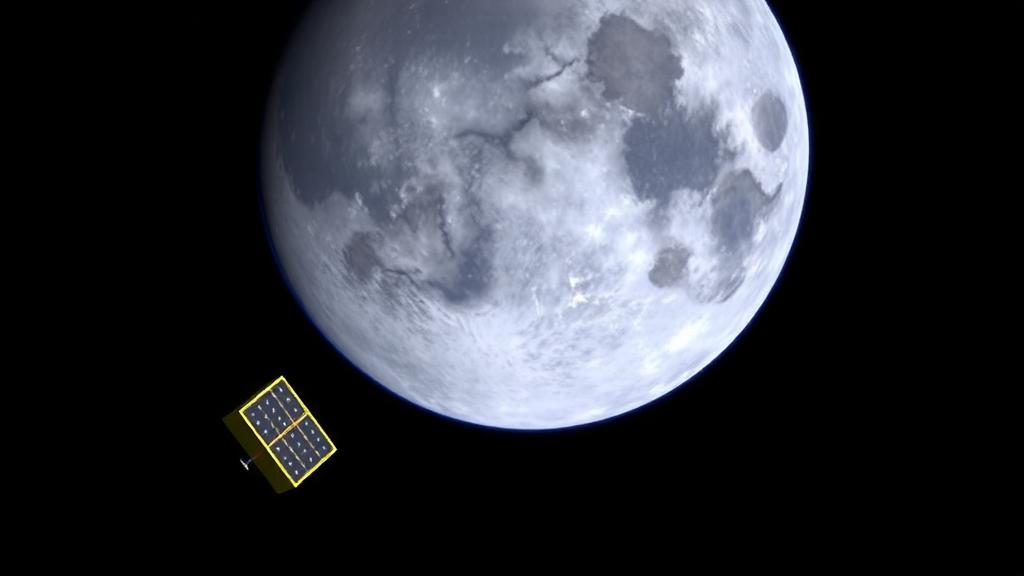
The study, published in Space: Science & Technology by researchers from Politecnico di Milano, examines whether LUMIO — the Lunar Meteoroid Impacts Observer, a 12U CubeSat developed within the European Space Agency — could be repurposed, or rather have its mission extended, to observe Apophis during and after the close encounter. LUMIO is planned for deployment into a quasi-halo orbit around the Earth-Moon L2 point, a gravitational balance region beyond the Moon where a spacecraft can maintain its position with modest station-keeping. Its primary science goal is to detect the brief flashes of light produced when meteoroids impact the lunar farside, a phenomenon invisible from Earth. Launch is expected in 2028, meaning that if the mission is still operating in April 2029, the spacecraft would be ideally positioned for an entirely different kind of target.
The geometry is strikingly favorable. Approximately 19 hours after skimming past Earth, Apophis will itself pass at close range to the Moon, and LUMIO, hovering near L2, will have a vantage point from which the receding asteroid remains visible long after it has slipped out of view for ground-based observatories. This matters because most of the massive observational campaign planned for the flyby — radar installations, optical telescopes, and a fleet of space missions — will be concentrated on or near Earth. As Apophis rapidly recedes, ground-based observers will face blind spots precisely during the hours and days when the asteroid’s post-encounter condition, altered by Earth’s tides, may be most revealing. A camera at L2 could help fill that gap.
But feasibility was far from obvious, and the Italian team framed their analysis around three critical questions. First, can LUMIO-Cam, an instrument designed to catch transient impact flashes rather than faint moving asteroids, actually detect Apophis as a sub-pixel target — a point of light occupying less than a single pixel on the detector? Second, can it resolve fluctuations in the asteroid’s light curve, the subtle brightening and dimming that reveals how the body is tumbling? Third, can it observe for long enough to capture complete spin-period information, which is essential for diagnosing how the flyby changes the asteroid’s rotation state? Answering these questions required a detailed radiometric model of the entire imaging chain, from sunlight striking the asteroid’s surface to electrons accumulating in the camera’s silicon.
The signal model built by the researchers accounts for three distinct illumination sources. The dominant one is direct sunlight reflected by Apophis toward the camera. The other two are more exotic: Earthshine, sunlight reflected off Earth and then bounced from the asteroid’s surface toward L2, and lunar albedo, light reflected from the Moon’s surface before striking Apophis and finding its way to the detector. On the noise side, the model incorporates a formidable list of contaminants: dark current generated thermally within the sensor, readout noise introduced when the charge is converted to a signal, photon shot noise inherent to the light itself, quantization noise from digitization, the cumulative glow of background stars, and stray light scattered within the optics. The team validated the model by comparing its calculations against synthetic images produced by a physically based rendering engine, confirming the accuracy of the predictions.
To translate signal and noise into practical observing plans, the researchers defined three evaluation windows with precise criteria. The detection window requires a signal-to-noise ratio of at least 10, the conventional threshold at which a source can be reliably distinguished from the background. The sensitivity window is more demanding: the difference in signal between the upper and lower size limits of the asteroid’s brightness variation must exceed the number of electrons corresponding to one gray level of the camera, ensuring that fluctuations in the light curve can actually be resolved rather than lost in digitization. The scientific window is defined as the intersection of the two — the period during which Apophis is both detectable and photometrically resolvable. It is this third window that determines whether real science can be done.
The quantitative results are encouraging. Under optimal camera settings of gain 1000 and an exposure time of 2 seconds, the detection window in the visible channel can last up to nearly 30 days before the flyby, and the near-infrared channel performs comparably, approaching 30 days as well. That duration far exceeds the time needed to observe a full rotation of Apophis, which the study places at approximately 30.56 hours before the encounter and roughly 21 hours after. In other words, LUMIO could accumulate many complete spin cycles of photometry in the weeks leading up to the flyby, building a robust baseline against which post-encounter changes could be measured.
Saturation — the risk that the asteroid’s signal overwhelms the detector’s full well capacity when Apophis is at its brightest — emerges as a manageable challenge. The sensitivity analysis shows that under high gain settings the camera would indeed saturate around the time of closest approach, but by appropriately selecting gain 1 with a 2-second exposure time, saturation can be avoided while preserving the ability to resolve light-curve fluctuations. The scientific window under optimal settings can reach several hundred hours before the flyby. Critically, the post-flyby outlook is also viable: after the encounter, the visible channel can still provide approximately 1.5 spin periods of usable observation, equivalent to about 31.5 hours of window, at gain 1000 and an exposure time of roughly 0.06 seconds. That post-encounter coverage is exactly what ground-based observers will struggle to obtain, and it is where evidence of tidally induced changes in spin state or surface material migration would be most valuable.
The study also points toward a hardware upgrade path. If LUMIO were to adopt a CMOS detector in place of its CCD, the resulting shorter exposure times and higher readout speeds could further enhance observational performance, easing the saturation constraints and improving the cadence of photometric measurements. While the current analysis is based on the camera as designed, the finding suggests that even modest detector improvements could expand the scientific return from a platform whose primary mission was never aimed at asteroids at all.
For the planetary defense community, the implications extend beyond a single asteroid. Apophis’s 2029 flyby offers a rare chance to study tidal interactions, spin-state variations, and surface material migration on a near-Earth body as it happens, and the study demonstrates that a small spacecraft in cislunar space can provide complementary observational data from a perspective no ground telescope can match. As space agencies finalize their observing strategies for April 2029, the Milan team’s work offers a concrete, quantitatively grounded case for keeping a meteor-watching CubeSat alive a few months longer — and for considering Earth-Moon L2 as a standing vantage point in the planetary defense toolkit.
Subject of Research: Feasibility of observing asteroid Apophis's 2029 Earth flyby with the LUMIO CubeSat from the Earth-Moon L2 point
Article Title: Observing Apophis's 2029 flyby from earth-moon L2 with LUMIO
Article References: Observing Apophis's 2029 flyby from earth-moon L2 with LUMIO. (n.d.). Original publication
Image Credits: AI Generated
DOI: Not provided
Keywords: Apophis, LUMIO, Earth-Moon L2, planetary defense, near-Earth asteroids, CubeSat, light curve, radiometric modeling, signal-to-noise ratio, ESA, Space Science and Technology, 2029 flyby
Cite Scienmag News
Grant Pearson. (October 5, 2026). ESA CubeSat at Earth-Moon L2 Could Watch Asteroid Apophis Sweep Past Earth in 2029. Scienmag. https://scienmag.com/esa-cubesat-at-earth-moon-l2-could-watch-asteroid-apophis-sweep-past-earth-in-2029/
Grant Pearson. "ESA CubeSat at Earth-Moon L2 Could Watch Asteroid Apophis Sweep Past Earth in 2029." Scienmag, 5 October 2026, https://scienmag.com/esa-cubesat-at-earth-moon-l2-could-watch-asteroid-apophis-sweep-past-earth-in-2029/. Accessed 5 October 2026.
Grant Pearson. "ESA CubeSat at Earth-Moon L2 Could Watch Asteroid Apophis Sweep Past Earth in 2029." Scienmag. October 5, 2026. https://scienmag.com/esa-cubesat-at-earth-moon-l2-could-watch-asteroid-apophis-sweep-past-earth-in-2029/


