


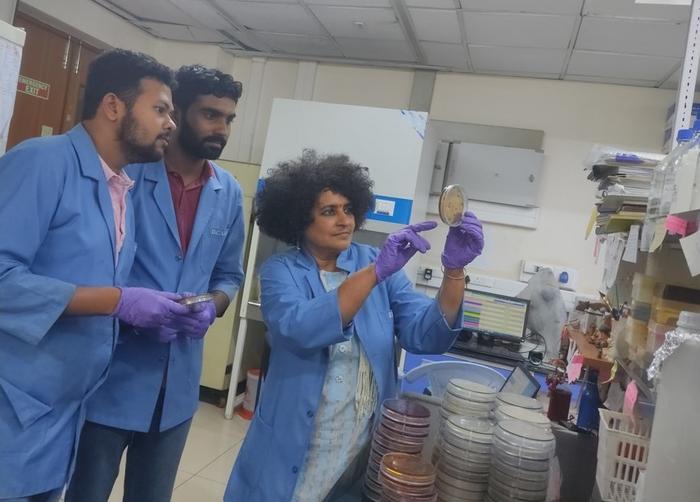
Food-borne diseases like typhoid, caused by Salmonella Typhimurium, are a severe threat to public health, especially in India. The indiscriminate use of antibiotics has allowed this bacterium to become resistant, posing a major hurdle in treating infections.

Credit: DC Lab/IISc
Food-borne diseases like typhoid, caused by Salmonella Typhimurium, are a severe threat to public health, especially in India. The indiscriminate use of antibiotics has allowed this bacterium to become resistant, posing a major hurdle in treating infections.
“Salmonella’s strategies to survive are par excellence. With an increase in antimicrobial resistance in Salmonella, it is just impossible to eradicate,” says Dipshikha Chakravortty, Professor in the Department of Microbiology and Cell Biology (MCB), Indian Institute of Science (IISc).
In a recent study published in Redox Biology, she and her team have pinpointed how the bacterium uses a key molecule called spermidine to shield itself from the onslaught of the host’s defence machinery. They also find that an existing FDA-approved drug can reduce spermidine production, weakening the bacterium’s ability to cause infection.
When Salmonella infects a host, it is engulfed by macrophages, cells that are part of the host’s immune system. After engulfment, macrophages start increasing the production of reactive oxygen species (ROS) and reactive nitrogen species (RNS) inside themselves. This creates a hostile environment for the bacteria to survive.
One of the key molecules that Salmonella seems to depend on is a polyamine called spermidine. Not only does the bacteria synthesise its own spermidine, but also hijacks the host machinery to produce more of the molecule.
In the current study, the researchers found that spermidine is crucial for Salmonella to protect itself from oxidative stress inside the macrophages. Spermidine specifically regulates the expression of an enzyme called GspSA, which causes spermidine to bind strongly to a protein called Glutathionyl (GSH). This conjugate forms chemical bonds with various bacterial proteins, strengthening and shielding them during oxidative stress. Mice infected with mutant Salmonella lacking the ability to import and produce spermidine showed higher survival rates compared to the ones infected with normal Salmonella.
“Spermidine from both bacteria and the host acts like a robust weapon for Salmonella to safeguard against reactive oxygen species,” explains Chakravortty.
With this revelation, the team began looking for drugs that could deplete spermidine levels in the host.
The team focused on D, L-alpha-difluoromethylornithine (DFMO), an FDA-approved drug used widely for treating human African trypanosomiasis. They found that DFMO irreversibly blocks ornithine decarboxylase, an enzyme involved in a key step of the spermidine biosynthesis pathway in the host, reducing its levels and making the bacteria more vulnerable. Mice which were administered the drug showed better survival rates.
“Since we are targeting the host machinery, and not targeting the bacteria, it will not evolve genetically,” explains Abhilash Vijay Nair, a former PhD student at MCB and the first author of the paper.
DFMO also acts on another enzyme called arginase, which is responsible for ensuring that an amino acid called arginine is available for spermidine synthesis. When arginase is blocked, less spermidine is synthesised, again making the bacteria more susceptible to oxidative stress. DFMO is, therefore, a promising candidate for treating salmonellosis, the researchers say. In future studies, they seek to pinpoint other players that might be involved in controlling spermidine synthesis.
Journal
Redox Biology
Article Title
Salmonella Typhimurium employs spermidine to exert protection against ROS-mediated cytotoxicity and rewires host polyamine metabolism to ameliorate its survival in macrophages
Article Publication Date
3-Apr-2024
Cite Scienmag News
Kristina Jarvis. (May 8, 2024). Targeting spermidine production to combat emerging drug resistance in Salmonella. Scienmag. https://scienmag.com/targeting-spermidine-production-to-combat-emerging-drug-resistance-in-salmonella/
Kristina Jarvis. "Targeting spermidine production to combat emerging drug resistance in Salmonella." Scienmag, 8 May 2024, https://scienmag.com/targeting-spermidine-production-to-combat-emerging-drug-resistance-in-salmonella/. Accessed 3 September 2026.
Kristina Jarvis. "Targeting spermidine production to combat emerging drug resistance in Salmonella." Scienmag. May 8, 2024. https://scienmag.com/targeting-spermidine-production-to-combat-emerging-drug-resistance-in-salmonella/

