


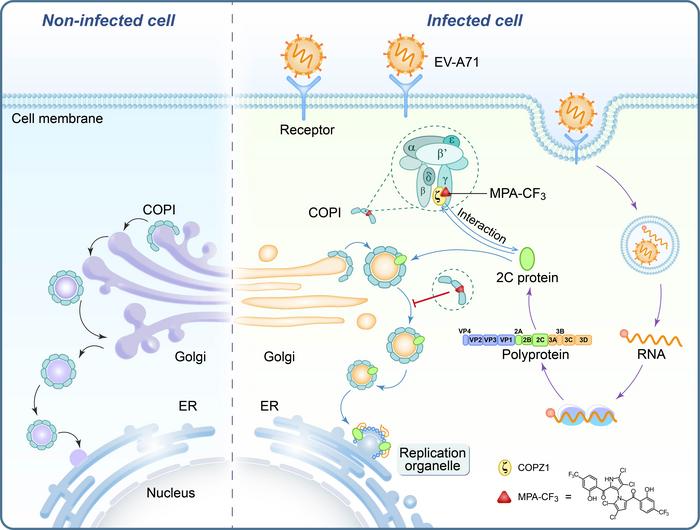
This study is spearheaded by researcher Wu Zhong (National Engineering Research Center for the Emergence Drugs, Beijing Institute of Pharmacology and Toxicology, Beijing) and Prof. Yong Qin (West China School of Pharmacy, Sichuan University). In a recent effort to identify the anti-EV-A71 target of a marine natural product marinopyrrole A derivative (MPA-CF3), they employed a quantitative chemoproteomic approach and identified the specific target of MPA-CF3 as host factor COPZ1. “This marks the inaugural instance of us uncovering a small-molecule ligand with antiviral activity of COPZ1, despite COPZ1 serving multiple physiological roles,” researcher Zhong says.

Credit: Researcher Wu Zhong, Prof. Yong Qin
This study is spearheaded by researcher Wu Zhong (National Engineering Research Center for the Emergence Drugs, Beijing Institute of Pharmacology and Toxicology, Beijing) and Prof. Yong Qin (West China School of Pharmacy, Sichuan University). In a recent effort to identify the anti-EV-A71 target of a marine natural product marinopyrrole A derivative (MPA-CF3), they employed a quantitative chemoproteomic approach and identified the specific target of MPA-CF3 as host factor COPZ1. “This marks the inaugural instance of us uncovering a small-molecule ligand with antiviral activity of COPZ1, despite COPZ1 serving multiple physiological roles,” researcher Zhong says.
They determined the binding affinity between MPA-CF3 and COPZ1 by surface plasmon resonance analysis, which revealed a strong interaction between the two partners. Through a range of phenotypic validation analysis, researchers demonstrated that COPZ1 knockdown by siRNA in human rhabdomyosarcoma (RD) cells resulted in a significant reduction in EV-A71 replication, as well as the expression of viral capsid protein VP1, confirming the target engagement of COPZ1 for EV-A71 replication.
The study showed that MPA-CF3 inhibits EV-A71 replication in a concentration-dependent manner and is eight-fold more potent than adenosine analogue NITD008. “Given the structurally significant disparity between MPA-CF3 and NITD008, MPA-CF3 may possess a unique antiviral mechanism of action,” says researcher Zhong.
To unravel the mechanism of action (MOA) of MPA-CF3 against EV-A71, Zhong’s team conducted protein thermal shift assay to determine the effect of MPA-CF3 on the stability of COPZ1. “MPA-CF3 destabilizes COPZ1 upon binding,and the subsequent disruption of the interaction of COPZ1 with EV-A71 2C protein, as confirmed by co-immunoprecipitation analysis, could signify its primary antiviral MOA,” explained first author Dr.Li.
The elucidation of the novel MOA regarding MPA-CF3 against EV-A71 will propel the advancement of host-targeting antivirals and provide an opportunity for effective combination therapies with other direct-acting antivirals for EV-A71 cure.
The financial support of this study were from the National Key Research and Development Project (No. 2021YFC2300704, China). Xiaoyong Li and Jin Zhang are co-first authors, West China School of Pharmacy, Sichuan University. College of Chemistry and Molecular Engineering, Peking University, respectively.
See the article:
Chemoproteomics enables identification of coatomer subunit zeta-1 targeted by a small molecule for enterovirus A71 inhibition
Journal
MedComm
DOI
Method of Research
Experimental study
Subject of Research
Cells
Article Title
Chemoproteomics enables identification of coatomer subunit zeta-1 targeted by a small molecule for enterovirus A71 inhibition
Article Publication Date
5-Jun-2024
COI Statement
The authors declare that they have no conflict of interest.
Cite Scienmag News
Violet Maxwell. (June 26, 2024). Targeting human coatomer subunit zeta-1 by a marine natural product derivative represents a new therapeutic strategy to inhibit enterovirus A71 replication. Scienmag. https://scienmag.com/targeting-human-coatomer-subunit-zeta-1-by-a-marine-natural-product-derivative-represents-a-new-therapeutic-strategy-to-inhibit-enterovirus-a71-replication/
Violet Maxwell. "Targeting human coatomer subunit zeta-1 by a marine natural product derivative represents a new therapeutic strategy to inhibit enterovirus A71 replication." Scienmag, 26 June 2024, https://scienmag.com/targeting-human-coatomer-subunit-zeta-1-by-a-marine-natural-product-derivative-represents-a-new-therapeutic-strategy-to-inhibit-enterovirus-a71-replication/. Accessed 5 September 2026.
Violet Maxwell. "Targeting human coatomer subunit zeta-1 by a marine natural product derivative represents a new therapeutic strategy to inhibit enterovirus A71 replication." Scienmag. June 26, 2024. https://scienmag.com/targeting-human-coatomer-subunit-zeta-1-by-a-marine-natural-product-derivative-represents-a-new-therapeutic-strategy-to-inhibit-enterovirus-a71-replication/

