


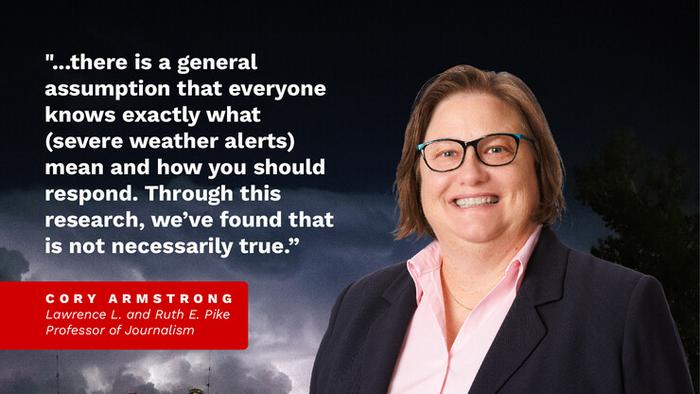
Research by Nebraska’s Cory Armstrong is defining the effectiveness of the alerts, warnings and advisories that swirl around extreme weather events.

Credit: University Communication and Marketing/University of Nebraska-Lincoln
Research by Nebraska’s Cory Armstrong is defining the effectiveness of the alerts, warnings and advisories that swirl around extreme weather events.
A professor of journalism in the University of Nebraska–Lincoln’s College of Journalism and Mass Communications, Armstrong began studying alerts related to hurricanes and how Gulf Coast residents respond to them in 2016. The work has expanded to include thunderstorms, tornadoes, floods and drought.
“As a professional communicator, I am fascinated by how individuals receive and respond to various messaging,” Armstrong said. “It is especially interesting with severe weather alerts, because there is a general assumption that everyone knows exactly what they mean and how you should respond.
“Through this research, we’ve found that is not necessarily true.”
In her most recent study, Armstrong found that roughly 50% of those surveyed in the mid-south (portions of Tennessee, Missouri, Arkansas and Mississippi) could not accurately define a tornado warning. Conducted with support from the National Weather Service in Memphis, Tennessee, the study showed that just 11% could properly identify the warning as a tornado being sighted or indicated on weather radar — while 35% successfully responded with one of those two standards.
“We’ve found that many respondents misidentify a warning as a watch, which means conditions are favorable for a tornado,” Armstrong said. “The findings indicate that, to reduce overall risk to the public, emergency personnel and disaster communication need to improve their overall messaging.”
Geography and past experiences with severe weather also impacted respondents’ preparation for tornado threats. Survey results suggest that individuals who live in rural areas and those who have been through a tornado were more likely to prep when forecasts call for severe weather. The study also looked at how much warning an individual wants before a tornado strikes.
“Those who have past experiences with tornados reported that they needed fewer than 15 minutes to prepare when a warning was issued, but those without that experience wanted more lead time to prepare,” Armstrong said. “It indicates that those who have been in a tornado warning know how to prepare and have a plan to take shelter. Those who have not, as is often the case, are less prepared.”
Armstrong said the tornado alert study, published online May 9 in the Journal of Extreme Events, reinforces the need for individuals and families to make general preparation plans for severe weather events. It was supported by a $15,000 grant from University Corporation for Atmospheric Research.
Now, Armstrong is moving forward with a study of drought alert responses in the Federal Emergency Management Agency’s Region 7 (which includes Nebraska, Iowa, Kansas and Missouri). The work is supported through a $15,000 grant from the University of Nebraska Medical Center’s College of Public Health, with whom she is partnering for the project.
“It is going to be an interesting study, because drought is a different animal than other severe weather impacts,” Armstrong said. “We have started an initial analysis, but I am very excited about its prospects and the chance to help weather professionals develop more effective messaging for the public.”
Journal
Journal of Extreme Events
Method of Research
Survey
Subject of Research
People
Article Title
Are You Watching or Warning? the Role of Comprehension, Warning Lead Time and Prior Experience on Individual Preparation of Tornadic Events
COI Statement
None stated
Cite Scienmag News
Russell Cooper. (May 9, 2024). Take cover! Survey shows tornado warnings widely misunderstood. Scienmag. https://scienmag.com/take-cover-survey-shows-tornado-warnings-widely-misunderstood/
Russell Cooper. "Take cover! Survey shows tornado warnings widely misunderstood." Scienmag, 9 May 2024, https://scienmag.com/take-cover-survey-shows-tornado-warnings-widely-misunderstood/. Accessed 3 September 2026.
Russell Cooper. "Take cover! Survey shows tornado warnings widely misunderstood." Scienmag. May 9, 2024. https://scienmag.com/take-cover-survey-shows-tornado-warnings-widely-misunderstood/

