


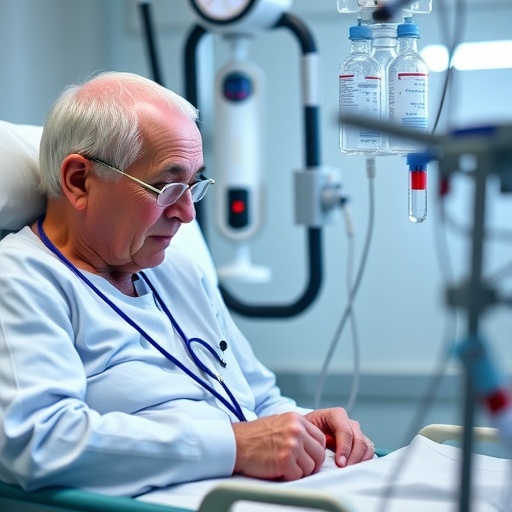
In a groundbreaking study that shines a critical light on the delicate balance of renal function and patient survival in the oldest demographics, researchers Klopp, de Rosa, Schmidt, and colleagues have unveiled revealing insights on how admission creatinine levels predict outcomes in very elderly critically ill patients. Published in BMC Geriatrics, this retrospective cohort study delves into the intricate biochemical and physiological interplay that dictates survival chances and recovery trajectories among a patient group often overlooked in critical care prognostication models.
Creatinine, a metabolic byproduct of muscle catabolism, serves as a sensitive biomarker reflecting kidney function. While this marker is a staple in clinical settings for assessing renal health, its prognostic power among the very elderly—patients aged 80 years and above—has remained ambiguous until now. The study begins by establishing the demographic context: an aging global population and an increasing incidence of critical illness in elderly cohorts necessitate refined tools to predict patient outcomes more accurately. The very elderly present unique challenges—frail physiology, complex comorbidities, and altered drug metabolism—that complicate traditional outcome prediction schemas.
This research capitalizes on data retrospectively gathered from intensive care units, exploring admission creatinine levels measured at the critical juncture when patients entered the ICU. The investigators hypothesized that admission creatinine could serve as a pivotal indicator not only of pre-existing renal impairment but also of the severity of the acute illness, thus influencing mortality risk. The data cohort comprised hundreds of very elderly patients, representing a broad spectrum of critical illnesses, from septic shock to acute respiratory distress syndrome (ARDS), providing critical depth and robustness to the analysis.
Methodologically, the team applied rigorous statistical models, including multivariate regression adjustments, to parse out the independent effect of admission creatinine on patient outcomes. Crucially, they controlled for confounding variables such as age, sex, underlying comorbidities, and severity scores like APACHE II and SOFA. This approach allowed for the isolation of admission creatinine as a predictor independent of other well-known mortality determinants. The results were striking: higher initial creatinine levels correlated strongly with increased mortality risk and prolonged ICU stays.
From a mechanistic perspective, the elevated creatinine observed upon admission reflects acute kidney injury (AKI) or chronic kidney disease (CKD) exacerbations, conditions notoriously associated with poor outcomes. Critically ill elderly patients often face multifactorial insults—hemodynamic instability, nephrotoxic medications, and systemic inflammation—that compromise renal perfusion and function. The study underscores that renal dysfunction in this context is not merely a symptom but a driving force in escalating morbidity and mortality, possibly by aggravating systemic metabolic disturbances and organ cross-talk dysfunction.
In addition to mortality predictions, the investigation explored secondary outcomes including the length of ICU stay, the necessity for renal replacement therapies, and post-discharge functional status. The findings suggest that elevated admission creatinine portends not only higher in-hospital mortality but also greater dependence on dialysis and poorer functional recovery, highlighting the cascading effects of early renal impairment on the clinical course of elderly patients. These insights beckon a re-evaluation of protocols for renal monitoring and early intervention in geriatric critical care.
One of the most compelling aspects of the study is its call to integrate creatinine measurement more strategically into clinical decision algorithms. The authors advocate for its inclusion in comprehensive geriatric risk assessment tools, emphasizing how early identification of elevated creatinine could prompt intensified monitoring, timely nephroprotective strategies, and personalized therapeutic adjustments. Such proactive measures could mitigate downstream complications, potentially improving survival and quality of life for this vulnerable population.
The work further contextualizes creatinine’s prognostic utility alongside emerging biomarkers and novel technologies. Although blood urea nitrogen (BUN), cystatin C, and novel urinary markers have shown promise, creatinine remains the most accessible and familiar parameter globally. This study revitalizes creatinine’s importance by demonstrating its predictive validity in a demographic often excluded from large-scale clinical trials and underscores how its simplicity belies its profound clinical significance.
Moreover, the research touches on the physiological nuances of creatinine metabolism in the elderly. Age-related muscle mass reduction—sarcopenia—can mask true renal impairment by lowering baseline creatinine production. Hence, interpreting creatinine in the very elderly demands a sophisticated understanding of these dynamics. The findings prompt clinicians to contextualize creatinine values carefully, perhaps complementing them with glomerular filtration rate (GFR) estimations and clinical judgement to optimize outcome predictions.
Ethically, the study raises important questions about care rationing and resource allocation in ICUs faced with burgeoning elderly populations. Understanding which patients are more likely to benefit from intensive interventions aids physicians and families in making informed decisions that respect patient autonomy while balancing medical feasibility. As such, creatinine-based models could become invaluable tools in the shared decision-making process, improving transparency and congruence between clinical intent and patient values.
This retrospective analysis also paves the way for prospective trials aimed at testing targeted renal-protective interventions triggered by admission creatinine thresholds. Identifying patients at high risk opens avenues for employing pharmacological agents, modifying fluid management approaches, or adjusting medication regimens that may attenuate renal injury progression. Furthermore, it advocates for the development of care bundles specifically tailored to the renal vulnerabilities of the very elderly.
Additionally, the team notes the potential for artificial intelligence and machine learning to harness creatinine alongside other clinical parameters, refining predictive models with unprecedented accuracy. Such integrations could automate early warnings and trigger protocolized responses, freeing clinicians to focus on nuanced care delivery. The study’s data offers a valuable foundation for building these advanced decision support systems, crucial in high-pressure ICU environments.
Altogether, Klopp and colleagues’ study represents a substantial advancement in geriatric critical care medicine. By shining a spotlight on admission creatinine as a potent, actionable indicator of outcome in very elderly ICU patients, the research bridges a crucial knowledge gap. It equips clinicians with an evidence-based tool to enhance prognostication, personalize treatments, and ultimately improve survival and quality of life in a demographic whose healthcare needs are rapidly expanding with the aging global population.
Looking forward, this work advocates the prioritization of renal function monitoring in geriatric critical protocols and invites further exploration of integrated biomarker panels. As clinical science advances, blending traditional measures like creatinine with cutting-edge diagnostics promises to revolutionize care paradigms, ensuring that the very elderly receive care that is as precise as it is compassionate. The implications resound far beyond nephrology and geriatrics, speaking to the broader imperative of tailored, data-driven medicine in an era defined by demographic transformation.
This investigation thus not only advances scientific knowledge but also ignites a vital conversation within the medical community about optimizing care for one of medicine’s most complex populations. The challenge ahead lies in translating these insights into routine practice and policy, where they can tangibly impact lives. With this study as a foundation, a future of more informed, sensitive, and effective geriatric critical care is unequivocally attainable.
Cite Scienmag News
Beatrice Stafford. (June 14, 2026). Admission Creatinine Predicts Outcomes in Elderly ICU. Scienmag. https://scienmag.com/admission-creatinine-predicts-outcomes-in-elderly-icu/
Beatrice Stafford. "Admission Creatinine Predicts Outcomes in Elderly ICU." Scienmag, 14 June 2026, https://scienmag.com/admission-creatinine-predicts-outcomes-in-elderly-icu/. Accessed 4 September 2026.
Beatrice Stafford. "Admission Creatinine Predicts Outcomes in Elderly ICU." Scienmag. June 14, 2026. https://scienmag.com/admission-creatinine-predicts-outcomes-in-elderly-icu/


