


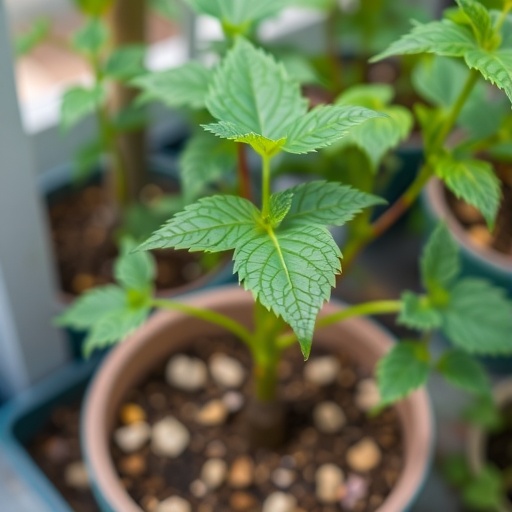
In a significant leap forward for agricultural technology, researchers have unveiled a groundbreaking deep learning framework designed to enhance the efficacy of plant disease detection. This innovative study, spearheaded by a team of scientists including Rahaman, Paul, and Chowdhury, harnesses the power of the state-of-the-art MobileNetV3Large architecture, pushing the boundaries of machine learning applications in agriculture. The implications of this research are vast, as it stands to revolutionize how farmers and scientists approach plant health management on a global scale.
MobileNetV3Large is a versatile and efficient neural network tailored for mobile and edge applications. The choice of this architecture stems from its remarkable ability to achieve high accuracy while maintaining a lightweight model that is crucial for deployment on resource-constrained devices. The researchers meticulously customized the MobileNetV3Large model for their specific requirements, prioritizing both precision and efficiency in detecting a wide array of plant diseases. This level of optimization is critical, particularly in scenarios where timely interventions can save crops and secure farmers’ livelihoods.
The significance of plant disease detection cannot be overstated. It affects food security, farmer income, and the overall health of ecosystems. Traditional methods of disease identification often rely on human expertise, which can be time-consuming and prone to error. By incorporating deep learning techniques, the research aims to automate and enhance the detection process, ensuring that diseases can be identified rapidly and accurately, thus enabling prompt intervention measures that can mitigate crop losses significantly.
The researchers implemented a comprehensive dataset that encompassed images of various plants suffering from multiple diseases. This rich repository of images served as the backbone for training the deep learning model. The approach emphasizes diversity in the data, ensuring that the model learns to generalize effectively across different species and disease types. Having well-labeled datasets is fundamental in machine learning, and this research exemplifies a meticulously curated approach that enhances model performance.
As the study progresses, the researchers have conducted extensive experiments to fine-tune the MobileNetV3Large model. Various optimization techniques were employed, including hyperparameter tuning, data augmentation, and transfer learning. Each of these strategies contributes to improving the model’s accuracy and robustness, proving essential for real-world applications where variability in the data is the norm. The experimental phase is crucial, as it helps to understand which configurations yield the best results in terms of disease identification speed and accuracy.
The researchers also addressed the challenges associated with deploying deep learning models in real-world agricultural settings. Technical limitations such as hardware compatibility, environmental factors, and the need for real-time processing were taken into account. By ensuring that the model can function effectively on mobile devices, the team has opened up possibilities for farmers to utilize this technology in the field without needing robust infrastructures. This aspect is vital for improving accessibility and usability across different geographical regions, especially in areas with limited resources.
A significant highlight of this research is the potential for early detection of plant diseases. Early intervention has transformative effects on managing crop health and minimizing losses. By enabling farmers to detect diseases at their nascent stages, the framework not only helps safeguard the crops but also reduces the reliance on chemical treatments, promoting sustainable agricultural practices. The benefits extend beyond individual farms, potentially impacting supply chains and market stability by ensuring healthier crops reach consumers.
Furthermore, the findings of this research align with the ongoing global discussions about food security and sustainability. As the world grapples with the challenges posed by climate change and population growth, innovative solutions like this deep learning framework for plant disease detection become increasingly relevant. The technology promises to bridge the gap between traditional agricultural practices and modern technological advancements, fostering resilience in food systems worldwide.
Additionally, the research team considers partnerships with stakeholders in the agricultural sector, including local governments, NGOs, and farming cooperatives. Collaboration is paramount for implementing this technology effectively and ensuring it meets the needs of those it aims to assist. By working directly with the farming community, they aim to refine the application further, gathering feedback that can inform future iterations of the model and enhance its practical utility.
In conclusion, the advent of a MobileNetV3Large-based deep learning framework for detecting plant diseases marks a pivotal moment in agricultural technology. With the promise of efficiency and accuracy, the work of Rahaman, Paul, and Chowdhury not only represents a scientific achievement but also reflects a commitment to advancing sustainable agricultural practices. The potential impact on food security and crop health management is profound, and as this research progresses, it could very well set a new standard for innovations within the agricultural domain. The future looks bright for farmers and researchers embracing these technological advancements, paving the way for improved agricultural outcomes globally.
This study will appear in the upcoming issue of the journal “Discov Artif Intell” in 2026, amid a growing interest in applying machine learning to practical challenges in various fields. With continuous advancements in technology, further developments in deep learning applications are anticipated, promising a future where agriculture and technology harmoniously coexist to address some of the most pressing challenges faced by the industry.
Rahaman, J., Paul, P., Chowdhury, A. et al. A customized MobileNetV3Large-based deep learning framework for plant disease detection.
Discov Artif Intell (2026). https://doi.org/10.1007/s44163-025-00733-8
Cite Scienmag News
Blake Davidson. (January 11, 2026). Tailored MobileNetV3Large Framework for Detecting Plant Diseases. Scienmag. https://scienmag.com/tailored-mobilenetv3large-framework-for-detecting-plant-diseases/
Blake Davidson. "Tailored MobileNetV3Large Framework for Detecting Plant Diseases." Scienmag, 11 January 2026, https://scienmag.com/tailored-mobilenetv3large-framework-for-detecting-plant-diseases/. Accessed 4 September 2026.
Blake Davidson. "Tailored MobileNetV3Large Framework for Detecting Plant Diseases." Scienmag. January 11, 2026. https://scienmag.com/tailored-mobilenetv3large-framework-for-detecting-plant-diseases/


